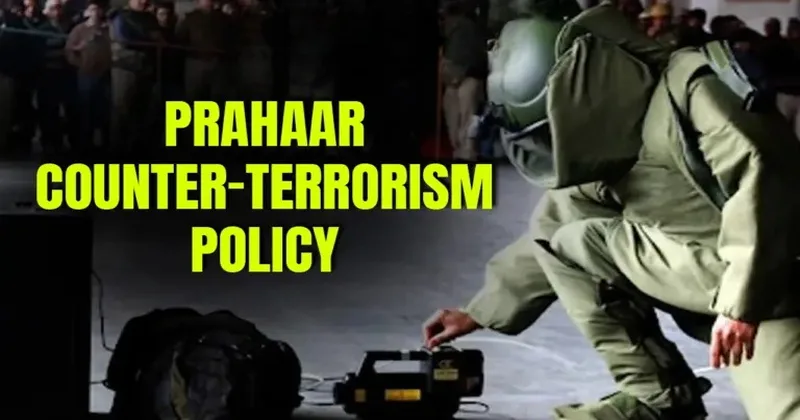
India has heralded a new chapter in its relentless fight against terrorism. In a major and overarching strategic push to fortify national security against “sponsored terrorism”, organised crimes, ideological indoctrination and other forms of emerging threats, the Ministry of Home Affairs has unveiled a comprehensive counter-terrorism policy. The policy titled as “PRAHAAR”, is the country’s maiden comprehensive counter-terrorism doctrine which is aimed at not just dismantling cross-border terrorism but also other forms of threats that are embedded with modern technological tools such as cyber crimes, malware attack, online phishing etc. The doctrine is a mutli-layered strategic structure to defend national security and global peace.
PRAHAAR: A policy to sack the atrocities of “sponsored terrorism” & Jihadi terrorists
The PRAHAAR counter-terrorism policy released by the Ministry of Home Affairs asserts that India does not link terrorism to any specific religion, ethnicity, nationality or civilisation. However, India has been a victim of cross-border and sponsored terrorism for a long time. “Jihadi terror outfits as well as their frontal organisations” continue to plan, coordinate, facilitate and execute terror atrocities in India to fulfill their illicit goals, the PRAHAAR document reiterates.
Thus, India continues to fight against this Jiahdi terror outfits channelized from the other side of the border. In this direction, India aims to consolidate national security and ensure regional or global peace. The strategic doctrine of PRAHAAR indeed renders new and reinvigorated direction and push for India in its resolve to uproot terrorism.
PRAHAAR mentions the horrors of Al Qaeda, ISIS
The PRAHAAR document further explains how India is a victim of terrorism under the illicit hands of globally infamous terror organisations such as ISIS, Al Qaeda etc. who are the kingpin for the destruction of global peace, harmony and stability. “India has been the target of global terrorist groups such as Al-Qaeda, and the Islamic State of Iraq and Syria(ISIS) which have been trying to incite violence in the country through sleeper cells”, reads the PRAHAAR document.
The counter-terrorism policy further adds that certain violent extremist wings operating from the foreign countries have unleashed conspiracies with their illicit agenda against India to disturb the socio-political fabric of the country. By espousing terrorism and other forms of organised crimes such as cyber threats, the terror outfits aim to harm the developmental prospects of India.
Techno-terrorism: A new weapon for terror outfits
Apart from channelizing cross border terrorism, through infiltration and other traditional means, the terrorists are embarking on other novel means, which are posing greater security challenges to India. In this direction, the PRAHAAR policy also addresses the means to thwart these emerging challenges which can be popularly called a “techno-terrorism”, i.e. use of emerging technological tools to espouse terror activities. “Their handlers from across the border frequently use the latest technologies, including the use of drones, for facilitating terror-related activities and attacks in Punjab and Jammu and Kashmir. Increasingly, terrorist groups are engaging organised criminal networks for logistics and recruitment to execute and facilitate terror strikes in India”, says the PRAHAAR policy.
The counter-terrorism policy also explained how the terror organisation utilizes social media and other novel platforms to communicate, spread propaganda and indoctrinate the innocent minds to fulfill terror motives. Social media and other instant messaging applications are widely used by the terror outfits for recruitment, to channelize terror thoughts and ideologies and also for funding, guiding and coordinating the terror attacks. Other technological advancements such as encrypted form of messaging, dark webs, crypto wallets are used by the terrorists to raise funds, operate unanimously and escape the security radar. Thus the PRAHAAR document mentions how technological innovations are misused by the terror organisations to insulate from the security scanner and inflict threat.
Critical weapons should be out of reach of the terrorists
The PRAHAAR document also enlists the strategies and solutions to counter terrorism in all its forms and manifestations. The document states that all forms of weapons i.e. CBRNED(Chemical, Biological, Radiological, Nuclear, Explosive and Digital) has to be kept out of the reach of the terrorists. It is the duty and responsibility of the international community to safeguard these weapons so that they are not used for illicit motives by the notorious terror groups, to destroy national security apparatus.
“The threat of state and non-state actors misusing drones and robotics for lethal purposes remains another area of concern”, the PRAHAAR policy thus raises concerns about the misuse of strategic weapons and other technological advancements by the terror outfits. World governments and other organisations should be committed and be vigilant to thwart such abuse that ultimately harms global peace and security.
Role of legal experts in countering terrorism
The PRAHAAR document further reiterates the role of legal experts in countering terror threats. To keep the perpetrators of terrorism accountable, legal experts at every level of the society have to play an active role. From local police stations to national level and at the international level, legal experts have to guide in terms of filing FIR, protecting the weapons away from the terror reach and ultimately locking the terrorists by producing them before courts or judicial authorities for investigation and prosecution.
Grassroots to global: Effort at every level of hierarchy to counter terrorism
The PRAHAAR counter-terrorism policy also highlights how coordination and effort at every level is critical to eradicate terrorism in all its forms and manifestations. The policy is thus a holistic and multi-layered approach to counter terrorism, where every stakeholder in the society is critical to dismantle the threat. Terrorist groups in recent days are well aware of the local culture, terrain and build a rapport with the local population, which helps them to easily escalate terror activities. On the other hand, terrorism has transcended national boundaries and is an imminent transnational threat.
Terror outfits receive funding from foreign organisations and launch attacks with the aid of local populace. Thus, effort and coordination at every level is equally important to counter terrorism. From the grassroots communities’ support to coordination at the regional and international level, every stakeholder is critical to uproot terrorism and other organised crimes, which are indeed emerging in new forms and frontiers.
“National actions, coupled with international and regional cooperation, are key elements in addressing the transnational terrorism challenge”, PRAHAAR document adds. The strategic doctrine further highlights the role of NGOs, civil society and community and religious leaders in spreading awareness among the local population about the adverse impact of radicalisation, extremist violence etc. so that the people are insulated from terror atrocities.
PRAHAAR: The policy underscores India’s readiness to counter terror threats
The PRAHAAR policy, as India’s maiden comprehensive strategic doctrine to counter terrorism in all its forms and manifestations spotlights the multi-facet preparedness of India. The document says, India faces terror threats from all fronts, i.e., water, land and air. Thus critical capabilities are rigorously being developed at the infrastructure level to protect the strategic landscapes of India and bolster the comprehensive national security apparatus.
Efforts are underway to defend the critical sectors of the economy from terror atrocities. This includes, power sector, railways, defence establishments and infrastructure, atomic energy centres, airports, ports, space sector and other critical zones belonging to both state and non-state actors. Multi-facet protection has to be ascertained so that sheild is rendered against conventional threats and other emerging threats such as cyber crime, malware attack etc.
Apart from building infrastructure capabilities, the populace of the country, especially the youth who are considered as most vulnerable to radicalisation and other extremist motives, should be continuously monitored and constructively engaged to raise awareness and shield them from radicalisation. Even the prison staff are cautioned from time to time to ensure that prison inmates are not vulnerable to any radical or anti-national motives. De-radicalisation programmes are also initiated for the imprisoned people, PRAHAAR policy states.
In the long run, the PRAHAAR policy aims to nourish a uniform, systematic and standardised anti-terror ecosystem across the country. A similar set of rules and procedures must be implemented in every state of India so that a coordinated, synchronised fight against terror attacks is possible, with state police and central security agencies not operating in silos. India criminalises all terrorist acts and denies access to terrorists, their financiers, supporters who provide funds, weapons and safe havens to terrorists. With the PRAHAAR policy, India thus scripts a new and reinvigorated chapter to fulfil the goal of zero-tolerance to terrorism and marches in the path with greater vigour, resolve and determination to defend national security and uplift regional & global peace.