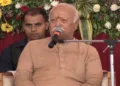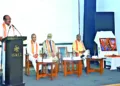
The world now expects Bharat to assume a leadership role once again, said RSS Sarsanghchalak Dr Mohan Bhagwat while addressing a gathering and multi-sector dialogue on the theme “100 Years of Sangh Journey – New Horizons, New Dimensions” organised at the auditorium of the Himalayan Cultural Centre.
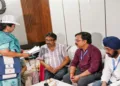
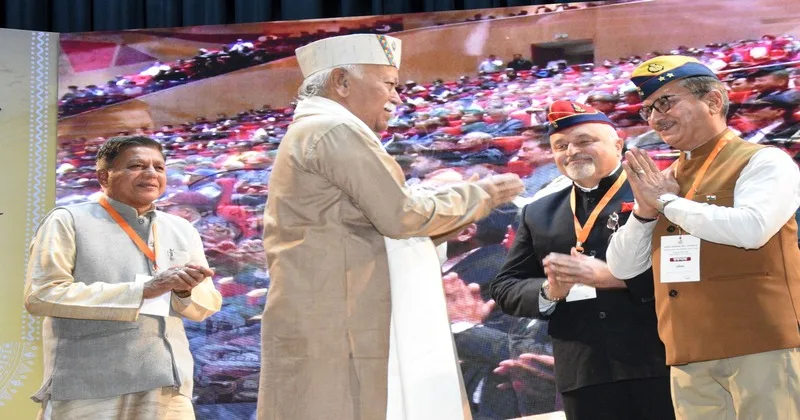
On the second day of his Uttarakhand visit, RSS Sarsanghchalak Dr Mohan Bhagwat had an interaction with former servicemen and retired defence officers at the Himalayan Cultural Centre in Nimbuwala, Garhi Cantt. Veterans from the Army, Navy, ITBP, Coast Guard and other defence services participated in the inspiring programme.
The event began with a ceremonial welcome in which General Gulab Singh Rawat, Colonel Ajay Kothiyal and Colonel Mayank honoured Dr Mohan Bhagwat with a traditional shawl and cap. The session was conducted by Rajesh Sethi. Retired officers ranging from General, Vice Admiral, Brigadier and Colonel ranks, along with numerous veterans, participated enthusiastically.
Role of Society in Nation-Building
In his address, Dr Bhagwat stated that society plays the foremost role in shaping the destiny of the nation. He asserted, “If society is strong, national defence will also be strong.” The organised strength of society empowers every citizen, making it essential for leadership to be disciplined and rooted in character.
Recalling the legacy of Bharat’s freedom struggle, he referred to the First War of Independence in 1857, noting that although immediate success was not achieved, the flame of freedom never faded. He also cited historical lessons from global events, including the Second World War, emphasising the importance of learning from history. Revolutionary movements sustained the struggle, ultimately leading to independence. He underlined that the success of the freedom movement was rooted in social reform and unity beyond caste divisions.
Remembering Keshav Baliram Hedgewar
Remembering RSS founder Keshav Baliram Hedgewar, Dr Bhagwat described him as a born patriot who actively participated in the freedom movement. He observed that while Bharat’s valour was globally recognised, internal divisions and social weaknesses were repeatedly exploited by adversaries, offering an important historical lesson.
Cultural Diversity of Bharat
Highlighting Bharat’s cultural diversity as a unique strength, he said that despite differences in language, faith traditions and customs, an underlying unity binds the nation, and strengthening that bond remains the core mission of the RSS. He clarified that the RSS is not a political organisation and does not engage in electoral politics; its primary objective is character-building, which, in turn, strengthens society and the nation.
Dr Bhagwat remarked that while Bharat is independent, safeguarding its freedom requires a vigilant defence system. Protection against both external threats and internal challenges necessitates preparedness. He noted that the RSS has grown solely through societal strength despite past bans.
Inviting veterans to engage with RSS activities, he mentioned that over 1,30,000 service projects are currently active across the country, with expanded outreach during the centenary year.
Dr Bhagwat summarised his message, stating that history should record that the nation grew due to the strength of society. The RSS, he said, has never sought publicity but remains committed to organising society and uplifting the nation. The programme concluded with the rendition of the National Song.
Question/ Answers Session
Responding to a question regarding ideological outlook, religion and Hindu identity, Dr Mohan Bhagwat stated that the Bharatiya worldview considers both animate and inanimate existence as its own and functions with the spirit of “Vasudhaiva Kutumbakam.” He explained that Dharma is the element that sustains humanity and society, and abandoning it would weaken the social foundation. He further noted that Hindu thought is inherently liberal and a person can become part of Hindu society without any formal conversion.
National Security, Agniveer Scheme and Regional Challenges
On national security, the Agniveer scheme and regional strategic concerns, Dr Bhagwat emphasised the need for capable leadership for national defence. He stated that the first batch of Agniveers is about to complete its term and that the scheme should be viewed as an experiment, with scope for improvements based on experience.
Referring to regional issues, he mentioned Nepal, Bangladesh and Kashmir, reiterating that the entire Kashmir region is an integral part of Bharat. He also observed that several neighbouring countries were historically part of Bharat and retain emotional ties with it, suggesting that such nations should remain close to Bharat, especially in the face of larger global powers.
Addressing questions about social harmony and the rise of ideological bitterness on social media, Dr Bhagwat stressed the need for dialogue and constructive debate rather than hostility. He said public resources such as temples, water sources and cremation grounds should remain open to all Hindus to strengthen social harmony.
Regarding corruption and administrative reforms, he remarked that corruption often operates in subtle ways and must be curbed. He described it as not merely a structural issue but a question of intent. He emphasised character-building among children, financial prudence, and the cultivation of a spirit of sharing with society, noting that rising above self-interest to serve others forms the basis of nation-building.
Youth, Demography and Uniform Civil Code
On youth and demographic concerns, Dr Bhagwat highlighted opportunities in education, healthcare and local development, particularly stressing the need to address migration from regions like Garhwal. He described the Uniform Civil Code as a means of strengthening national integration and reducing disputes.
Regarding demographic imbalance, he cited conversion, infiltration, and birth rate disparities as contributing factors and advocated a comprehensive policy response. He also stated that while soldiers defend the nation at the borders, service and struggle within society are equally essential.