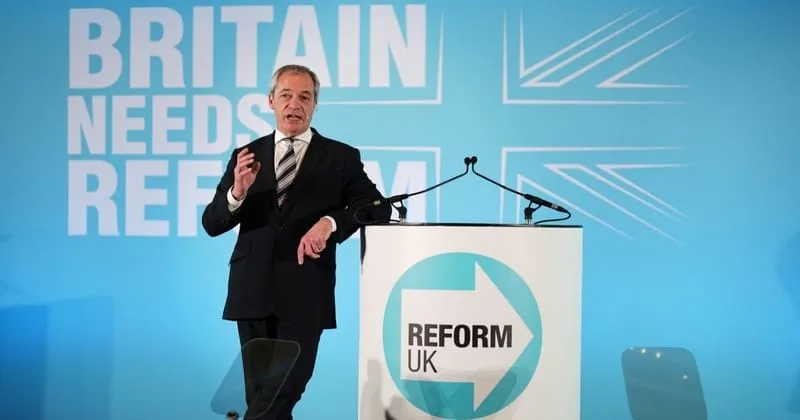
London: Britain’s right-wing party Reform UK has announced sweeping proposals to ban all forms of face-covering clothing in public places if it comes to power, citing national security, crime prevention, and public safety. The party’s spokesperson for home affairs, Zia Youssef, said the measure would apply to everything from burqas to hoods, arguing that criminals increasingly evade CCTV surveillance by concealing their faces. Speaking in Dover, Youssef unveiled Reform’s new policy paper covering immigration, policing, counter-terrorism and what the party calls the protection of Britain’s Christian heritage. He said the public “naturally feels uneasy” when encountering masked strangers on the streets, particularly after dark, and insisted that a blanket ban on face coverings would make communities safer.
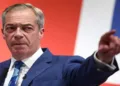
Reform UK leader Nigel Farage backed the proposal, warning that masked crowds had fuelled violent disturbances in cities such as Newcastle. “Covering the face in public places is problematic for a number of reasons. It’s not just religious,” Farage said, arguing that tougher laws are needed to deter disorder and improve policing.
Face-covering ban and security push
Youssef told reporters that he personally supports a ban on all face coverings in public places and confirmed that Reform UK will soon decide whether to adopt the policy formally. In comments to The Sun, he said many offenders deliberately hide their faces to avoid identification, making it harder for police to track attackers and secure convictions. The stance marks a sharp change from Youssef’s earlier position. Last year, he temporarily stepped aside from his role after criticising a Reform MP’s call for a burqa ban. His shift has already sparked debate in political circles.
Former Home Secretary Suella Braverman, who recently joined Reform UK, has also thrown her weight behind the proposal. She said burqas should be banned in public places and especially in classrooms, arguing that face coverings undermine social cohesion and security. Farage echoed those concerns, saying that recent unrest demonstrated how anonymity can embolden violence. Reform leaders insist the policy is aimed at crime prevention rather than religion, though critics have questioned its broader social impact.
Deportations, emergency powers and a new enforcement unit
At the heart of Reform’s platform is a dramatic overhaul of immigration enforcement. Youssef declared that a future Reform government would announce a “national security emergency” in response to rising illegal migration. He pledged to deport more than 600,000 people during his first term in office. Central to that effort would be the creation of a “UK Deportation Command,” described as Britain’s equivalent of the US Immigration and Customs Enforcement agency. The unit would be tasked with locating undocumented migrants, detaining up to 24,000 people at any one time, and removing them from the country on as many as five flights a day.
Reform UK also plans to withdraw Britain from the European Court of Human Rights, arguing that current legal frameworks obstruct swift deportations. Party officials said they would scrap international agreements that block removals and launch a new drive dubbed “Operation Restoring Justice.”
Youssef further promised to outlaw the Muslim Brotherhood and Iran’s Islamic Revolutionary Guard Corps, claiming the bans are necessary to prevent the spread of extremist ideologies in Britain.
On crime, he outlined plans for month-long police checkpoints in knife-crime hotspots and tougher penalties for anyone found facilitating illegal immigration.
Protecting Churches and “Christian heritage”
Reform UK’s proposals also include measures aimed at safeguarding what it describes as Britain’s Christian identity. Youssef said historic churches would be automatically placed on a protected list to prevent their conversion into mosques, while mosques themselves would also be included under heritage protections. The party argues that these steps are about preserving national history rather than targeting any faith community. Nevertheless, the proposals have drawn scrutiny for their scope and implications.
Addressing supporters in Dover, Youssef said Reform’s platform responds to what he described as growing public anxiety over immigration, crime and social change. “People want safe streets, clear laws, and a government that acts decisively,” he said. Farage reinforced that message, insisting that only firm action can restore order. “We’ve seen what happens when masked mobs are allowed to roam freely. These measures are about protecting ordinary citizens,” he said.
Reform UK has yet to confirm when the face-covering ban will become official party policy, but leaders made clear that it would form a central plank of their election platform. With hardline pledges on deportations, civil liberties and national identity now on the table, the party is positioning itself for a confrontational campaign focused on security and immigration, issues it believes resonate strongly with voters.