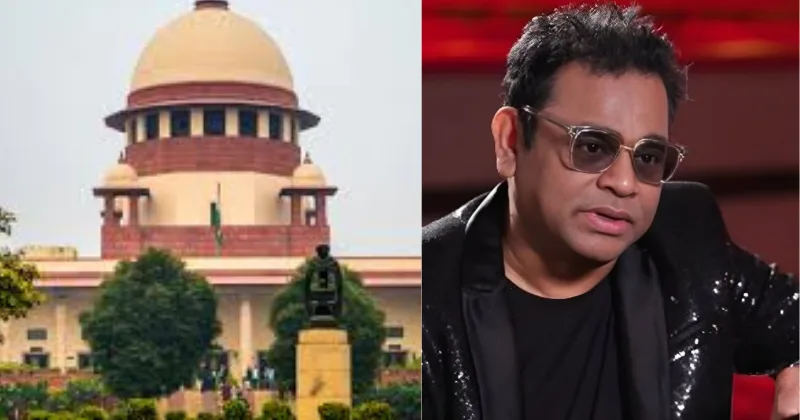
The Supreme Court disposed of the plea after composer A.R. Rahman consented to extend credit to the ‘Shiva Stuti’ performance of the Junior Dagar brothers in the song “Veera Raja Veera” from the film Ponniyin Selvan II.
On February 20, the Bench was hearing a plea filed by Dhrupad vocalist Ustad Faiyaz Wasifuddin Dagar challenging the Delhi High Court order that had set aside the injunction against music composer A.R. Rahman in relation to the composition “Veera Raja Veera” in the Tamil film Ponniyin Selvan II.
The Bench comprising Chief Justice Surya Kant, Justice Joymalya Bagchi and Justice Vipul M Pancholi directed:
“Upon persuasion, Mr Rahman has agreed that, as an interim arrangement, on all OTT and online platforms, the line depicting credits in respect of the subject song shall be as follows: ‘Composition inspired from the Dagarwani tradition Dhrupad, first recorded by Late Ustad M Faiyazuddin Dagar and his nephew of late Ustad…’.”
It further observed: “Since no opinion on merits, let all issues be open to be agitated. It goes without saying that the suit shall proceed without being influenced by observations in one or other court. The orders of the single judge and the division bench stand modified to the extent above. Let the revised credit be displayed in 5 weeks.”
Earlier, the Bench had suggested that the filmmakers formally acknowledge that “Veera Raja Veera” draws from a “Shiva Stuti” rendered by the Junior Dagar Brothers, eminent exponents of the Dagarvani tradition.
During the proceedings, Senior Advocate Abhishek Manu Singhvi, appearing for Rahman, informed the Court that the composer had accepted the earlier suggestion to provide specific credit to the original performers, notwithstanding the continuing dispute concerning plagiarism and authorship.
By way of an alternate arrangement, the Bench modified the earlier High Court directions. As an interim measure, all OTT and online platforms hosting the song will carry a revised credit line reading:
“Composition inspired from Dagarwani tradition Dhrupad, first recorded by Late Ustad M. Faiyazuddin Dagar and his nephew.”
The Court directed that this revised credit be implemented across digital platforms within five weeks. It also recorded that the respondents have deposited ₹3 crores pursuant to earlier directions, which shall remain with the Registrar General of the High Court pending final adjudication.
Singhvi raised concerns about media reportage, stating that certain reports inaccurately suggested that Rahman had “lost” the case or “acknowledged plagiarism.” The Bench remarked that it cannot invariably regulate how matters are reported in the press.
Background:
On 13th February, the Supreme Court upheld an earlier order directing A.R. Rahman and the film’s producers to deposit Rs 2 crore with the Delhi High Court as security in connection with an ongoing legal case. The apex court highlighted the need to recognise the contribution of classical musicians from the Dagar tradition in the disputed composition.
The case pertains to a song “Veera Raja Veera”, composed by Rahman for Ponniyin Selvan 2, which was released in 2023.
Ustad Faiyaz Wasifuddin Dagar, a Padma Shri-winning classical musician, alleged that the track’s core musical composition was lifted from a classical Dhrupad piece called “Shiva Stuti”, originally composed and performed by his father Ustad Nasir Faiyazuddin Dagar and uncle Ustad Nasir Zahiruddin Dagar, the ‘Junior Dagar Brothers’.
A Bench of Chief Justice of India Surya Kant and Justice Joymalya Bagchi was hearing a plea filed by Dhrupad vocalist Ustad Faiyaz Wasifuddin Dagar challenging a September 2025 order of the Delhi High Court. The High Court had held that there was no prima facie evidence to show that the Junior Dagar Brothers were the authors of the classical rendition “Shiv Stuti”.
In April 2025, Justice Prathiba M Singh of the Delhi High Court ruled that “Veera Raja Veera” was not merely inspired by the classical piece but was “identical” in its musical structure, emotional expression, and aural impact to Shiva Stuti, a composition rooted in the Hindustani classical Dagarvani tradition.
The court said the similarity extended beyond mere stylistic influence to an actual replication of the core melody and emotional effect. On that basis, the court directed Rahman and the film’s production house Madras Talkies to deposit Rs 2 crore as security and also revise the song’s credits on all OTT and digital platforms to clearly acknowledge the original composers.
Aggrieved by the HC interim order, Rahman and the film producers appealed in the HC, questioning both the finding of infringement and the directions on credits and compensation.
In September 2025, a division bench of the Delhi High Court stayed parts of the order, including the direction on credits.
Legal experts say the Supreme Court’s order marks a significant development, holding A.R. Rahman liable to pay the stipulated amount as compensation to the claimants. They point out that the SC ruling reinforces the importance of strict adherence to copyright laws in the music and film industry. Composers, producers, and studios are reminded to secure proper permissions and licences when creating or using pre-existing musical content. The apex court order to pay compensation to the rightful claimants clarified that copyright infringement cases are taken seriously, regardless of the stature of the individuals involved.