Remembering Shri Madhav Sadashivrao Golwalkar: Architect of Hindu Nationalism
September 16, 2026
  • Read Ecopy
  • Circulation
  • Advertise
  • Careers
  • About Us
  • Contact Us
Android AppiPhone AppArattai
Organiser
  • ‌
  • Bharat
    • Assam
    • Bihar
    • Chhattisgarh
    • Jharkhand
    • Maharashtra
    • View All States
  • World
    • Asia
    • Europe
    • North America
    • South America
    • Africa
    • Australia
  • Editorial
  • International
  • Opinion
  • RSS @ 100
  • More
    • World Hindu Congress 2026
    • Op Sindoor
    • Analysis
    • Sports
    • Defence
    • Politics
    • Business
    • Economy
    • Culture
    • Special Report
    • Sci & Tech
    • Entertainment
    • G20
    • Azadi Ka Amrit Mahotsav
    • Vocal4Local
    • Web Stories
    • Education
    • Employment
    • Books
    • Interviews
    • Travel
    • Law
    • Health
    • Obituary
  • Subscribe
    • Subscribe Print Edition
    • Subscribe Ecopy
    • Read Ecopy
  • ‌
  • Bharat
    • Assam
    • Bihar
    • Chhattisgarh
    • Jharkhand
    • Maharashtra
    • View All States
  • World
    • Asia
    • Europe
    • North America
    • South America
    • Africa
    • Australia
  • Editorial
  • International
  • Opinion
  • RSS @ 100
  • More
    • World Hindu Congress 2026
    • Op Sindoor
    • Analysis
    • Sports
    • Defence
    • Politics
    • Business
    • Economy
    • Culture
    • Special Report
    • Sci & Tech
    • Entertainment
    • G20
    • Azadi Ka Amrit Mahotsav
    • Vocal4Local
    • Web Stories
    • Education
    • Employment
    • Books
    • Interviews
    • Travel
    • Law
    • Health
    • Obituary
  • Subscribe
    • Subscribe Print Edition
    • Subscribe Ecopy
    • Read Ecopy
Organiser
  • Home
  • Bharat
  • World
  • Operation Sindoor
  • Editorial
  • Analysis
  • Opinion
  • Culture
  • Defence
  • International Edition
  • RSS @ 100
  • Magazine
  • Read Ecopy
Home Bharat

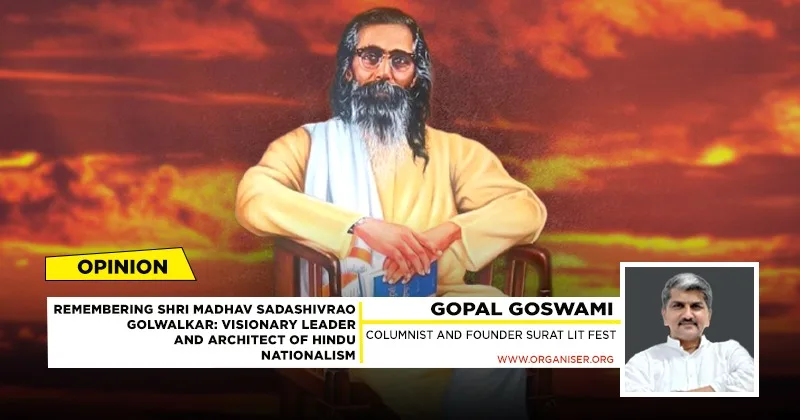
Remembering Shri Madhav Sadashivrao Golwalkar: Visionary leader and architect of Hindu Nationalism

In philosophy, Guruji Golwalkar authored seminal works that shaped Hindu nationalist thought. His 1939 book, We or Our Nationhood Defined, articulated the concept of a Hindu Rashtra, emphasizing cultural unity as the bedrock of national identity

Gopal GoswamiGopal Goswami
Feb 20, 2026, 07:00 pm IST
inBharat, Analysis, Opinion, RSS in News
Follow on Google News
Remembering Shri Madhav Sadashivrao Golwalkar: Visionary Leader and Architect of Hindu Nationalism
Facebook
Twitter
WhatsAppTelegramEmail

On February 19, we commemorate the birth anniversary of Shri Madhav Sadashivrao Golwalkar, widely known as Guruji, a towering figure in India’s nationalist landscape. Born in 1906 near Nagpur, he rose from humble beginnings to become the second Sarsanghchalak of the Rashtriya Swayamsevak Sangh (RSS), steering it through turbulent times and embedding it deeply into the fabric of Indian society. His life, marked by profound personal achievements in philosophy, spirituality, and academics, coupled with his transformative leadership of the RSS, left an indelible impact on India’s ideology, cultural renaissance, and nationalism. As India navigates through modern challenges, Golwalkar’s vision of a unified Hindu Rashtra continues to inspire and provoke debate, reflecting both admiration for his organizational genius from right and criticism from left ecosystems.

Personal Achievements: A Blend of Intellect, Spirit, and Scholarship

Guruji Golwalkar’s early life was a testament to his intellectual prowess and spiritual depth. A prodigy, he graduated from Hislop College in Nagpur and pursued a Master’s degree in Science at Banaras Hindu University (BHU), where he was influenced by luminaries like Pandit Madan Mohan Malaviya.  His academic excellence earned him a professorship at BHU, where students affectionately called him “Guruji” for his inspiring teaching style.  This nickname stuck throughout his life, symbolizing his role as a mentor and guide.

In philosophy, Guruji Golwalkar authored seminal works that shaped Hindu nationalist thought. His 1939 book, We or Our Nationhood Defined, articulated the concept of a Hindu Rashtra, emphasizing cultural unity as the bedrock of national identity. He drew from historical and sociological perspectives, arguing that India’s unity lay in its Hindu cultural heritage. His later compilation, Bunch of Thoughts (1966), delved into nationalism, cultural revival, and the role of Hindus in society, categorizing Muslim, Christian as alien thoughts. These writings provided ideological rigor to the RSS, blending ancient Indian philosophy with modern nationalist fervor. Critics, however, point to passages praising German anti-Semitism as evidence of fascist leanings, though they were views or call for cultural preservation.

Spiritually, Guruji was deeply influenced by the Ramakrishna Math and Swami Akhandananda, leading him to briefly embrace monastic life in the 1930s. His time in Sargachi Ashram honed his ascetic discipline, which he later infused into RSS practices for full time workers or Pracharak. He emphasized character development through moral education, discipline, and self-restraint, viewing spirituality as a tool for personal and national upliftment. Golwalkar’s philosophy integrated Advaita Vedanta’s idea of a common Atman (soul) binding all Hindus, promoting service to society as worship of the divine.

This holistic approach merging academics with spiritual inquiry made him a revered thinker, influencing generations to see education as a means for cultural nationalism and moral integrity.

Leadership of the RSS: Expanding Ideology, Structure, and Sectors

Assuming leadership of the RSS in 1940 after founder Dr Keshav Baliram Hedgewar’s death, Guruji Golwalkar transformed a nascent organization into a national powerhouse. At that time, RSS was localized in Maharashtra with about 100,000 members and 50 shakhas (branches). Under his 33-year stewardship until 1973, membership swelled to over a million, with 10,000 shakhas spanning India. This expansion was multifaceted: ideological, structural, and sectoral.

Ideologically, Guruji Golwalkar crystallized Hindutva as a unifying force. He shifted from Dr Hedgewar’s empirical approach to a scholarly articulation, defining the nation through shared culture, history, and spirituality rather than territory alone. He introduced anti-communist and anti-socialist stances, coining “Not socialism but Hinduism” to counter leftist ideologies.  His vision of “Positive Hinduism” reframed service to society as devotion to the nation, adapting Swami Vivekananda’s ideas to prioritize “Our People” over abstract humanity. This ideological framework brought drastic change & attracted youth towards a Hindu Rashtra.

Structurally, Guruji Golwalkar emphasized discipline through daily shakhas, involving physical exercises, intellectual discussions, and patriotic songs. He toured India tirelessly, visiting provinces multiple times to build grassroots networks. Post-1948, after the RSS ban following Gandhi’s assassination (lifted in 1949), he navigated repression by portraying RSS as cultural, not political. This resilience expanded its reach to northeastern and southern India.

Sectorally, Guruji diversified RSS into the Sangh Parivar, creating affiliates like the Akhil Bharatiya Vidyarthi Parishad (ABVP) for students, Bharatiya Mazdoor Sangh (BMS) for labor, Vishva Hindu Parishad (VHP) for religious unity, and Vanvasi Kalyan Ashram for tribal welfare and Jansangh as political party and many more to name. This effected the cadre spread into education, politics, and social service, allowing indirect influence while maintaining RSS’s apolitical facade. By 1973, the Parivar had spread nearly every societal aspect, from schools to unions.

Impact on Indian Society, Ideology, and Cultural Renaissance

Guruji Golwalkar’s legacy profoundly shaped Indian society. He fostered a cultural renaissance by reviving Hindu traditions, emphasizing Sanskriti (culture) as the soul of the nation. Through RSS programs, he promoted character building, discipline, and seva (service), inspiring initiatives in education and disaster relief. His ideas influenced the Bharatiya Jana Sangh (predecessor to the BJP), embedding Hindutva in politics.

Ideologically, Guruji Golwalkar championed integral humanism though often attributed to Deendayal Upadhyaya, it echoed his views on holistic development rooted in Hindu dharma. He viewed nationalism as cultural, not territorial, urging Hindus to unite against “internal threats” for national integrity. This bolstered the nationalism movement, countering secularism with a Hindu-centric vision. Supporters credit him with preserving Hindu identity amid colonial and post-colonial fragmentation.

However, his impact is contentious. Though the left leaning Critics argue his writings promoted exclusion, comparing Hindu purity to Nazi ideals and advocating minority assimilation or emigration, his thoughts are mostly sourced from Indian ethos only. In modern India, his ideology underpins policies like citizenship laws, seen as eroding pluralism but his culture nationalism says every Indian who was born in this land is Hindu by culture.

His emphasis on man-making and nation-building through engaged Hinduism via affiliates like the Vivekananda Kendra revived cultural pride, contributing to a renaissance in Hindu thought. His vision of a self-reliant India, free from Western materialism, resonates in contemporary debates on decolonization.

Conclusion: A Lasting Legacy Amidst Debate

As we mark Guruji Golwalkar’s 120th birth anniversary, his contributions remain pivotal. From personal scholarly pursuits to expanding the RSS’s ideological and structural might, he forged a path for Hindu nationalism that influences India’s polity today. His impact on society through cultural revival and integral humanism has empowered millions. In a polarized world, Guruji Golwalkar’s life urges reflection: Can nationalism unite without dividing? Yes because a nation is for each nation. RSS ideology is to respect the motherland, respect the common ancestors, and enemy to nation is enemy of RSS, where in this comes divide or marginalisation of minorities? His enduring message of discipline, service, and cultural pride offers lessons for India’s future.

Topics: RSSShri Madhav Sadashivrao GolwalkarGuruji Golwalkar RSS
Gopal Goswami
Gopal Goswami
Gopal Goswami, Columnist and founder, Surat Lit Fest Gopal Goswami stands at the intersection of intellectual depth, grassroots experience, and an unwavering commitment to nation-building. He has done his Ph. D from Sardar Vallabhbhai National Institute of Technology (SVNIT), Surat, Goswami brings to the contemporary discourse a rare blend of academic precision and lived reality. With a postgraduate degree in Public Administration and a doctorate in Business Management, his work transcends theoretical inquiry to engage directly with India’s socio-economic challenges. Rooted in the remote Himalayan village of Bageshwar, Uttarakhand, Goswami's early life, shaped by a disciplined army father and a resilient farmer mother, offers a firsthand perspective on the aspirations and struggles of rural India. These formative years, spent in government schools and colleges, laid the foundation for his lifelong empathy for the common citizen. His activism during the Mandal Commission agitation and the Uttarakhand statehood movement further cemented his commitment to social equity and justice. Goswami’s three-decade-long career in the construction sector, including leadership roles in projects of national importance and his current stewardship of the GAP Group in the ambitious Dholera SIR, has equipped him with a practical understanding of development and policy implementation. His association with the Rashtriya Swayamsevak Sangh (RSS) and his humanitarian efforts during the COVID-19 crisis highlight his deep engagement with societal welfare. As the founder of the Surat Literature Festival and a columnist for leading national dailies, Goswami also plays a pivotal role in shaping public thought. His upcoming book on India’s social welfare schemes, especially the Pradhan Mantri Awas Yojana in Surat, reflects his nuanced understanding of public policy and its impact on everyday lives. Through this work, Gopal Goswami emerges not only as a scholar but also as a vital voice in India's journey toward an inclusive and empowered future. www.gopalgoswami.com He is Chairman of www.gapgroup.in , www.jkprojectsindia.com www.greenmentors.in , www.srtlitfest.com [Read more]
Share
Tweet
SendShareSend
✮ Subscribe Organiser YouTube Channel. ✮
✮ Join Organiser's WhatsApp channel for Nationalist views beyond the news. ✮
Previous News

Supreme Court disposes plea after AR Rahman agrees to credit Dagar brothers in Ponniyin Selvan II song

Next News

Saga of Jagannath Puri’s Ratna Bhandar: How devotees and courts broke decades of secrecy

Related News

From Left to Right: Kamakshi Swaminathan, National Vice President, Saksham; Satish Bansal, National Treasurer, Saksham; Umesh Aandhare, National General Secretary, Saksham; Alok Kumar, Sah Sarkaryavah; Dayal Singh Panwar, National President, Saksham; Gurmeet Singh Mahal, Jodhpur Prant President, Saksham; Dr Jasraj Sharma, Jodhpur Mahanagar President, Saksham; and Dhananjay Kumar Singh, National Krida Ayam Pramukh, Saksham

Saksham’s resolve for inclusion

RSS Sarsanghchalak Dr Mohan Bhagwat with Rashtrasant Manojnyacharya Shri Pulak Sagar Ji Mahara

Rajasthan: Dr Bhagwat & Acharya Pulak Ji hold meaningful discussions on social harmony, cow service, dharma & culture

Hanuman Singh Rathore, Chairman of the Board of Secondary Education

Journey from ‘I’ to ‘We’ is the essence of Bharat’s thought: Hanuman Singh Rathore

Bharatiya Kisan Sangh distributed free school uniforms, notebooks, pen bundles, bags to 7,000 students in flood-affected areas of Assam

Assam: Bharatiya Kisan Sangh distributes free school uniforms, notebooks & bags to 7,000 flood-affected students

RSS Sarsanghchalak Dr Mohan Bhagwat, attended the 37th annual prize distribution ceremony ‘Swaraj’ at L.K. Singhania Education Centre

Education must go beyond livelihood and focus on holistic human development: Dr Mohan Bhagwat

The RSS has spent a century building influence through organisation, social networks and ideological formation beyond the electoral arena

RSS at 100: How the Sangh built a century-long network of influence beyond Indian politics

Load More

Latest News

Representative Image

India crossed 80 Lakh HPV vaccine doses despite a sustained misinformation campaign

Riyadh’s search for Israeli intelligence and Islamabad’s refusal to deploy forces to Yemen expose growing cracks in the regional security equation

Saudi turns to Israel for intelligence as Houthis escalate; Sunni NATO ally Pakistan refuses troops for Yemen war

Bihar Temple Vandalism: Police detain 3 minor Muslim boys for stone-throwing, urination at Hanuman murti in Nalanda

IIT Madras hosts first universal brotherhood day celebration, highlights Swami Vivekananda’s legacy and vision for youth

Universal Brotherhood Day: IIT Madras hosts first celebration honouring Swami Vivekananda’s historic Chicago speech

SECL is powering India’s energy security today while advancing responsible mining, greener operations and a sustainable path towards Net Zero

Powering the present, building the future: How SECL is delivering energy security and a net-zero pathway together

Representative Image

Who Owns the Blueprint Inside Your Chip? How India is Moving from Chip Imports to Home-Grown Silicon

From Left to Right: Kamakshi Swaminathan, National Vice President, Saksham; Satish Bansal, National Treasurer, Saksham; Umesh Aandhare, National General Secretary, Saksham; Alok Kumar, Sah Sarkaryavah; Dayal Singh Panwar, National President, Saksham; Gurmeet Singh Mahal, Jodhpur Prant President, Saksham; Dr Jasraj Sharma, Jodhpur Mahanagar President, Saksham; and Dhananjay Kumar Singh, National Krida Ayam Pramukh, Saksham

Saksham’s resolve for inclusion

Kashmiri Pandits perform a ritual on Balidan Diwas of Kashmiri Pandits, organised by Panun Kashmir in Paloura

Panun Kashmir observes Balidan Diwas in Jammu & Bengaluru, pay homage to martyrs

Tamil Nadu: Emerald Murugan murti stolen from Nadu Palani temple recovered from abandoned quarry, three arrested

Vande Mataram Row: Karnataka Congress govt faces HC challenge over two-stanza restriction

Load More
  • Privacy
  • Terms
  • Cookie Policy
  • Refund and Cancellation
  • Delivery and Shipping

© Bharat Prakashan (Delhi) Limited.
Tech-enabled by Ananthapuri Technologies

  • Home
  • Search Organiser
  • Bharat
    • Assam
    • Bihar
    • Chhattisgarh
    • Jharkhand
    • Maharashtra
    • View All States
  • World
    • Asia
    • Africa
    • North America
    • South America
    • Europe
    • Australia
  • Editorial
  • Operation Sindoor
  • Opinion
  • Analysis
  • Defence
  • Culture
  • Sports
  • Business
  • RSS @ 100
  • Entertainment
  • More ..
    • Sci & Tech
    • Vocal4Local
    • Special Report
    • Education
    • Employment
    • Books
    • Interviews
    • Travel
    • Health
    • Politics
    • Law
    • Economy
    • Obituary
  • Subscribe Magazine
  • Read Ecopy
  • Advertise
  • Circulation
  • Careers
  • About Us
  • Contact Us
  • Policies & Terms
    • Privacy Policy
    • Cookie Policy
    • Refund and Cancellation
    • Terms of Use

© Bharat Prakashan (Delhi) Limited.
Tech-enabled by Ananthapuri Technologies