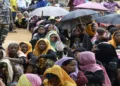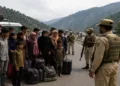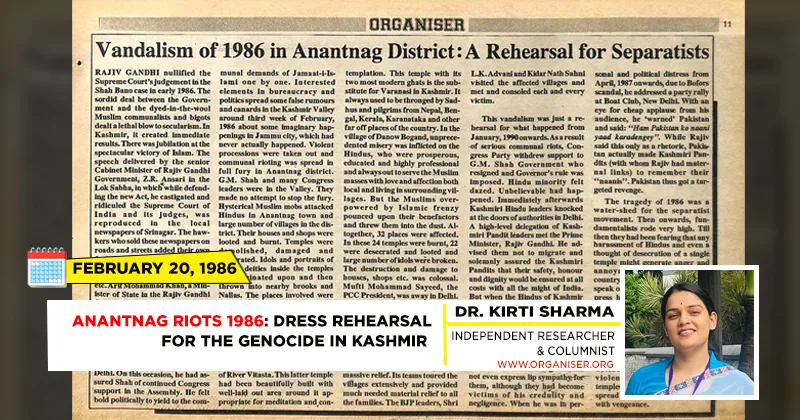
On this day, forty years ago, in February 1986, the Anantnag riots marked a disturbing point in the history of Jammu & Kashmir. What occurred was not an isolated outbreak of communal unrest, but a calculated assertion of separatist power. Temples were desecrated, homes of Hindus were looted, and a message of intimidation was delivered to the minority community. The riots exposed deep political fragilities within the Congress–National Conference dispensation and revealed how religious radicalism, political bias, and administrative indecision were like some procedural steps into a far more dangerous storm that would erupt fully in 1990.
The Anantnag riots or Kashmir Riots of 1986 were a preparatory phase before the advent of the heinous, violent outburst of terror in Kashmir during 1990. From then onwards separatists activities intensified each day in pursuit of their objectives. These riots remain marginally reported because of the hijacking of media and so-called nationalist political associates within the state administration by the separatists, who prevented the riots from coming to popular parlance outside Kashmir. Till this point, separatists were testing the waters to see the reaction of the country and the Hindu community against their acts of killings and temple desecration. But the harassment of the Hindu community or desecration of Hindus temples in any way would not have brought anger within the country as expected by fundamentalists. This gave them confidence that by killing Hindus openly, in Kashmir, they were not banished from the state or put behind bars. Separatists become confident that what more would the country do if the whole community was threatened or killed in Kashmir? They knew they would be protected somewhere. It was subsequently perceived that some attacks on temples and pujaris primarily generated fear among the Hindus, confining many to their homes. Concurrently, sections of the media appeared reluctant to comprehensively report anti-national developments within the state. In this context, the perceived alignment of media silence with separatist activity and the political silence regarding such anti-national activities fostered an atmosphere of intimidation, characterised by threats to Hindus. This climate of fear was then exploited to facilitate the large-scale displacement of Kashmiri Hindus, thereby advancing separatist aspirations aimed at transforming the region’s status to make it a separate state. Local support for separatists added feathers to their confidence. Separatists were seen saying, ‘Mujahids were invincible, and no power could face them, as they were blessed by Allah’. With an underlying motive of terrorising the Hindu community and to build an Islamic theocratic state, religiously motivated leaders from Kashmir spare no chance to communalise the situation in Kashmir during 1986.
The Scenarios in the State: From 1983 to 1986, Background Politics
Sheikh Abdullah and his heir, Farooq Abdullah: Sheikh Abdullah appointed his son, Dr Farooq Abdullah, as his political heir of the Jammu and Kashmir National Conference (JKNC), and he became the Chief Minister on September 8, 1982, after Sheikh’s death. Later, Farooq was elected the state’s official CM in the 1983 State Assembly elections.
June 5, 1983 State Assembly Elections: During the aforesaid elections, the party managers of Jammu and Kashmir National Conference (JKNC) resorted to fascist techniques. Lies were intentionally spread. Religious and regional feelings were unscrupulously exploited. To strengthen his position in the Valley and to create a mental climate in which anti-Centre, pro-plebiscite, and Muslim votes would constitute a solid phalanx in his favour, Dr Farooq Abdullah joined hands with Mirwaiz Moulvi Farooq, though the latter did not abandon, even temporarily, his pro-plebiscite and pro-Pakistan stance. The Maulvi’s uncle, the former “Mirwaiz,” Yusaf Shah, had migrated to Pakistan and become “president” of “Pakistan occupied Jammu and Kashmir (PoJK).” Dr Farooq Abdullah spoke different languages in different places. According to a famous saying, Farooq Abdullah was called a nationalist in Delhi, a secularist in Jammu and a communalist in Kashmir. In the Valley, he subtly enlisted the support of the groups, which once formed the core of the Plebiscite Front and which formally parted company with Sheikh Abdullah when he entered into the Kashmir Accord in 1975 (Indira-Sheikh Accord). Farooq himself propagated in the Valley, “this election is a plebiscite to allow the people to say which political party, National Conference or Congress, they liked”. The result of all this was a sharp polarisation of voters on communal and parochial lines.
Starting from August 15, 1983, a series of bomb explosions occurred in Kashmir. On October 13, 1983, highly deplorable acts of subversion were witnessed during the one-day international cricket match between India and the West Indies. The Indian players were humiliated, hooted at, heckled, abused, and even assaulted with rotten fruits and flag sticks. Pakistani flags were waved. Indira Gandhi was a powerful leader at that time in the Centre, and ‘Pakistan Zindabad’ slogans were raised during the cricket match between India and the West Indies, even when Pakistan was not playing. Notably, the Pakistan-backed terrorists attacked the Indian teams with stones and bottles. The match became more than a footnote in the chapter on terrorism in Kashmir. And, even before the match could settle, the pitch was dug by members of the now-banned Jamat-e-Islami. While fielding, Sunil Gavaskar was targeted with verbal missiles and shown a large poster of Imran Khan.
Sunil Gavaskar, in his book Runs ‘n Ruins, describes the unfortunate incident and writes, “this was unbelievable. Here we were in India and being hooted even before a ball had been bowled. Being hooted at after a defeat is understandable, but this was incredible. Moreover, there were many in the crowd shouting pro-Pakistan slogans, which confounded us, because we were playing the West Indies and not Pakistan.”
Farooq Abdullah was in charge during the match. He could have controlled the situation if he had taken the right actions. However, for his support to Jammat-i-Islami or to separatists, he remained a silent spectator on the ground.
The Congress and the JKNC both, for their own interests, surrendered in front of fundamentalists. If the Congress government could not have stopped the spread of fundamentalists at that time, then what good did they do in Kashmir? The sentiment among the separatists in the valley was unambiguous; they were not only preparing the groundwork for an exodus but also continually reminding and alerting both the Centre and the Hindu community that acts of cruelty were the real face of separatists in Kashmir.
Instability Within JKNC: Party Split
The members of the JKNC became disgruntled with Farooq Abdullah’s decisions, as he removed many trusted ministers from Sheikh Abdullah’s cabinet in September 1982, after Sheikh Abdullah’s death. Thus, a rift came between some party members and Farooq Abdullah. The tensions were not brewing only in the Party but also in Sheikh Abdullah’s family for a long time. Gulam Mohammed Shah, the brother-in-law of Farooq Abdullah, wanted to be the next political heir of JKNC and the state, but his dream was shattered when Farooq was appointed CM. G.M Shah thinks that the Sheikh cheated him, as he sacrificed his life for the Sheikh in jails and protests during his years in politics and supported the Sheikh’s downfall when Farooq was busy with his medical studies. The rift between G.M. Shah and Farooq had been covertly playing out to break each other’s political positions from the beginning; all it needed was an opportunity to burst. Clandestinely, about half a dozen erstwhile ministers in the Sheikh Abdullah cabinet, who were unceremoniously dropped by Farooq, joined hands with G.M. Shah. By the end of January 1984, it was no longer a secret that G.M. Shah and his supporters had decided to topple Dr Farooq Abdullah’s Ministry with the help of the Congress. During the State Assembly elections of June 1983, G.M Shah quietly managed, through his mother-in-law, Mrs Sheikh Abdullah, to secure party tickets for at least eight of his supporters. Shah saw his opportunity when relations between the Congress and the National Conference soured, and the Congress sent him encouraging signals to join hands. The relations between the State and the Central Government were also strained, particularly concerning the allegations about the existence of training camps in J&K for the Sikh extremists. Dr Farooq Abdullah had obtained the support of the Sikh extremists in the State elections of June 1983. Separately, the Congress launched a public agitation against rigging in the elections and the misrule of Dr Farooq Abdullah because Farooq was getting out of the Congress’s hands. He remained uncontrolled, beyond Congress’s handling. A number of demonstrations were held. During the course of one such demonstration on January 15, 1984, the police resorted to firing, in which four Congress supporters were killed. This further embittered the relations between the Congress and the National Conference.
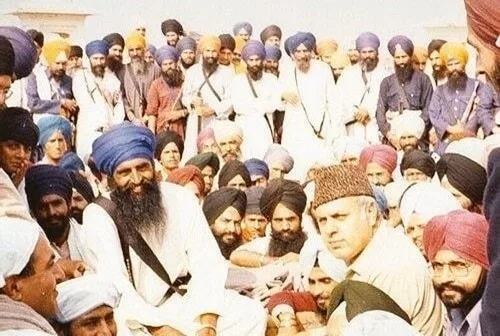
In the meantime, Farooq Abdullah also met Jarnail Singh Bhindranwale. At that time, Punjab was already witnessing escalating militancy and political instability. The growing militancy in Punjab had become a serious concern for the Central Government. Farooq’s meeting with Bhindranwale was therefore not viewed as a courtesy call by New Delhi, but as a politically sensitive development. For Indira Gandhi, already grappling with rising separatist currents in both Punjab and Jammu & Kashmir, such optics deepened anxieties about potential regional alignments that could challenge her authority. Thus, she decided to take G.M Shah into her confidence to topple the government of Farooq Abdullah. G.M Shah later became a supporter of Jamaat-e-Islami to motivate religious indoctrination in the state.
Jagmohan’s Appointment: The trigger for the JKNC–Congress fallout
Before Jagmohan was appointed as a Governor in J&K in 1984, Indira Gandhi talked about Dr Faroq Abdulah’s characteristics to Jagmohan. She said he is boyish, inconsistent and erratic in his ways. She thought that he was under the influence of some crafty men and, whenever it suited him, he would whip up communal and parochial emotions and promote ‘hate-Centre’ feelings. She was particularly worried about his-extraordinary friendship with Sikh fundamentalists in Punjab. This enraged Indira Gandi who viewed it as breaching an understanding she had with his father that the NC would not be party to efforts to challenge her Congress Party’s primacy in Indian politics.
On June 7, 1984, another combined procession of separatists was organised in which naked swords were freely brandished. The crowd went on a rampage and set several shops and houses on fire, including the Arya Samaj school and Nirankar Bhawan. The Hanuman temple was also attacked, the pujari beaten, and the idols thrown into the Jhelum. The atmosphere in the state was tense.
Maqbul Butt Execution: Fuel to the Wave of Separatism
In 1984, Maqbul Butt was hanged by the Government of India for his indiscriminate killings in the valley, and later he became the iconic martyr of Kashmiris, irrespective of his dream of secession of J&K from India. The valley was in grief and considered his death a cruelty of the Indian government on the son of the soil. The valley always carried that burn in their heart to take revenge on India for the loss of Maqbul Butt. Thus, separatists kept waiting for the right time. This added tension to the valley’s atmosphere, making it harder for the Centre to deal with.
Loss of Farooq’s Political Position
The situation in the valley was grim, and G.M. Shah had the opportunity to withdraw support for Farooq Abdullah. He initiated a withdrawal step and showed his political decision to Jagmohan to convince him to become the next C.M of the state. To convey such proceedings against his Chief Ministership of Farooq, Jagmohan called him to his place to decide his stance on the situation, and later Jagmohan also wrote a letter to him, describing it as follows: “13 MLAs of the Legislative Assembly of J&K (12 of the National Conference Party and one Independent) have approached me-in-person this morning. They told me, and have given in writing, that they have withdrawn their support from your government and pledged their support to Ghulam Mohammad Shah, MLC. Simultaneously, Moulvi Iftikhar Hussain Ansari, MLA and leader of the Congress Legislative Party, J&K, has informed me, in writing and in person, that the Congress Legislative Party, with a strength of 26 MLAs, has decided to support Gulam Mohammad Shah. I am satisfied that you no longer enjoy the majority support of the Legislative Assembly and have, therefore, forfeited the right to continue as Chief Minister and to head the Government. In these circumstances, I advise you to submit your resignation as Chief Minister forthwith.”
Jagmohan conveyed the event to Farooq and asked him to resign or allow the Governor rule in the state for the smooth functioning of the state. Farooq, later in consultation with his confidential members of the party, decided and conveyed through a letter to Jagmohan that he wanted the Assembly to be summoned forthwith so that, in the event of my failure to demonstrate confidence in the house, we can next consider the options available to us under the Constitution of the State. “If, however, you (Jagmohan) do not want to conform to this democratic method, I, on behalf of my Cabinet, would request you to accept our advice of dissolving the Legislative Assembly so that we can go back to our people”. Farooq believed that under the anti-defection law in the state, which disqualifies a member for violating the party whip, the 12 signatories have lost their right to vote after defecting from the party. All they have written cannot be of any consequence against his Chief Ministership, and he will not lose the majority in the Assembly. So far as the issue of disqualification of these 12 MLAs was concerned, the J&K High Court alone could declare them as disqualified in terms of the local law on the subject. Incidentally, the J&K. High Court later ruled that the MLAs were not defectors and that the National Conference had split.
The Unending Manipulations in Kashmir Politics
Dr Farooq Abdullah and his supporters’ intended to play foul became even clearer from the role that the Speaker, Wali Mohammad Itoo, played in the Assembly. As required under the anti-defection law of the Jammu and Kashmir State, the Speaker, on a complaint lodged by the National Conference Party, referred the case to the High Court to seek its decision on the status of the 12 MLAs in question. After hearing all the parties concerned, the Chief Justice, in his judgment of July 30, 1984, said: “I hold that the 12 MLAs have not incurred any disqualification within the meaning of Section 24-G of the Representation of the People Act. The reference is answered accordingly.” The court made it clear that the whip, if any, has to be dealt with on policy grounds, not on leadership grounds. It ruled that a legislator could not be said to have “given up the membership” of the party by refusing to support the leadership of the party. When the Chief Justice was pronouncing his judgment, the Speaker made a crude attempt, against the provisions of the law, to withdraw the reference. In this connection, the Chief Justice ruled that “the High Court was a court of record and no party could treat the matter pending before it as withdrawn at the party’s sweet will”. The speaker went further and crossed all limits of propriety. In utter disregard of the provisions of the J&K constitution, the provisions of the anti-defection law and the verdict of the High Court, he himself passed an order disqualifying all the 12 MLAs and declaring their seats vacant. Constitutionally and morally, what could be worse than this in the power dynamics played in Kashmir?
GM Shah: Next Chief Minister
It was dangerous to have a power vacuum in the State. Therefore, Jagmohan called upon G.M. Shah to form the government on July 2, 1984. He obtained an assurance from Shah that he would convene the Assembly within one month to again prove his majority in the house.
The government of G.M. Shah was often accused of political manipulation, corruption, biased recruitment, and administrative weaknesses, which encouraged divisions within the state. The most unfortunate event in the ministry of Shah was the Anantnag Riots that further increased the Hindu-Muslim polarisation within the state, encouraging instability that further led to full-scale terrorism in the 1990s. The Shah ministry was dismissed in March 1986 after it lost its majority, and Governor’s Rule was imposed in J&K. The failure of the Shah government to control the situation reveals the inner supports politician gave to fundamentalist in J&K to immobilise the working of the state.
Anantnag Riots: Immediate Causes:
1. Desecration of the Al-Aqsa Mosque in Jerusalem
Many factors triggered the outbreak of the riots, which were not Kashmir-centric at first. The major blow to violence came from the proposed desecration of the Al-Aqsa Mosque in Jerusalem on February 3, 1986, which led to the initiation of the selective targeting of Kashmiri Hindus. The religious leaders in Kashmir used the instance of Al-Aqsa Mosque to make the Kashmiris believe that the same situation will be repeated in India if the youth of Kashmir do not stand to protect their religion or community. The religious indoctrination, as well as the covert plans of Pakistan to Islamize the Kashmir valley, led to the rise of communal tensions in Kashmir. No one has threatened the Muslim community or their faith in Kashmir during 1986, despite what was happening in the world. The history is evident in the fact that more temples of Hindus were destroyed in Kashmir than the Mosques in Kashmir. If Muslims were really threatened in some ways in Kashmir, then they would have left Kashmir rather than the Hindus from the valley.
2. Ramjanmboomi and disputed structure Issue
Secondly, the Ramjanambhoomi matter entered a significant phase in 1986. On February 1, 1986, the Faizabad district court ordered the gates of the Ram temple to be unlocked for Hindu worship. Also, earlier, the Shah Bano case (1985) challenged the conservative leaders of the Muslim community. The Supreme Court’s Judgement in Mohd. Ahmad Khan v. Shah Bano Begum upheld the right of a divorced Muslim woman under Section 125 of the Criminal Procedure Code. While the judgment was widely accepted, it provoked opposition from high-ranking and orthodox leaders who perceived it as an interference with or a shock to Muslim Personal Laws. In response, the Rajiv Gandhi-led Congress government enacted the Muslim Women (Protection of Right to Divorce) Act 1986. The hawkers who sold the newspaper on roads and streets added their own fuel to the situation in Kashmir. To attract the purchasers, they loudly shouted ‘La deen Hindustan per Islam a Tamacha’ in the context of the law enacted. This legislation effectively curbed the Supreme Court ruling and appeared to be a measure taken to appease the Muslim vote bank. Consequently, it garnered widespread criticism for contravening the principles of constitutional secularism. Meanwhile, the opening of the gates of the Ram Temple for worship has not only challenged the long-standing halt on the decision of the land dispute between the Ram Temple and Babri Masjid, but also sought to counterbalance the faith of the Hindu community against the enactment of the Muslim Women (Protection of Right to Divorce) Act.
The strategic balancing done by the Congress government never dissolved the growing hostility between Hindus and Muslims in India, but it further aggravated the distrust between the two communities during such controversies. The results of this policy were seen in the Anantnag Riots in Kashmir.
3. Proposed Construction of a Mosque inside the Jammu Civil Secretariat
Lastly, Chief Minister G.M Shah proposed the construction of a mosque inside the Jammu Civil Secretariat complex, further inflaming the local political dispute in Jammu and Kashmir, whose tentacles further cushioned the Anantnag riots in Kashmir. G.M. Shah was politically confident about his position in the state because of Congress’s support for him in the valley, and to keep his government in the state, he has also maintained cordial relations with the Jammat-i-Islami. Moreover, he was approving the communal demands of Jammat one by one to actualise the Islamic homogenisation of Kashmir. Thus, politics and religion were intertwined in Kashmir.
Spread of Anantnag Riots
The violence began around February 20, 1986, in Wanpoh village of Anantnag district, before spreading to other villages such as Dayalgam, Bijbehara, Danow Bogund, Akoora, Chowgam, Luk Bhawan, etc., and eventually reaching Srinagar. The agenda of separatists was to destroy the Hindus’ cultural life in Kashmir and restrict their long-term scope of settlement in Kashmir. Hindu temples were deliberately burned, idols were illicitly damaged, deities inside the temple were urinated upon and thrown into nearby brooks and nallas. The businesses of Hindus were plundered, and their homes were vandalised. In Bijbehara, four ancient and most revered temples were desecrated. There was the Vijeshwar temple and the temple dedicated to Bhagwan Shiv on the Harischandra Ghat of the River Vitasta. This latter temple had been beautifully built with a well-laid-out area around it appropriate for meditation and contemplation. This temple, with its most modern ghats, is situated in Varanasi in Kashmir. It was always thronged by Sadhus and pilgrims from Nepal, Bengal, Kerala, Karnataka and other far-off places of the country. But they were destroyed. Even after Mahashivratri, on March 8, 1986, the terror prevailed and spread further to Pulwama, Tral, Sopore, and Baramulla, encircling the entire Hindu-dominated regions of Kashmir in its fire. South Kashmir was chosen deliberately to spread the message of secession with vengeance and to create a pan-Islamic support. Later south Kashmir became the hub of terrorism in Kashmir.
GM Shah and Jamaat Links
The government of Shah exhibited leniency towards Jamaat-e-Islami and Islamic leaders within the state. Farooq Abdullah and G.M. Shah were responsible for granting access to the Valley to separatists, despite being aware of their true intentions for the region. Not only were Pakistani fundamentalists provided refuge within the state, but Sikh fundamentalists were also afforded safe havens to develop their anti-national agendas. Both Farooq and Shah, in order to uphold their political dominance over Jammu and Kashmir, exploited politically and religiously motivated youth within the state to maintain their power structures. The decade spanning from 1980 to 1990 was governed by the Congress and the National Conference in the region. During this period, the state became increasingly infested with separatism and secessionist tendencies. The power dynamics of Congress and the NC failed to curb the growth of separatism; instead, they facilitated the expansion of secessionist ambitions. The Jamaat-e-Islami, which had been dormant prior to 1980, became notably active during this decade, as evidenced by its support for the leaders of the Muslim United Front during the 1987 State Assembly elections. Consequently, Congress and the NC served as political guardians of terrorists within the state, thereby undermining the unity of Jammu and Kashmir from within and rendering the region vulnerable to external attacks to satisfy their insatiable thirst for power.
Over time, the incident faded from memory and our history. Hardly anyone was punished, and slowly people stopped talking about it. It became just another forgotten chapter in Kashmir’s history, where many such attacks happened, but justice was never delivered, and the pain of the victims was ignored.
Four decades later, the Anantnag riots must be recalled not merely as just another episode of communal violence, but as a voice of thousands of victims that went unheard. The desecrations, targeted attacks in the mid-1980s, signalled the steady institutional weakening of the state and the emboldening of separatist forces. Instead of decisive correction, ambiguity and politics deepened the crisis. By the time full-scale terrorism engulfed the Valley in 1990, the base of ‘Raliv-Galiv-Chaliv’ had already been laid.