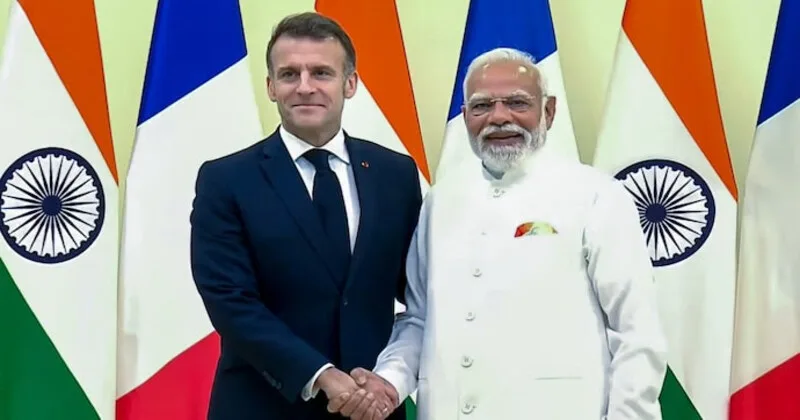
MUMBAI: Prime Minister Narendra Modi and French President Emmanuel Macron on February 17 announced over 20 agreements and outcomes spanning defence, skilling, technology cooperation, trade, and health after extensive bilateral discussions in Mumbai. The announcements came during Macron’s three-day official visit to India, focused on deepening strategic ties and expanding cooperation in emerging sectors, including artificial intelligence.
The two leaders underlined their shared vision for a stronger partnership, formally elevating bilateral relations to a Special Global Strategic Partnership. The move reflects what both sides described as a high level of trust, ambition, and long-term commitment to global stability.
A strategic partnership for uncertain times
Addressing a joint press conference in Mumbai, PM Modi said the world is currently passing through a period of uncertainty and stressed that the India–France relationship serves as “a force for global stability.” He described France as one of India’s oldest strategic partners and noted that, together with President Macron, both countries had infused their relationship with “unprecedented depth and energy.” “Based on this trust and shared vision, today we are establishing our relations as a Special Global Strategic Partnership,” Modi said.
A major highlight of the visit was the launch of the India–France Year of Innovation, which Modi described as a decisive step toward transforming a government-led strategic relationship into a people-centric collaboration. He said innovation thrives through cooperation, not isolation, and explained that the initiative aims to strengthen people-to-people links while connecting industries, startups, MSMEs, students, and researchers across defence, clean energy, space, and emerging technologies.
Speaking at the India-France Innovation Forum in Mumbai. https://t.co/i78YjmvrrL
— Narendra Modi (@narendramodi) February 17, 2026
As part of this innovation push, Modi announced the creation of several new institutions: the Indo-French Centre for AI in Health, the Indo-French Centre for Digital Science and Technology, and the National Centre of Excellence for Skilling in Aeronautics. He emphasised that these are not merely institutions but “future-building platforms” designed to nurture talent and accelerate joint technological progress.
President Macron, thanking Modi for the warm welcome on his fourth official visit to India, described the bilateral relationship as “truly remarkable and unique,” rooted in trust, openness, and ambition. He said both nations had agreed to elevate ties to reflect “complete faith in this relationship,” adding that India is among France’s most trusted global partners.
Modi also highlighted expanding cultural cooperation, announcing that India would soon open the Swami Vivekananda Cultural Centre in France. He further said both sides would collaborate on heritage projects such as the National Maritime Heritage Complex in Lothal, signalling a broader engagement that extends beyond economics and security.
Defence, innovation, and industrial collaboration
In a significant defence-industrial development, Modi and Macron virtually inaugurated the H125 helicopter Final Assembly Line at Vemagal in Karnataka, a joint venture between Airbus and Tata Advanced Systems. The facility will manufacture H125 Light Utility Helicopters in India. Modi said that India and France will together produce the world’s only helicopter capable of flying to the heights of Mount Everest, adding that the aircraft will also be exported globally. Calling France a “special partner,” he said the project reflects growing confidence in India’s manufacturing capabilities and marks a major step forward in defence cooperation.
The summit also comes days after India cleared a proposal to procure 114 Rafale fighter jets from France under a government-to-government framework, one of the largest military procurement programmes in recent years. Macron noted that defence cooperation is expanding across platforms, from fighter jets to submarines, reinforcing strategic trust between the two countries.
Highlighting broader geopolitical cooperation, Macron said India and France work closely in the Indo-Pacific and share common values such as respect for the rule of law and opposition to global hegemony. He also pointed to joint initiatives launched over the past eight years, including the International Solar Alliance, as examples of how both nations are addressing global challenges together. Modi echoed this sentiment, stating that the friendship between India and France “has no boundaries” and that their partnership can extend “from deep oceans to the tallest mountains.” He described the relationship as particularly important in today’s turbulent global environment, reiterating that it is anchored in mutual respect and shared strategic interests.
Trust, openness and ambition. pic.twitter.com/6J9k3W6kSu
— Emmanuel Macron (@EmmanuelMacron) February 17, 2026
High-level diplomacy and a forward-looking agenda
President Macron arrived in Mumbai for his three-day visit to India, accompanied by First Lady Brigitte Macron. They were received at the airport by Maharashtra Governor Acharya Devvrat and Chief Minister Devendra Fadnavis. The visit includes Macron’s participation in the AI Impact Summit 2026 as well as high-level bilateral meetings with Indian leadership. During the talks, both sides focused on boosting cooperation in trade, defence, energy, critical technologies, and artificial intelligence. Macron said the two countries also collaborate closely on connectivity and regional stability, adding that India plays a central role in France’s vision for a balanced and multipolar world.
Referring to the newly elevated Special Global Strategic Partnership, Macron said the decision reflects a shared belief in long-term cooperation and mutual reliability. He reaffirmed France’s commitment to supporting India’s development ambitions while expanding joint work in technology, innovation, and clean energy.
For his part, Modi stressed that the India–France partnership is evolving into a comprehensive alliance that combines strategic, economic, cultural, and people-to-people dimensions. He said the agreements signed in Mumbai represent tangible progress toward that goal, covering skilling, healthcare, digital science, aeronautics, and advanced manufacturing. As Macron concluded his remarks, he reiterated that India is one of France’s most dependable partners and praised the breadth of cooperation achieved during the visit. With more than 20 agreements announced and new institutional frameworks launched, both leaders signalled that the relationship is entering a new phase, one aimed not only at national development but also at contributing to global stability and prosperity.
The Mumbai summit, marked by major defence announcements, innovation initiatives, and a formal upgrade of ties, underscored the growing strategic convergence between India and France, setting the stage for deeper collaboration in the years ahead.