

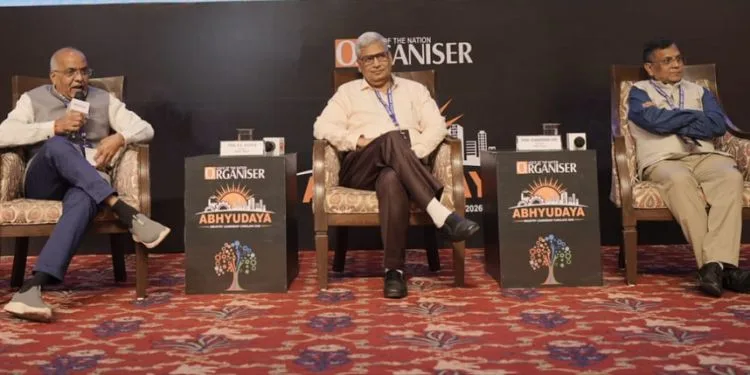
As India positions itself at the forefront of emerging technologies, senior academicians and institutional leaders have underlined a critical shift in the country’s innovation strategy — from basic research dominance to translational and industry-linked outcomes.
Speaking at Organiser’s Abhyudaya – Industry Leadership Conclave 2026, experts asserted that Bharat should no longer be described merely as a “developing country,” but as a “re-developing nation” reclaiming lost centuries of scientific and economic leadership. “We lost nearly eight hundred years, plus another two hundred. But today we are speaking of a New India,” Prof Gobardhan Das, IISER Director remarked, emphasizing resurgence through education and research.
Federation of Madhya Pradesh Chamber of Commerce & Industry (FMPCCI) President Deepak Sharma moderated the session.
According to Prof. K.K. Shukla, Director, MANIT, institutions perform strongly at early Technology Readiness Levels (TRL 1–4), where problems are conceptualized, simulated, and demonstrated in laboratories. However, he added that beyond TRL 4, institutions struggle due to gaps in the ecosystem and lack of industry support.
Academic excellence, now demands real-world delivery
Globally, Bharat ranks third in research publications and PhD production. However, panellists raised a pressing concern: how much of this research translates into real-world products and societal impact?
Progressing further requires a robust support system: MANIT Director KK Shukla
“We are very good at defining and designing problems. If we speak in terms of Technology Readiness Levels (TRL), we perform well at TRL 1 and 2. Most institutions are strong at this stage because we are effective at conceptualizing problems. We are also quite capable of developing those ideas further. Up to TRL 3 and 4, within laboratory settings, we perform competently.
But beyond that stage, we struggle. Progressing further requires a robust support system. The necessary innovation ecosystem is, to some extent, missing. We design the solution, we develop it, and we reach TRL 4. At that point, the process often stops. Typically, we publish a paper or file a patent—but we fail when it comes to “lab-to-land” transfer.”
The bottleneck lies in scaling and commercialisation. The cost of experimentation and deployment rises sharply at advanced stages, and most government-funded institutions lack sufficient industry backing to push innovations to market.
Industry–Academia Disconnect
Industry support in Bharat accounts for roughly 30 percent of research funding, significantly lower than in developed economies. Experts stressed that without stronger private-sector participation, lab-to-land transfer will remain limited.
“Industry often expects immediate returns. But without supporting fundamental science, long-term product innovation is impossible,” a Prof Gobardhan Das said, citing examples such as Thomas Edison’s early work on the electric bulb and Nobel laureate Katalin Karikó’s foundational RNA research that later enabled mRNA vaccines.
The discussion highlighted international models, including Taiwan, where universities maintain dedicated industry liaison offices and industry-sponsored research projects are common. “In Taiwan, even master’s projects were industry-funded. That ecosystem enables scaling,” a former visiting faculty member observed.
Shift Toward Translational Research
According to the experts, the government’s policy direction is now pushing institutions beyond “know why” and “know how”— emphasizing demonstrable implementation.
Reforms include:
– Industry-embedded academic units
– Mandatory one-year industry internships for students
– Recognition of technology transfer outcomes for PhD degrees, even without mandatory publication
– Sector-focused AI development under the national AI Mission
Under the Bharat’s AI Mission, the government is prioritising the development of indigenous AI models across four strategic sectors to drive inclusive and scalable growth. The major sectors where AI models are being developed are
- AI in agriculture
- AI in smart infra structure
- AI in manufacturing
- AI in Health care
According to KK Shukla, “Work has already begun in the AI field and said that Bharat will emerge as a leader in AI.”
Bharat is growing on both fronts—academia and industry: Prof Gobardhan Das, IISER Director
“If we look at the education sector today, there are more than 1,600 universities, around 8,850 engineering colleges, 22 IITs, 26 AIIMS institutions, approximately 855 medical colleges, and 7 IIMs. The scale is significant.
On the other side, if we look at the entrepreneurial ecosystem, I checked the data this morning: Bharat has around 159,000 startup companies, out of which 125 are unicorns. So Bharat is growing on both fronts—academia and industry.” IISER Director Prof Gobardhan Das said.
However, the key issue is connection. According to him, bridging the two sides is essential, as a gap still remains. Industry often expects immediate returns. At the same time, without fundamental research, products cannot emerge.
Speakers repeatedly emphasized the role of young innovators. “It begins with an eighteen-year-old entering a laboratory in an engineering college,” one academic said, pointing to battery storage technology as a decisive area for technological independence.
Rather than copying Western technologies, Bharat must build for itself and within itself, they argued. The country’s youth possess immense potential but require structured mentorship and institutional support.
“Our institutions have the capability. The focus earlier was on basic research. Now the time has come for synergistic engagement with industry and translational impact,” the panel concluded.
As Bharat expands both its research footprint and start-up ecosystem, the consensus was clear: bridging academia and industry is no longer optional. Without that bridge, innovation will remain confined to journals and patents. With it, Bharat could reclaim its position as a global leader in technology and production.