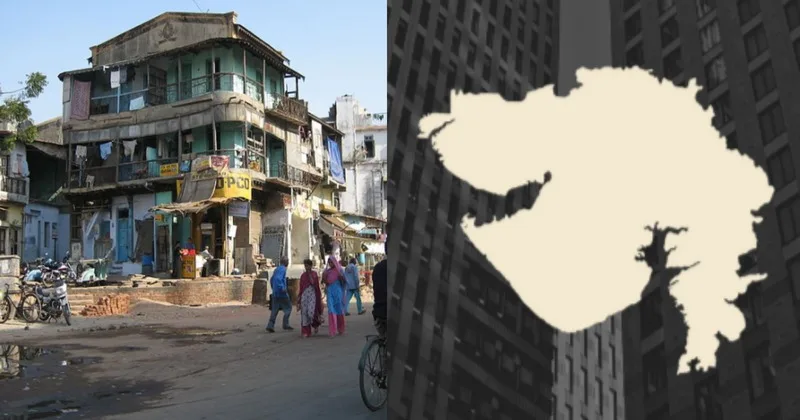
Vadodara: Protests broke out in the Gayatrinagar society in the Gorwa area of Vadodara district, Gujarat, on February 13 after two houses in the predominantly Hindu locality were allegedly sold to non-Hindus in violation of the Disturbed Areas Act, 1991.
Members of local Hindu organisations and a Sangharsh Samiti staged a demonstration and marched to the District Magistrate’s office, where they submitted a memorandum seeking strict enforcement of the Act. Protesters claimed that although the property owners initially stated the houses had been rented out, residents suspected that the properties had in fact been sold. They demanded a probe into the transactions and appropriate legal action if any violations were found. Residents also alleged that despite approaching the Municipal Commissioner earlier, no action had been taken.
What is the Disturbed Areas Act?
The Gujarat Prohibition of Transfer of Immovable Property and Provision for Protection of Tenants from Eviction from Premises in Disturbed Areas Act, 1991, commonly referred to as the Disturbed Areas Act, was enacted by the Gujarat government to regulate property transactions in communally sensitive areas and prevent demographic polarisation.
Under the law, both the seller and the buyer must obtain prior permission from the District Magistrate before completing any property transaction in a notified disturbed area. The District Magistrate examines whether the proposed sale is voluntary or the result of coercion, pressure, or inducement. If not satisfied with the circumstances, the authority has the power to refuse permission for the transaction.
The Act was brought in against the backdrop of recurring communal tensions in parts of Gujarat during the 1980s. During this period, several incidents of communal violence were reported in cities such as Ahmedabad, Vadodara, Kheda, Bharuch, and Surat. These clashes led to large-scale displacement and distress sales of properties in communally sensitive areas.
In response to the unrest and concerns about forced or distress-driven property transfers, the Gujarat government first enacted the Disturbed Areas law in 1986 to regulate property transactions in identified sensitive zones. However, due to certain shortcomings, the legislation was repealed and re-enacted as the Gujarat Disturbed Areas Act, 1991. The revised law empowered the state government to officially notify specific localities as “disturbed areas,” where property transfers would require prior administrative approval to prevent exploitation and maintain public order.
In 2019, significant amendments were introduced to the Gujarat Disturbed Areas Act, which received Presidential assent in 2020. These changes expanded the powers of the District Magistrate, enabling the authority to examine not only coercion or inducement in property transactions but also factors such as potential polarisation, unfair clustering, and demographic shifts linked to a proposed sale.
However, in January 2021, the Gujarat High Court stayed the amended provisions after petitions were filed by several Islamic organisations, including the Jamiat Ulema-e-Hind. In 2023, the state government withdrew the 2019 amendments. As a result, the original 1991 version of the law currently remains in force.
When is an area declared ‘disturbed’?
Under Section 3 of the Act, an area can be declared a “disturbed area” by the state government based on reports submitted by the District Magistrate and the police authorities. The formal notification is issued by the state government. Factors such as communal tension, riots, violence, or a history of communal imbalance are considered while making this determination.
Following the 2002 riots, several localities in Ahmedabad—including Juhapura, Sarkhej, and Gomtipur—were notified as disturbed areas to regulate property transactions and prevent distress sales. Such a notification remains valid for five years from its publication in the state gazette and may be extended further depending on prevailing conditions.
Under the Act, any transfer of property in a notified disturbed area carried out without prior approval from the District Magistrate is deemed invalid. Before granting permission, the District Magistrate scrutinises the applications and affidavits submitted by both the buyer and the seller, along with police reports, statements from neighbours, and relevant Revenue Department records.
The additional grounds introduced through the 2019 amendment—such as “impairment of demographic balance” and “unfair grouping”—are currently not applicable due to the stay imposed by the Gujarat High Court. As a result, decisions must be based solely on the provisions of the 1991 Act. State government rehabilitation schemes are exempt from the law, allowing property transfers in cases involving resettlement or rehabilitation of persons displaced by violence.
The Disturbed Areas Act is operational in multiple districts across Gujarat, with the list of notified areas periodically updated by the state government. Several localities in Ahmedabad, Vadodara, Surat, Bharuch, Panchmahal, Anand, Narmada, Godhra, Bhavnagar and Amreli are covered under its provisions.
In Ahmedabad city, areas such as Juhapura, Meghaninagar, Odhav, Gomtipur, Danilimda, and Sarkhej-Jamalpur-Kankaria fall within the notified zones. More recently, localities including Vastrapur, Thaltej, and Bodakdev in western Ahmedabad were added through a public notification. The Act is also in force in parts of Surat, Vadodara, and Anand districts, and its implementation in Anand city and certain adjoining areas has recently been extended for another five years.
The law’s implementation is overseen by government authorities, including the District Magistrate, the Police Commissioner or Superintendent of Police, and officials from the Revenue Department. Areas are formally notified by the state government, and currently, around 1,000 localities across Gujarat fall under the Act. All property transactions in these notified areas require prior approval from the District Magistrate.