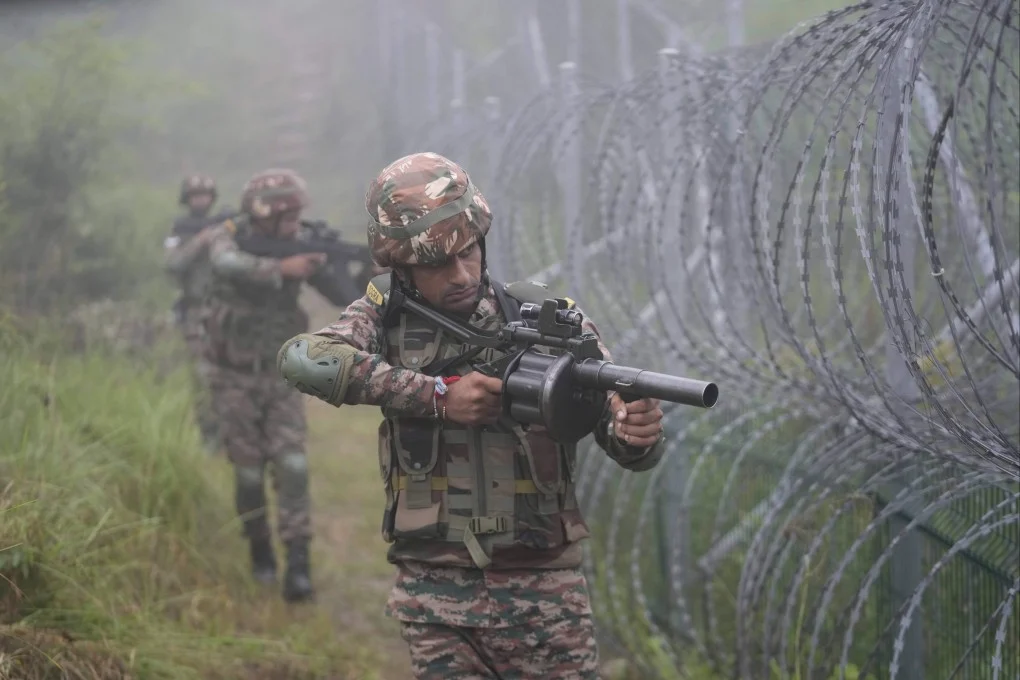
New Delhi: On the occasion of Mahashivratri, the Indian Army unveiled a high-production short film titled Bhairav, spotlighting its newly raised Bhairav Light Commando Battalions and their rapid-response combat role.
The film was launched as part of the Army’s ongoing digital outreach initiative, Shadows and Steel. The timing of the release on Mahashivratri carries deep cultural resonance. In Hindu tradition, Bhairav is a fierce manifestation of Lord Shiva, a guardian and destroyer of evil, representing both protection and retribution.
By invoking this imagery, the Army appears to position the Bhairav Battalions as a modern embodiment of that archetype: unseen, restrained, but capable of swift and decisive action when required.
The short film combines dramatic visuals, battlefield imagery and a powerful poetic narrative that elevates the unit’s identity beyond conventional military symbolism.
A poetic narrative of deterrence
At the heart of the film lies a stirring poem that portrays Bhairav commandos not merely as soldiers, but as an inevitable force. One striking line declares, “Main ant ka aarambh hoon” (I am the beginning of the end), suggesting that by the time the unit is visibly deployed, the process of reckoning may already have begun — possibly deep within hostile terrain.
Another evocative line, “Main deh nahi, parinaam hoon” (I am not a body, but the consequence), reinforces the idea of invisible operators whose physical presence may remain concealed, but whose impact is unmistakable and final.
The narrative deliberately moves beyond conventional notions of defence toward the concept of deterrence. Through imagery of silence before a storm, the film highlights stealth, patience and sudden overwhelming force, the defining attributes of these new formations.
The Bhairav Light Commando Battalions
The Bhairav Light Commando Battalions represent a significant structural evolution within the Indian Army. Named after the warrior form of Shiva, these units are designed to be compact, agile and mission-ready at short notice.
Each battalion comprises approximately 250 troops, striking a balance between mobility and operational flexibility. Unlike conventional infantry formations, which may require larger logistical footprints, the Bhairav units are structured for rapid deployment and independent action.
At the same time, they retain broader operational scope than highly specialised elite formations, positioning them as a versatile instrument in sensitive and high-risk theatres.
These battalions have been strategically positioned in regions of operational importance, including Ladakh, Jammu and Kashmir, and Rajasthan, areas that demand constant vigilance and readiness due to their proximity to international borders.
“Fight Tonight” Doctrine
Military sources describe the Bhairav Battalions as embodying a “fight tonight” approach, a doctrine that prioritises immediate operational readiness and swift retaliation capabilities.
Under this framework, units are prepared to launch independent missions at very short notice, without the prolonged mobilisation cycles traditionally associated with large-scale formations.
The restructuring and raising of these battalions come in the broader context of post-Operation Sindoor reforms within the Army. These changes aim to recalibrate force posture in response to evolving security dynamics, hybrid warfare threats and the need for rapid, technology-driven operations.
The Bhairav troops were first publicly seen earlier this year during the Army Day and Republic Day parades, where they appeared in distinctive combat gear, drawing considerable attention.
The release of the Bhairav film builds on that visibility, taking the formation’s introduction beyond ceremonial display into the realm of narrative projection.
Through initiatives like Shadows and Steel, the Army is recalibrating how it communicates with the public — particularly younger, digitally native audiences. High-production visual storytelling, cinematic sound design and symbolic messaging are increasingly becoming part of its outreach strategy.
Beyond domestic audiences, the film may also serve as a subtle signal to adversaries. The emphasis on stealth, unpredictability and swift consequence reinforces the message that India’s military posture is evolving to meet emerging threats with agility.
The unveiling of Bhairav on Mahashivratri thus represents more than a ceremonial tribute. It marks the public articulation of a broader transformation within the Indian Army’s operational philosophy.
As the Army continues to modernise its capabilities and refine its communication strategy, the Bhairav initiative stands as a symbol of that transition, blending tradition, deterrence and digital-era storytelling.