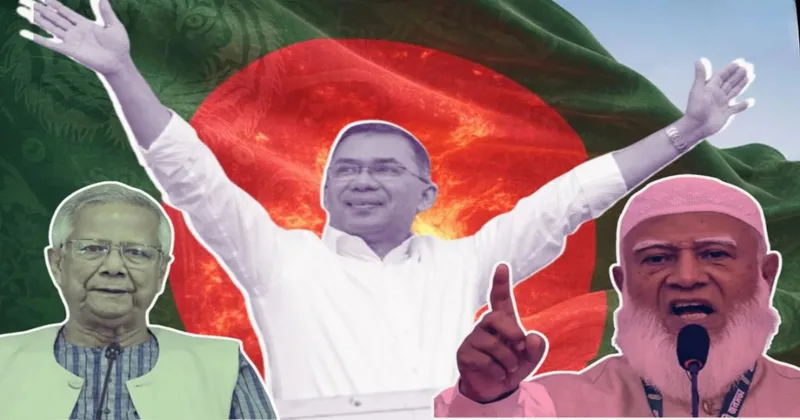
The elections said to be the most consequential in the political history of Bangladesh have been concluded and the Bangladesh Nationalist Party(BNP) has scripted a sliding victory by breaching the benchmark of 150 seats. Out of the 350 parliamentary seats, the BNP has easily achieved more than 200 seats, thus winning a clear majority and defeating the key opponent Jamaat-e-Islami led coalition. Deciphering the Bangladesh election results, thus reveal key attributes regarding the political and public mood in the country. The preferences of the voters reflect key details and determining factors underlining the current political landscape of Bangladesh and the nature of the future political course can also be analysed.
Preference for centrist ideology prevails over radicalism
As per the political analysts and geopolitical observers the decisive victory etched by the Bangladesh Nationalist Party(BNP) in the elections sends a clear message regarding the voter preferences. The Awami League political party, the party of the ousted Prime Minister Sheikh Hasina was barred from contesting the elections by the Muhummad Yunus led interim regime. Henceforth, BNP and Jamaat-e-Islami were two key parties contesting the Bangladesh national elections. The people have rendered their clear preference by choosing BNP over Jamaat-e-Islami.
This echoes the message that the people of Bangladesh prefer centrist ideology over radical Islam. Despite a decisive campaigning by the Jamaat and the assurance for a democratic, inclusive and peaceful Bangladesh, the people have preferred the centrist BNP ideology rather than the radical Jamaat ideology. The Jamaat-e-Islami led coalition spoke about dismantling from its radical character and working for the progress of Bangladesh. However, this didn’t yield any tangible results. This clearly illustrates the fact that the people of Bangladesh prefer and vote for non-radical ideologies. Henceforth, the election results can also act as a little hope in the path of protecting minority Hindu rights in Bangladesh, which is currently at the mercy of radical elements.
The gradual rise of Jamaat-e-Islami in Bangladesh politics
Though the Jamaat-e-Islami has lost the elections against the BNP wave, the political course for the party has not completely faded. They are gradually rising as a prominent and detrimental stakeholder in the political landscape of Bangladesh by winning a remarkable 70 seats. Numbers claim that though Jamaat has lost the current elections, there is a probability that they will emerge as a strong contender in the long-run. Under the present circumstances, Jamaat has not been able to successfully capture the secular voter base of Bangladesh. However, their vote base has been drastically increased compared to previous elections.
It has doubled its seat share and as per the political analysts it will further build on this momentum in the current years to emerge as the dominant party of Bangladesh and will seek to occupy the power corridors of Dhaka. However, will Jamaat, dismantle itself from its radical era and work for a democratic, secular and inclusive Bangladesh consistently is an enigma. Jamaat, in its coalition also includes the NCP, the newly formed political party which comprises the students and other activists who led the August 2024 mass uprising that led to the topple of Sheikh Hasina regime. Thus, the future course of Jamaat and how they will make a strong footprint in the political mainstream of Bangladesh, is being keenly watched.
Women voters act as the silent architects of election results
As huge debates surrounding the Bangladesh elections and intense face-off between BNP and Jamaat hit headlines, as per the political experts, women voters have acted as the silent architects in determining the election results. The women population of Bangladesh comprise the key workforce in the textile and other industries of the country. Their votes do matter to a major extent. They have thus clearly chosen the comparatively secular BNP over Jamaat-e-Islami.
They have ensured that Jamaat and other radical elements stay away from power. Women voters have reiterated BNP is a preferable alternative to Awami League and as per the analysts, it appears that the women population have voted overwhelmingly against the Jamaat. The women voters of Bangladesh, thus have acted as the silent sailors of the political course of Bangladesh. Will their decision reduce the radical elements and other atrocities in the country, which is entangled in a deep security crisis under the Yunus regime that has to be awaited.
Muhammad Yunus fades from political focus of Dhaka
The Bangladesh election results and the re-emergence of BNP to the political mainstream of the country echoes one message with clarity. The political future and the hegemonic ambitions of Muhammad Yunus, the Chief Advisor of the interim government back slides and fades in history. The people of Bangladesh, have indeed not appreciated the political experiments of Yunus. His failed policies have been debunked by the very people of Bangladesh. The political career of Muhammad Yunus seems to have no future, as BNP resurfaces to power. Also, the radical elements, foreign forces, western liberal NGOs and other alien powers who backed the Yunus regime and all the atrocities surrounding it in Bangladesh, now fades.
Since the ouster of Hasina regime and the takeover by the interim government under Muhammad Yunsu as its Chief Advisor, Bangladesh has witnessed nothing other than security crisis, law & order chaos, severe political instability, deep economic bankruptcy and the unbridled rise of the radical elements. The rights and safety of Hindus and other minority communities fell apart with targeted attacks, murder, torching of houses etc. With no concrete action from the Yunus government, violence against the minority community spiked to the peak with no crackdown. Under the Yunus administration, Bangladesh lost its secular fabric and economic growth momentum. The Yunus experiment in Bangladesh thus is a failed phenomenon, which is debunked by the people of the country. This is clearly reflected in the election results.
The BNP victory and the future of bilateral ties with India
Another pivotal facet in the Bangladesh election results, is deciphering the Delhi-Dhaka relations. Under the Yunus regime, the bilateral ties between India and Bangladesh had hit rock bottom. The diplomatic partnership completely froze and Dhaka turned towards Pakistan, thus posing a major national security challenge to New Delhi. The bilateral trade halted and political bonhomie weakened severely. The Yunus government instead targeted India with radical statements that harmed the sovereignty and territorial integrity of India, especially pertaining to the Northeastern region of the country.
During Sheikh Hasina rule, Delhi-Dhaka bilateral relations were a testament to good neighbourhood ties. However, under Yunus regime, the scenario was completely altered. Atrocities escalated on the minority Hindu community in Bangladesh, with no concrete action from the interim administration. Will the new BNP rule in Dhaka thus make a genuine effort to rebuild the ties with India, as per the political analysts only time can answer this question. During the earlier era of BNP from 2001-2006, the relations between New Delhi and Dhaka had many irritants and were not on a high note. Will the Tarique Rahman led BNP, rectify its past errors and proceed with India with good neighbourhood policy for the benifit of both the nations and the larger geopolitical region, has to be seen!