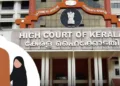


The High Court of Kerala has ordered a forensic test for Sabarimala Gold Plunder Probe. The High Court, on February 11, permitted specialised metallurgical testing of temple gold structures as part of the current Special Investigation Team probe. Court has separately directed a vigilance enquiry into the alleged discrepancies in gold accounting in connection with the Sabarimala temple flag mast installation.
The High Court directed advanced scientific and metallurgical examination of the gold-plated temple structures at Sabarimala. It was part of a court-mentioned investigation. It was in connection with the allegations of the removal and substitution of the original cladding of the new temple flag mast in 2017. The Court was hearing a suo motu Writ petition with respect to the allegations concerning the loot of gold from the gold-clad Dwarapalakas and allied structures at Sabarimala shrine.
The Division Bench reviewed the status of the investigation being run by a Special Investigation Team (SIT). Its senior officers appeared before the Court and briefed it on the progress of the investigation. The SIT informed the High Court that 262 witnesses had been examined; their statements were recorded. Endeavours are in progress to obtain historic call data records of certain accused persons and forensic analysis of digital materials seized during the investigation. Specimens of handwriting and signatures of the accused have been forwarded for expert comparison.
Simultaneously, scientific examination of the Dwarapalaka idols, which underwent gold plating in 2025, is in progress. The idea is to determine the material alterations.
According to the SIT, the investigation covered the events from 1998 to 2025; it is structured into four phases. The documentary materials collected in the first phase established that the original gold cladding of the sanctum sanctorum and related structures had been undertaken by a private entity.
The second phase was concerning the 2019 replacement of the door of the sanctum sanctorum with a gold-plated door.
The third phase was on allegations that original gold cladding from the Dwarapalakas and allied plates was removed and replaced with thinner plating to hide misappropriation. Sufficient oral evidence has been collected in this regard.
SIT proposed advanced scientific testing to determine the extent and nature of any metallurgical manipulation. They were specialised tests including X-Ray Fluorescence Spectroscopy, Inductively Coupled Plasma Mass Spectrometry and Optical Emission Spectroscopy. According to officers, these techniques would enable elemental profiling, alloy comparison, and trace mapping to establish whether substitution or dilution of gold had occurred.
The Court accepted the submission stating that the evidence was essential. Court observed that the allegations involving the removal of the precious gold from the temple structures could not rest solely on testimonial or documentary material. It also required objective scientific verification; it may withstand judicial scrutiny. The Bench noted that advanced metallurgical testing would allow accurate determination of alteration, quantification of material loss, and correlation of timelines.
The required facilities are not available in Kerala. Therefore, the SIT proposed to approach national research institutions, including the Bhabha Atomic Research Centre (BARC), National Metallurgical Laboratory, and Defence Metallurgical Research Laboratory. The Court granted permission to collect representative specimens from the shrine under controlled conditions. It directed the SIT to report on sampling and testing arrangements.
The bench stated, they were therefore satisfied that such advanced forensic and metallurgical examination is absolutely essential; the results thereof would constitute a strong base upon which the prosecution case must rest so as to establish the allegations in a clear, cogent, and legally sustainable manner.
Temple Flag Mast Issue
During the proceedings, the Court also considered a separate complaint. It alleged misappropriation of gold and cash in connection with the installation of a new temple flag mast in 2017. Preliminary records placed before the Court indicated that gold purchased from Customs and also donations from devotees were utilised for the project, but discrepancies existed in accounting and documentation. The Court noted that while mahazars recorded entrustment of gold donations, individual sealed receipts mandated under Devaswom procedures were absent. It made verification of donor contributions difficult. Officers submitted that this constituted a serious procedural lapse hence it required detailed enquiry, including examination of donors and financial records. The bench stated, they view that it may not be proper to entrust the investigation, relating to the alleged misappropriation of gold connected with the temple flag mast, to the SIT.
The SIT is presently engaged in investigating other serious offences pursuant to their earlier directions. The Bench stated while observing that the matter requires an independent vigilance enquiry.
Accordingly, the Court directed the Director – Vigilance and Anti-Corruption Bureau, to conduct an independent preliminary enquiry. All relevant records relating to the flag mast installation are to be forwarded to the Vigilance Bureau. It must constitute a team to examine materials, record donor statements, and submit a report within 30 days.
Directions
The Court permitted the SIT to collect samples for scientific examination. It directed the listing of the matter for progress reporting. It further ordered that Vigilance authorities undertake an independent enquiry into the flag mast gold accounting issue and submit the findings before the Court. The investigating officers were directed to remain personally present on the next hearing date. The matter has been listed again on February 19, 2026.