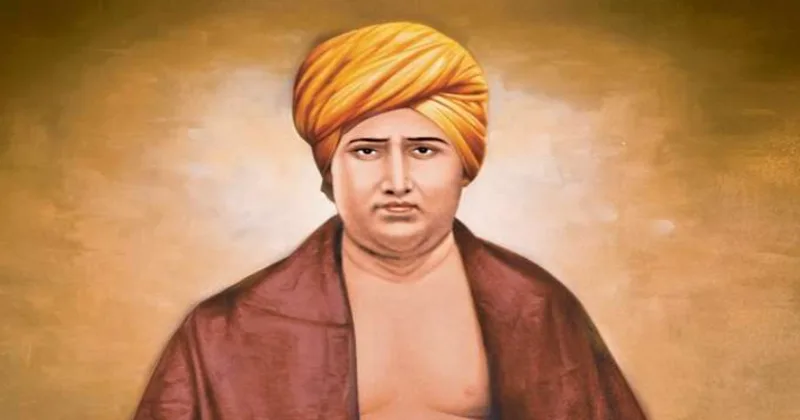
Swami Dayanand Saraswati was born as Mool Shankar Tiwari in 1824 in Tankara, Gujarat, into a deeply religious Brahmin family. His father was a devout Shaivite who ensured Mool Shankar received a traditional education in Sanskrit, the Vedas, and Hindu philosophy. A turning point in his life came during a Shivratri vigil, when he observed a mouse climbing over the idol of Bhagwan Shiva. This incident led him to question idol worship and the prevailing religious practices. Overwhelmed by existential questions about life, death, and truth—especially after the death of close family members—he renounced household life and became a sanyasi in search of true knowledge.
Education and Philosophical Foundations
Swami Dayanand spent many years wandering across India, engaging with scholars and religious leaders. His most significant intellectual influence was Swami Virajanand, a blind but brilliant Vedic scholar of Mathura. Under his guidance, Dayanand mastered the Vedas and resolved to dedicate his life to restoring their true meaning. He firmly believed that the Vedas are the infallible source of knowledge, promoting reason, morality, equality, and scientific thinking. He rejected later texts and practices that contradicted Vedic principles, emphasising rational inquiry over blind faith.
Founding of Arya Samaj
In 1875, Swami Dayanand founded the Arya Samaj in Bombay. The organisation aimed at moral, social, and religious reform based on Vedic ideals. Its core principles included:
Belief in one formless, Omnipotent God, Authority of the Vedas.
Rejection of idol worship and superstition, Promotion of truth, rationality, and ethical living, Social equality and justice
Arya Samaj became a dynamic force for reform, spreading rapidly across northern India and beyond. Social Reforms and Progressive Vision. Swami Dayanand was far ahead of his time in advocating social equality and justice. His major reformist ideas included: opposition to caste by birth; support for caste based on merit and occupation; strong support for women’s education, widow remarriage, and gender equality.
Condemnation of child marriage, untouchability, and sati, Promotion of education in Indian languages. He emphasised that women had equal rights to education and spiritual knowledge, citing Vedic references to support his views.
Teachings of Swami Dayanand Saraswati Ji
Swami Dayanand Saraswati (1824–1883) was one of the greatest religious and social reformers of modern India. His teachings were rooted in the Vedas and aimed at reforming Indian society by promoting truth, reason, equality, and moral living. His ideas laid the foundation for religious revival and social transformation.
Authority of the Vedas
Swami Dayanand believed that the Vedas are the supreme and infallible source of knowledge. According to him, the Vedas contain eternal truths related to religion, science, morality, and social order. He strongly advocated the slogan “Back to the Vedas.”
Concept of One Formless God
He taught that there is only one God, who is formless, omnipotent, omniscient, and eternal. He rejected idol worship, rituals, and superstitions, emphasising devotion through knowledge, prayer, and righteous conduct.
Importance of Reason and Rational Thinking
Swami Dayanand encouraged the use of logic and reason in religious matters. He opposed blind faith and believed that religion should be understood through critical thinking and evidence.
Social Equality and Justice
He strongly opposed caste discrimination based on birth. According to him, caste should be determined by one’s qualities, actions, and profession, not by birth. He also condemned untouchability and social injustice.
Women Empowerment
Swami Dayanand was a strong supporter of women’s rights. He advocated women’s education, widow remarriage, and equality of men and women in social and religious life. He opposed child marriage and supported women’s access to Vedic education.
Education for National Progress
He emphasised the importance of education for social reform and national development. He supported education in Sanskrit and Indian languages along with modern scientific knowledge. Though he lived before the freedom struggle gained momentum, his teachings inspired nationalism. He encouraged pride in Indian culture and self-reliance, which later influenced leaders of the freedom movement.
Moral and Ethical Living
According to Swami Dayanand, truthfulness, honesty, self-discipline, and service to humanity are essential for a meaningful life. He believed that individual character building leads to national progress.
The teachings of Swami Dayanand Saraswati remain relevant even today. His emphasis on truth, rationality, social equality, education, and moral values continues to inspire individuals and institutions. He played a crucial role in shaping modern Indian society.