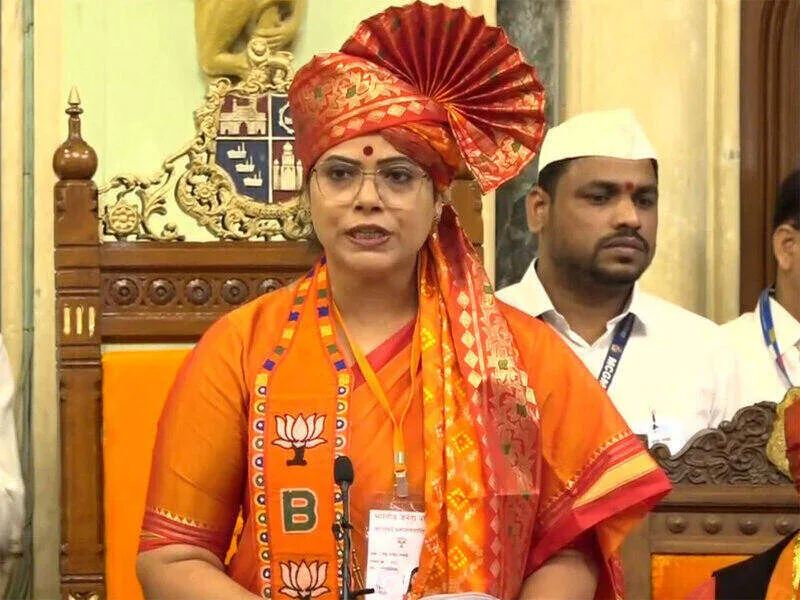
Mumbai: In a landmark moment for the Bharatiya Janata Party (BJP) in Maharashtra, senior corporator Ritu Tawde has been elected as the Mayor of Mumbai. With her appointment, Tawde becomes the second BJP leader to occupy the mayor’s office and the first woman from the party to do so in the Brihanmumbai Municipal Corporation (BMC).
Her elevation to the top civic post comes after a steady political journey marked by grassroots engagement and administrative experience within the municipal framework.
Political Journey in BMC
Ritu Tawde first entered Mumbai’s civic politics in 2012 when she was elected as a corporator from Ward No. 127. Her debut term established her as an active representative in local governance.
In 2017, she was re-elected from Ward No. 121 in Ghatkopar, consolidating her presence in the BMC and strengthening her political base in Mumbai’s eastern suburbs.
In the latest civic elections held on January 15, Tawde secured victory from Ward No. 132, further reinforcing her position within the municipal corporation and emerging as a key face in the BJP’s urban leadership.
Administrative experience and leadership role
Apart from her tenure as corporator, Tawde has also served as the Chairperson of the Education Committee of the Mumbai Municipal Corporation. In this role, she handled crucial civic matters related to municipal schools, policy decisions, and administrative oversight.
Party leaders and colleagues have described her as an experienced administrator with strong grassroots connections, qualities that reportedly made her a strong contender for the mayoral position.
Significance of the appointment
The BMC, regarded as the country’s richest civic body, plays a critical role in managing Mumbai’s infrastructure, public health systems, education, urban planning, and civic amenities. Tawde’s appointment is being seen as a significant political development in Maharashtra’s municipal landscape.
Her elevation also reflects the BJP’s attempt to strengthen its leadership footprint in Mumbai’s civic administration, particularly through women leadership in key posts.
With Tawde at the helm, attention will now turn to how the new Mayor steers Mumbai’s governance agenda amid ongoing infrastructure expansion, environmental challenges, and urban development priorities.
The BMC election
The BMC elections, held on January 15, 2026, marked a major shift in the city’s urban political landscape. The elections took place for all 227 wards of the BMC, Asia’s richest civic body, with a voter turnout of 52.94 percent.
In the run-up to the polls, the BJP and the Eknath Shinde-led Shiv Sena stitched a pre-poll seat-sharing agreement under the Mahayuti alliance. Under this arrangement, the BJP contested the larger share of seats while the Shiv Sena (Shinde faction) contested the rest, together aiming to cross the majority mark of 114 seats required to control the civic body.
The results, declared on January 16, resulted in a decisive victory for the BJP-Shiv Sena (Shinde) alliance, which won a combined 118 seats, comfortably above the majority threshold. The BJP emerged as the single largest party with 89 seats, while its ally, the Shinde faction of Shiv Sena, secured 29 seats.
On the opposition front, Uddhav Thackeray’s Shiv Sena (UBT) secured 65 seats, making it the principal opposition force in the BMC. Other parties won smaller numbers of seats: the Congress secured 24 seats, AIMIM won 8, MNS got 6 and various smaller parties including split NCP factions captured a handful more.
The Mahayuti’s victory changed nearly three decades of control by the undivided Shiv Sena in the BMC and showed a broader political realignment in Mumbai, with the BJP emerging as the dominant urban political force.