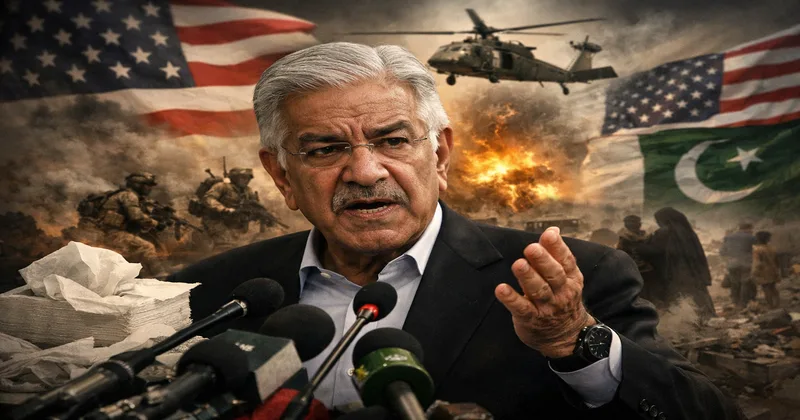
Pakistan’s Defence Minister Khawaja Asif has told parliament the country was “used and discarded” after backing the United States in the Afghan wars. He described Pakistan’s involvement as a mistake that led to long-term violence, radicalisation and economic strain after the US withdrawal.
Taking a moralistic posture, Asif accused the US of killing at least 10 to 12 crores during the past 25 or 30 years. He said that one only needs to look at the wars being fought during the regimes of a few US Presidents. He was alluding to the US war against Iraq waged on false allegations of Weapons of Mass Destruction (WMDs), in Libya and in Afghanistan, which led to the deaths of millions of Muslims.
In a rare candid admission, Asif said terrorism in Pakistan is a “blowback” from its past policies. He urged the country to acknowledge its history and the lasting impact of decisions made during the periods of rule by General Zia ul Haq and General Pervez Musharraf, two dictators, as he put it, who ruled the country at different times.
Love-Hate Ties
The statement broadly indicates that Pakistan may once again be at odds with the United States, a relationship that had seen some upswing during Donald Trump’s second term. Mainly due to the sycophancy displayed by Pakistan Prime Minister Shehbaz Sharif in a rather cringing manner. He had backed President Trump’s demand that he be conferred the Nobel Peace Prize.
The fact is that Pakistan loves the US money, technology and armaments but hates its policies. Incidentally, the US is the country most powerful Pakistanis want to settle in. Many of its former military officials, who did the US’s bidding while in service, are today settled in different parts of the country, rewarded for serving US interests.
The alignment with the US has enabled Pakistan to get armaments for free. These arms, like Patton tanks, Sabre jets, and F-16s, have been used by Pakistan for waging wars against India. In 1965, Pakistan was aligned with the US and received millions of dollars of aid, as well as military equipment.
PM Shehbaz Sharif had also gone along with Trump’s claims regarding the stoppage of the war between India and Pakistan that had started on May 6/7. India had strongly denied that Trump had anything to do with the ceasefire. Instead, it was a desperate call from Pakistan DGMO to his Indian counterpart, Lieutenant General Rajiv Ghai, that had led to a halt in hostilities, India had said.
Last year, Islamabad and Washington appeared to rediscover strategic alignment under US President Donald Trump. This apparent improvement in ties was marked by high-profile meetings, including that between President Trump and Pakistan’s most powerful military commander, Field Marshall Asim Munir. Later, Pakistan PM Shehbaz Sharif met Mr Trump, along with Munir, to show him some critical minerals extracted from mines in Balochistan. The duo had met a strong pitch for US investments in the mining business in the violent Pakistani province, and the US seemed to go along.
The economic initiatives between the two nations also included some decisions regarding cryptocurrency, which may have benefited Mr Trump and his family personally. However, by the beginning of this month, February 2026, the relationship already seems rocky. Going by the intervention from Pakistan’s Defence Minister Khawaja Asif in a debate pertaining to terrorism in Pakistan. The context was last Friday’s suicide bomb blast in a Shia mosque in Islamabad during prayers.
Old Wounds Reopened?
Khwaja Asif’s statement, sharply worded, has served to reopen old wounds about the costs of past alliances with Washington. His language and choice of words can sure be called colourful and direct. Speaking in Urdu, Khwaja Asif said: “We have been used and discarded like a tissue paper. Not tissue paper actually. It is more like a toilet paper, by the US. But despite that, we have learnt nothing from this. Bill Clinton was here in Islamabad for barely two hours and those in power at that time started celebrating big time. They (the US) then abandoned us but that failed to teach us any lessons.
“Due to all this, our relationship with neighbouring Afghanistan was defined. In at least two major wars waged on Afghan soil, we sided with the US. Once in the 1980s, when the Soviet Union was in Afghanistan, and later after the 9/11 bombings of the twin towers in the US. The Soviets had come to Afghanistan on the invitation of the government that was in power in Afghanistan at that time. This was not an invasion as falsely claimed, as the government of the day had asked the Soviet Union to intervene. The invasion is a theory given by the Americans.’’
He added that Pakistan did not participate in these wars in Afghanistan because of any love for Islam or jihad, as is made out. The fact is that the two dictators (General Zia ul Haq and General Pervez Musharraf) neededthe legitimacy and support of a superpower. They got it by siding with the US. “One should be very clear about the basic reasons for siding with the US. It was not jihad. There was nothing like jihad or love for Islam that made Pakistan of the day side with the US. We went so far as to change the curriculum taught in our schools. We have not been able to correct that curriculum to date. It is not the curriculum that many of you and I studied in the 1960s and 19702 when we were students.’’ Khwaja Asif said.
He was less than economical with the truth, as the alignment with the US has emboldened it to nurse animosity toward its eastern neighbour, India. This alignment also emboldened it to foster terrorism in India, as it has been secure in the knowledge that the US will protect it from retaliation by India. These tactical and strategic calculations, which have been the compass for Pakistan’s policies, were nowhere in Khwaja Asif’s speech. It was an out-and-out indictment of the policies pursued by Pakistan’s military generals.
Religious Hatred
He added that the religious ethos of Pakistan and, at a micro level, the treatment of people from all faiths had changed. They were changed because we (Pakistanis) were fighting a “Made in America Jihad’’ and it had to fit in with the US narrative. The government that came to power after the 1999 military coup was very desperate to secure US endorsement. Hillary Clinton made a speech at the UN where she described in detail how the US used Pakistan in its wars. If we take into account the terms of the past few US Presidents, we find that they have killed 10 to 12 crore Muslims. They did not spare even Libyan leader Muammar Gaddafi’s son,’’ he said.
We (Pakistan) look for sponsors outside the country, but the need of the hour is that we start loving this land and look within to stand on our own two feet. We follow the Arabic kafala system here, but our kafeels should be here in Pakistan only, not outsiders, he said. Incidentally, the kafala sponsorship system originates from the Arabic word kafala, meaning to take care of or protect. A kafeel is a guardian or a patron, embodying dependability and responsibility.
In Gulf countries like Saudi Arabia, a kafeel is the Arabic sponsor (not very different from a virtual owner) of an expatriate Pakistani or Bangladeshi worker. In much the same manner, Khwaja said, the US has acted as a kafeel of its country, responsible for its policies. The relationship between a kafeel and the person being sponsored is that of master and servant. In the context of Pakistan’s relationship with the US, the latter is the kafeel (owner and sponsor) and the former (Pakistani state) a servant or subsidiary, Khwaja Asif said.
Master Servant Relations
It is unfortunate that Pakistan keeps on looking for kafeels (owner sponsors) all the time. “In this pursuit of kafeels, we sometimes go to the US, sometimes to Russia and at other times to Britain. We lack independent policies and perspectives or a world view,’’ he added.
“We deny our history and do not accept our mistakes. Terrorism is a blowback of the mistakes committed by dictators in the past. The losses we have suffered can never be compensated,” Asif added, calling Pakistan’s mistakes ‘irreversible’ policy changes, the consequences of which it will have to bear for the coming decades.