BHUBANESWAR: The Odisha government has revised its surrender and rehabilitation policy for Maoists, introducing stricter eligibility criteria to ensure that benefits are extended only to genuine cadres with operational links to the state. The move marks a shift from the broader framework announced on 27 November 2025.
According to a Home Department notification, Maoists whose activities are not connected to Odisha will no longer be eligible for benefits under the scheme. However, Maoists from any state who are active within Odisha can avail themselves of the policy. Odia natives involved in Maoist activities outside the state may also surrender under the scheme, provided their involvement is certified by the concerned Superintendent of Police, and a no-objection certificate (NOC) is obtained from the state where they were active, confirming that rehabilitation benefits have not already been granted there.
Officials said the earlier policy lacked clearly defined eligibility criteria and risked misuse by cadres from neighbouring states seeking higher financial incentives. Odisha’s package offers a flat 10 per cent higher bounty than Chhattisgarh’s, raising concerns that it could become a magnet for rebels with no operational presence in the state.
“The absence of robust eligibility criteria risked turning the programme into a reward mechanism rather than a genuine de-radicalisation effort,” a senior official said, adding that the revised guidelines aim to ensure that only those genuinely involved in Maoist activities within Odisha benefit from the scheme.
Under the policy revised in November, surrendered Maoists are categorised into Category A (higher-ranked members) and Category B (middle- and lower-ranked cadres). Financial assistance ranges from ₹5 lakh for Category A and Rs 2.5 lakh for Category B. Additional incentives are provided for surrendering weapons, including Rs 4.95 lakh for a light machine gun and Rs 55 per round of ammunition.
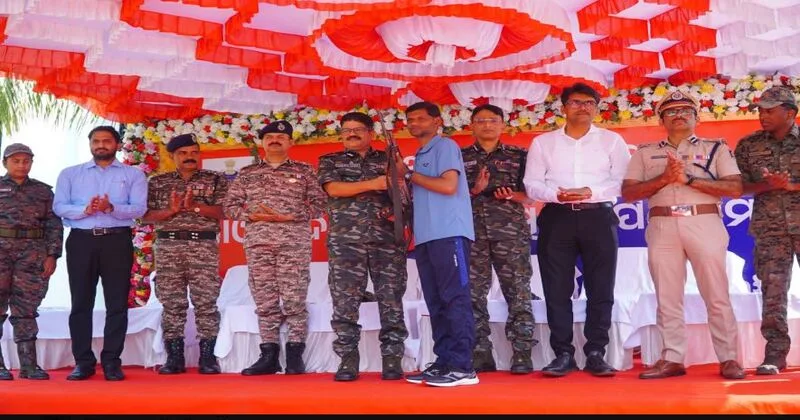
Since the launch of the revised policy, at least 45 Maoists have surrendered, making them eligible for benefits worth approximately Rs 6.5 crore. Of this amount, nearly Rs 4.5 crore represents bounty rewards, while about ₹2 crore will be disbursed as instant cash incentives and weapon compensation. Nineteen Maoists surrendered this month alone.
The recent surrender of senior Maoist couple Nikhil and Indu, along with 17 others in Rayagada and Kandhamal districts, has significantly weakened the organisation’s presence in the state. Currently, Maoist activity is largely confined to the tri-junction area of Kandhamal, Rayagada, and Kalahandi districts, as well as the Gandhamardan hills in Balangir.
From 19 January onwards, Odisha Police declared Nuapada, Nabarangpur, Malkangiri, Koraput, and Boudh districts Naxal-free in phases after the surrender of the last active cadres in those regions.
ADG (Anti-Naxal Operations) Sanjeeb Panda stated that fewer than 50 Maoists remain active in Odisha. Among them is CPI (Maoist) state committee member Sukru alias Krishna (49), a native of Malkangiri, currently active in Kandhamal. “Only a handful of cadres remain. We expect more surrenders in the coming days as we intensify operations alongside appeals for surrender,” Panda said.
Odisha first introduced its surrender and rehabilitation policy in 2006. Between 2006 and 2025, at least 610 Maoists have laid down arms in the state, including 24 in 2024 and 29 in 2025.
With the Union government’s March 31 deadline to eliminate red terrorism nationwide approaching, Odisha has adopted a two-pronged strategy of intensified operations and attractive rehabilitation incentives to achieve its goal of becoming Maoist-free.