
In order to maximize the integration of Bharatiya services into the global economy and encourage domestic manufacturing through the promotion of investment opportunities, Bharat’s new strategy to international trade seeks to make use of the nation’s existing as well as newly developed economic structure while redesigning according to current and future needs. Supply chain interruptions, increased trade restrictions, resurgent tariff threats and geopolitical tensions are all affecting the global economy. The world and Bharat are viewed as dependable, long-term allies in light of this.
Bharat’s approach to international trade is evolving along with the global trade environment, as trends indicate that protectionist policies are becoming more prevalent in various regions and that commerce in Asia-Pacific is becoming more regionalized. PM Modi government’s new strategy entails both reorganizing and utilizing its existing economic structure. The Modi government noted that in fiscal 2024–2025, manufacturing accounted for less than 20 per cent of the nation’s GDP, while services accounted for over 50 per cent.
Therefore, Bharat’s strategy is to promote investment possibilities to boost domestic manufacturing and improve export possibilities in manufacturing while optimizing the integration of Bharatiya services into the global economy. Bharat under PM Modi government has been enacting a number of significant policy changes that are influencing the direction of its economy over the years that followed in order to address internal issues and adjust to changes in the external environment. The Make in India 2.0 initiative’s trade reforms are intended to bolster 27 distinct industries and establish the nation as a dependable exporter to the world.
Attracting long-term foreign investment and advancing the “Make in India” movement are two of this effort’s main goals. To improve the nation’s reputation as a top location for international investments, growth and stability, the government is pushing regulatory reforms, providing targeted incentives and extending free trade agreements(FTAs). With the goal of raising its exports to $2 trillion by 2030, Bharat redesigned its Foreign Trade Policy (FTP) in 2023. The FTP is a flexible and dynamic strategy that establishes a framework that promotes ease of doing business (EoDB), lowers procedural barriers, enables trade digitization and increases the competitiveness of Bharatiya businesses.
Building a responsive and adaptable structure that can be changed without waiting for set policy cycles is the aim. In keeping with this trade strategy, the 2026 Union Budget of the PM Modi government included new initiatives to position Bharat as a global production and sourcing base by moving away from a mostly defensive trade posture and toward a more aggressive, forward-looking approach. Bharat’s changing trade policies aim to reposition the economy for global leadership rather than merely focusing on exports and investments.
Bharat’s competitiveness in the products and services industry will probably increase with comprehensive free trade agreements and simplified tariff systems. Bharat is building the groundwork to become a $10 trillion economy by 2032 by focusing on high-tech manufacturing, labor-intensive exports, digital infrastructure and robust free trade agreements. These reforms are also intended to increase per capita income in the long run and create jobs, especially for Bharat’s youth.
Significant and historic Bharat-EU trade deal
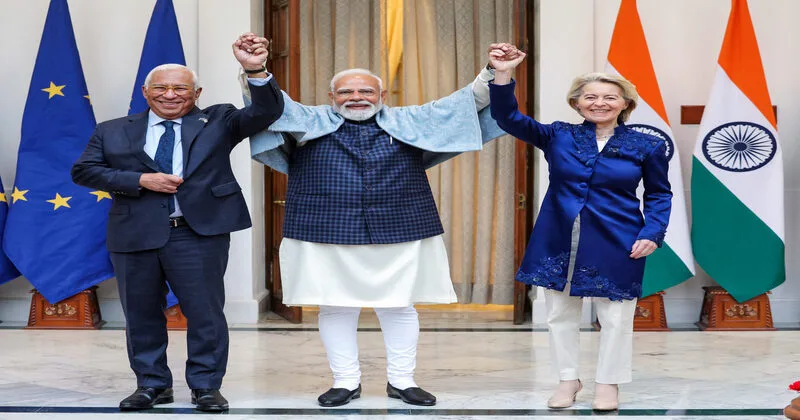
Prime Minister Narendra Modi and European Commission President H.E. Ms. Ursula von der Leyen announced a historic milestone at the 16th India-EU Summit. The EU’s second-largest economy, which accounts for 25 per cent of global GDP and India’s fourth-largest economy, forge a trusted partnership and unprecedented market access. Preferential entry into the EU is granted to more than 99 per cent of Indian exports, opening up enormous development possibilities. The fundamental goal of the India-EU Free commerce Agreement is to improve the predictability, affordability and ease of commerce between India and the 27 EU members.
With 33 billion USD of exports in labor-intensive industries like textiles, leather, marine products, gems and jewelry set to benefit greatly from preferential access under the FTA, the FTA will open up new opportunities for MSMEs and create jobs for women, artisans, youth and professionals. Additionally, the FTA’s carefully calibrated auto liberalization with reciprocal market access will open doors for Bharat’s agricultural and processed food exports and safeguard sensitive agricultural products and dairy sector with no market access. Innovative and Economically Significant Market Access in Services.
A Framework for Future-Ready Mobility increases the opportunities available to skilled and semi-skilled Bharatiya professionals worldwide. Prospective CBAM provisions Ensure positive interaction, communication and assistance Bharat-EU Free Trade Agreement Establishes the Basis for Future-Ready, Resilient and Inclusive Growth One of Bharat’s biggest commercial partners is the European Union, with bilateral commerce in products and services increasing gradually over time. With exports of INR 6.4 Lakh Crore(USD 75.85 billion) and imports of INR 5.1 Lakh Crore(USD 60.68 billion), Bharat’s bilateral trade in goods with the EU totaled INR 11.5 Lakh Crore(USD 136.54 billion) in 2024–2025. In 2024, trade in services between Bharat and the EU totaled INR 7.2 lakh crore (USD 83.10 billion).
With one of the fastest-growing major economies and a youthful, vibrant labor population, Bharat is well-positioned to take advantage of this free trade agreement to boost employment, encourage innovation, open up opportunities in a variety of industries and improve its competitiveness internationally. In addition to traditional sectors like trade in commodities and services, trade remedies, rules of origin, customs and trade facilitation, the Bharat-EU trade pact also covers newer areas like SMEs and digital trade. Furthermore, in EU Member States where traditional medical practices are unregulated, Bharat has obtained the right for practitioners of Bharatiya traditional medicine to operate under home title.
Diversification and way ahead
Bharat’s 22nd free trade partner is the EU. Since 2014, the government has announced a trade agreement with New Zealand and signed agreements with Mauritius, the United Arab Emirates, the United Kingdom, EFTA, Oman and Australia. Bharat announced the completion of a trade agreement with New Zealand in 2025 and signed agreements with Oman and the United Kingdom. The EU trade agreement, Bharat’s free trade agreement with the UK and the EFTA essentially give Bharatiya companies, exporters and entrepreneurs access to the whole European market. According to statements made by US President Donald Trump and Prime Minister Narendra Modi, the Bharat US trade deal will be the best deal ever and would greatly help Bharatiya companies.
Given that Bharat’s merchandise exports are concentrated in a small number of important countries and commodities, with quantities outside of these groupings staying relatively modest, diversification is essential. In the year 2024, 39 per cent of Bharat’s merchandise exports went to the US and the EU, its two biggest export destinations. These markets are also the main destinations for foreign direct investment and the biggest consumers of Bharat’s services exports.
Bharat is constructing a future trade environment that seeks to integrate its robust local ecosystem with international markets and efficiently addresses a range of logistical and infrastructural issues as the nation advances toward greater global economic integration. Bharat’s many industries, which have all prospered over time, are reflected in the country’s strong local commerce environment. These industries include petroleum products, engineering machinery, iron and steel. Bharat’s changing strategy for striking a balance between international economic integration and the safeguarding of its own industries.
With 731.2 million workers, Bharat boasts a labor pool that approaches mainland China’s and exceeds that of Southeast Asian economies. Bharat is entering its demographic dividend era as many global economies struggle to withstand the silver tsunami of an aging workforce, which erodes the mass of critical skills. According to the United Nations, Bharat’s population is expected to grow at an average annual rate of 0.8 per cent between 2025 and 2030. Bharat has a large but untapped labor pool, which gives it a competitive edge in international trade discussions and in its efforts to become more regionally competitive.
In general, Bharat’s trade policy is still changing, striking a balance between the demands of a rising economy and the significance of international integration. Adopting globalization can greatly boost economies, such as Bharat’s, by increasing economic growth and raising living standards through the advantages of international trade. Additionally, it can promote regulatory and infrastructure advancements, increasing overall effectiveness and competitiveness of th economy.