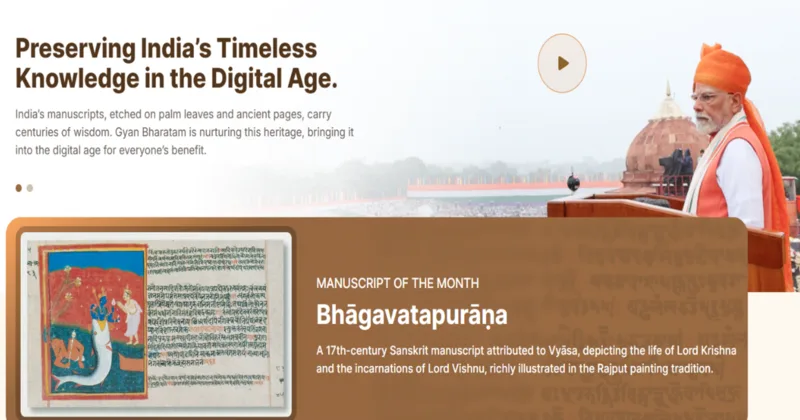
India’s civilisational strength has never rested solely on monuments or oral traditions; it has been carried for centuries in manuscripts fragile, handwritten repositories of knowledge spanning philosophy, science, medicine, astronomy, governance, linguistics and the arts. Despite of having one of the world’s largest manuscript traditions, a substantial part of this intellectual wealth has remained scattered, undocumented, vulnerable to decay or inaccessible to scholars and citizens alike. It is within this historical gap that Gyan Bharatam emerges as a decisive national intervention.
Announced in the Union Budget 2025-26, Gyan Bharatam is a flagship scheme of the Ministry of Culture, Government of India aimed at systematically surveying, conserving, digitizing, translating and democratizing access to the manuscript heritage of India. This initiative represents a paradigm shift from sporadic conservation activities to a mission mode, technology enabled cultural infrastructure that resonates with the overall national vision of Viksit Bharat@2047
What Gyan Bharatam is and why it matters
Gyan Bharatam is more than just a digitization effort. It is a national framework that seeks to address manuscripts as strategic knowledge assets and not as relics of the past. It is estimated that India has millions of manuscripts penned in dozens of scripts and languages, including Sanskrit, Prakrit, Tamil, Persian, Arabic, Assamese, Odia, Grantha, Sharada and many more. Many of these manuscripts surviving only in a single copy. Losing these would mean the loss of indigenous knowledge systems.
Recognising this, Gyan Bharatam has been conceptualised as a five-vertical mission, covering the entire lifecycle of manuscript knowledge:
- Survey and Cataloguing
- Conservation and Capacity Building
- Technology and Digitisation
- Linguistics and Translation
- Research, Publication and Outreach
This structure ensures that preservation is not isolated from scholarship nor digitisation detached from public access. The initiative integrates cultural conservation with human capital development by positioning ancient knowledge as a living resource for contemporary India.
Financial commitment and institutional action
The seriousness of intent is evident in the financial and institutional support. The Standing Finance Committee has sanctioned ₹491.66 crore over the period of 2025-2031, which indicates a long-term commitment and not a short-term gesture. This long-term approach enables capacity building, infrastructure development and quality assurance, which are usually sacrificed in time-bound cultural schemes.
To implement the mission, Gyan Bharatam requires the establishment of a countrywide network of Cluster Centres (CCs) and Independent Centres (ICs). Currently 45 centres have been brought on board to implement activities under the five verticals, which will be implemented in a decentralised yet standardized manner. At the same time, 20 States and Union Territories have been brought on board as Nodal Coordinating Authorities will integrate the mission with the federal administrative framework of India
This collaborative framework will ensure that the manuscripts in temples, mutts, libraries, universities and private collections are documented and preserved without centralizing their ownership and losing the local custodianship.
Digitisation with global standards
One of the prominent features of Gyan Bharatam is its insistence on technical rigour. Unlike earlier digitisation drives that prioritised speed over quality, this initiative enforces strict imaging and metadata protocols aligned with international archival standards.
Digitisation mandates include:
- Minimum 400 DPI, 24-bit colour scanning (600 DPI where required)
- Use of non-destructive, face-up overhead scanners with cold light
- Manual image verification to ensure colour integrity and textual clarity
- Master files stored in TIFF v6.0, access copies in JPEG and searchable PDF/A formats with indelible watermarking
- Long-term preservation through LTO-9 magnetic tapes, supported by cloud-based backup and disaster recovery systems
Each manuscript is documented through descriptive, structural, technical and administrative metadata capturing language, script, region, conservation status, source institution, file format and digital object relationships. Metadata is supplied in CSV and XML formats, enabling interoperability with national and global repositories.
The Gyan Bharatam Digital Platform
Technology is not an afterthought but a backbone of the initiative. Over 7.5 lakh manuscripts have already been digitised and 1.29 lakh manuscripts are currently accessible through the Gyan Bharatam portal, making it one of the largest publicly accessible manuscript platforms in the world.
The platform is being developed as an AI-integrated digital ecosystem, supported by a mobile application, enabling advanced search, multilingual access and future integration of machine-assisted transcription and translation tools. Technical partners have been onboarded for scanner deployment, metadata integration with the National Digital Repository, cybersecurity and long-term storage management. This approach ensures that manuscripts are used for education, research and cultural engagement.
Role of the Modi Government in reviving India
Gyan Bharatam embodies this larger philosophical turn in the current administration’s policies where culture is no longer seen as something that exists on the margins of development but as the bedrock of national confidence and intellectual independence. In making manuscript preservation a part of Viksit Bharat@2047, the government has placed culture at the forefront of innovation, policy and soft power.
In contrast to previous policies that were more elitist in their focus, the current policy framework is more inclusive and decentralized, involving state governments, universities, traditional communities and preservation specialists in one framework. The creation of a national conservation manual, an application for surveys and a feedback mechanism for stakeholders also reinforce this approach.
This initiative bridges culture and governance. Manuscripts on ancient ecology, water management, metallurgy, medicine, mathematics, linguistics and statecraft are no longer treated as antiquarian curiosities but as knowledge systems with contemporary relevance.
What Gyan Bharatam means for India
For India, Gyan Bharatam is a reclaiming of the narrative of its own intellectual history. For so many centuries, the availability of Indian knowledge systems has been mediated by foreign archives, translations or piecemeal scholarship. By creating a national, publicly available manuscript environment, India takes possession of its own documentation, interpretation and dissemination of its civilisational heritage.
It also redefines education and research. Scholars, linguists, historians, technologists and inter-disciplinary researchers now have authentic primary materials, allowing original research rather than secondary studies. For indigenous communities and traditional knowledge holders, it provides validation support for preservation and inclusion in national knowledge networks.
Gyan Bharatam redefines heritage as a living continuum that links India’s past wisdom with its future aspirations. Gyan Bharatam stands as one of the most comprehensive cultural knowledge missions undertaken in independent India. With sustained funding, institutional depth, technological sophistication and cooperative federalism at its core, the initiative transforms manuscript preservation from an archival exercise into a national development strategy.
India moves towards 2047, Gyan Bharatam ensures that progress is not achieved by forgetting the past, but by understanding, preserving and reactivating it on India’s own terms.