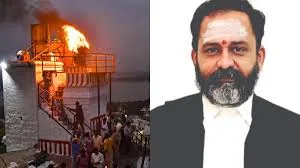
A judge makes a light, offhand quip at a public event. A media outlet turns it into proof of communal intent, judicial recklessness, and institutional decay. This, yet again, is the template The News Minute has followed, this time in a three-minute short video targeting Justice G.R. Swaminathan over his remarks at an event organised by the Dhara Foundation.
Instead of engaging with the substance of any judicial order or offering a balanced critique of judicial conduct, the video carefully stitches together insinuations. The result is a narrative that paints a sitting High Court judge as communal, politically aligned, and unfit for office, all while wearing the performative garb of concern for “public confidence in the judiciary.”
What begins with a casual reference to the Thirupparankundram Karthigai Deepam order quickly spirals into a character assassination exercise. Justice Swaminathan is portrayed as reckless and provocative, with no serious attempt to explain the legal context of the order, the historical and ritual significance of Karthigai Deepam, or the fact that courts routinely adjudicate such matters based on established practice and law.
The hypocrisy is hard to miss. To lend moral weight to its argument, TNM foregrounds a young Muslim voice, Azeeza Fathima, positioning her as an authority on Sanatana Dharma and as a critic of the judge’s beliefs. At the same time, the outlet remains conspicuously silent on many who openly participate in political activism, share stages with ideological groups favoured by the Left, or transition seamlessly into partisan politics post-retirement. Outrage, it appears, is strictly selective.
Poisoned framing disguised as journalism
Consider the language deployed by TNM: “This was not just a joke. It was a reference to a controversy simmering with communal tension in Tamil Nadu.”
With this single line, the outlet labels a lawful judicial order as inherently “communal,” without examining its merits or legal reasoning. Such framing imputes motive to a sitting judge, an act that edges dangerously close to “scandalising the court” under Section 2(c) of the Contempt of Courts Act, 1971, by eroding public faith in judicial impartiality without evidence.
The script escalates further: “Justice Swaminathan allowed it. The order triggered protests and raised serious law and order concerns.”
Here, TNM effectively holds the judge personally responsible for protests and alleged near-breakdowns of law and order, functions squarely within the domain of the state government and police machinery, not the judiciary. This mirrors precisely the kind of motive-ascribing commentary that the Supreme Court warned against in E.M.S. Namboodiripad v. T. Narayanan Nambiar (1970).
The crescendo comes when the video links the judge’s remarks to pending impeachment demands, suggesting that his humour, coupled with his religious references, renders him morally suspect. The implication is clear: personal faith, specifically Sanatana Dharma is incompatible with judicial office.
Religion as indictment, not argument
The News Minute makes no serious attempt to interrogate the legal soundness of Justice Swaminathan’s judgments. Instead, it treats his personal expressions, such as quoting scriptures or speaking about Sanatana Dharma as evidence of bias. This is not legal analysis; it is ideological policing.
Judges are permitted beliefs. Judges are permitted to speak on culture, philosophy, and civilisational traditions. Singling out Sanatana Dharma as uniquely disqualifying, while ignoring judges who quote the Bible, the Quran, or espouse explicitly Left-liberal worldviews, exposes the underlying prejudice driving the narrative.
Individually, TNM’s claims hover just within the boundary of harsh criticism. Collectively, they assemble a portrait of a judge as communal, irresponsible, and dangerous, without ever stating it outright. This is how contempt is laundered: through tone, insinuation, and repetition.
Indian jurisprudence has consistently drawn a line between criticism of judgments and attacks on judicial integrity. The News Minute crosses that line repeatedly, yet shields itself behind the language of “public confidence.”
The real threat to judicial credibility
Ironically, the video concludes by sermonising about how public confidence in the judiciary is shaped by what judges say and do outside court. What it fails to acknowledge is that confidence is equally damaged by media outlets that conduct ideological hit jobs, selectively targeting Hindu-leaning judges while shielding those aligned with their own worldview.
If TNM is genuinely concerned about judicial credibility, why not scrutinise political leaders who openly call for the eradication of Sanatana Dharma? Why not interrogate judicial people with overt partisan associations? Silence, once again, is the answer.
A pattern, not an exception
This is not an isolated lapse. As seen in The News Minute’s handling of the Chitra Subramaniam controversy, which we examined in detail yesterday, the pattern is consistent: sanctimonious framing, selective outrage, and a studied blindness to facts that complicate the preferred narrative. Different subject, same method.
Here’s what happened:
During a live prime-time Times Now debate on language politics and alleged “Hindi imposition,” DMK spokesperson Saravanan was confronted with pointed questions on the party’s ideological history, its long-standing narrative on language, and the apparent contradiction of its current alliance with the Congress. Instead of responding with facts or political reasoning, Saravanan abruptly broke into prolonged, loud laughter, disrupting the discussion and overwhelming the studio. The moment, widely circulated on social media, was seen by viewers as an evasion tactic rather than debate, turning a serious political discussion into an episode of televised farce.
Soon after the clip went viral, Saravanan shared a carefully edited version of the debate on social media that conspicuously excluded the laughter. The post reframed the episode as a confrontation with the BJP and a critique of national media, shifting focus away from his own conduct. It was at this stage that senior journalist and The News Minute co-founder Chitra Subramaniam intervened. Sharing Saravanan’s edited clip, she criticised the television channel instead of questioning the spokesperson’s behaviour, accusing English-language news media of “arrogance” and “mediocrity” while asserting that “journalism is a public good.”
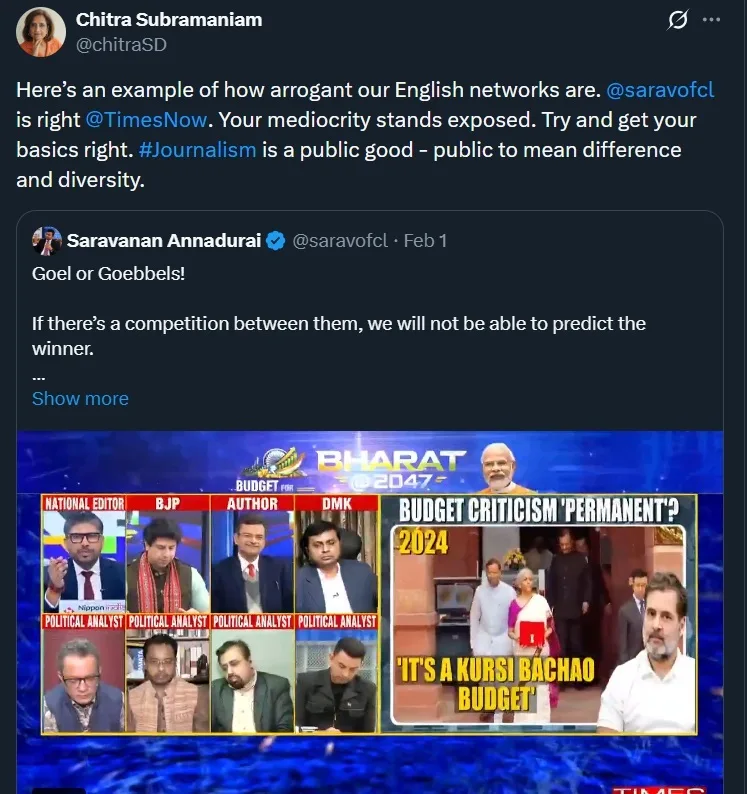
By doing so, Subramaniam effectively insulated Saravanan from scrutiny. There was no mention of his refusal to answer questions, no concern about substituting debate with theatrics, and no defence of the anchor’s right to press for accountability. The intervention shifted the narrative from a political spokesperson avoiding scrutiny to a supposed failure of television journalism, mirroring a broader pattern where standards of ethics and accountability are vigorously invoked against ideological opponents but quietly suspended when political allies are under pressure.
Justice G.R. Swaminathan’s case only reinforces a growing concern: when ideology masquerades as journalism, critique mutates into character assassination, and public discourse is poorer for it.