New Delhi: India’s trade agreement with the United States, following a similar deal with the European Union, is being viewed as a major setback for Bangladesh’s export sector. The development comes at a sensitive time for Dhaka, which had only recently urged the European Union to pursue a trade agreement on the Indian model. Within hours of that request, India concluded a trade deal with the US at tariff levels even lower than those applicable to Bangladesh. Adding to Dhaka’s concerns, the Indian government has also delivered a financial jolt by sharply cutting budgetary assistance to Bangladesh in the latest Union Budget.
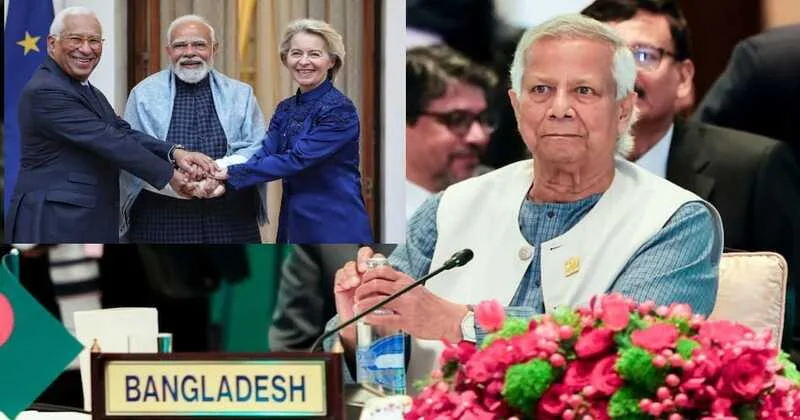
Mohammad Yunus, Chief Adviser of Bangladesh’s interim government, has urged the European Union to immediately initiate negotiations on a comprehensive trade agreement. Yunus held discussions with EU Ambassador to Bangladesh Michael Miller and EU Chamber of Commerce Chairperson Nuria Lopez. According to an official statement, the move was prompted by the imminent expiry of Bangladesh’s duty-free access to the European market. During the meeting, Yunus also referred to Bangladesh’s recent success in securing a duty-free export agreement with Japan, underlining the urgency of similar arrangements with Europe.
Bangladesh is among the world’s leading exporters of textiles, with Europe being one of its most important markets. At present, Bangladeshi textile exports enjoy duty-free access to the EU under special concessions granted to least developed countries. However, this preferential status is set to be withdrawn soon, which would require Bangladeshi textile products to face import duties.
Dhaka fears that once this happens, the India–EU trade agreement will deliver a severe blow to its textile industry.
Currently, Indian textile exports to the European Union are subject to duties ranging between 9 and 12 per cent. Trade observers believe that by November 2029, Indian products could gain complete duty-free access to the EU market. If that materialises, Indian exporters would be able to offer higher-quality products at significantly lower prices, sharply increasing their competitiveness in Europe.
India’s relatively lower tariff regime compared to other Asian economies is also emerging as a challenge for Bangladesh in the United States market. While Bangladesh faces tariffs of around 20 per cent, India’s tariffs stand at approximately 18 per cent. This differential is expected to give Indian textile exporters a decisive advantage in the US, further squeezing Bangladesh’s export prospects. Bangladesh has also faced a setback in India’s latest Union Budget, presented by Union Finance Minister Nirmala Sitharaman. The allocation for Bangladesh under India’s financial assistance scheme for neighbouring countries has been cut by half. While Bangladesh earlier received Rs 120 crore, the allocation has now been reduced to Rs 60 crore. Reports suggest that Dhaka’s growing proximity to Pakistan under the Yunus-led interim regime, along with a rise in attacks on religious minorities in Bangladesh, has strained relations with New Delhi. It is widely believed that these developments have influenced India’s decision to take tougher economic and diplomatic measures.