The rugged and complex mountainous terrain has turned into a strategic advantage and weapon for the Baloch Liberation Army(BLA) to attack the Pakistani Army in order to counter its atrocities and seek the long-held goal of liberation of Balochistan from the iron fist of Islamabad. In a carefully calibrated attack, the Baloch Army has kept a high vigilance on the Pakistani security forces by hiding amidst the treacherous and inaccessible mountainous terrain of the region. Thus, as a part of Operation Herof 2.0, the Balochistan Liberation Army(BLA) has launched a massive attack on the Pakistani forces.
The military wing of Balochistan has keenly watched and calculated every action of the Pakistan Army prior to escalating the operation, by hiding behind the humungous mountains and its narrow lanes. While Pakistan was fighting against the Tehreek-e-Taliban Pakistan(TTP) in the northwestern part of the Khyber Pakhtunkhwa province, the Baloch Army, estimated it as the right moment and escalated the operation to thwart the Pakistani security forces from the Baloch land. The Pakistan Army, thus has been surrounded and being blocked by the Baloch forces in the ongoing Operation Herof 2.0.
The Baloch fighters have clearly harnessed the difficult terrain as a strategic weapon to attack Pakistan. The BLA monitored every moment of the Pakistan Army and accelerated the momentum to attack. The Baloch Liberation Army further claimed that the convoys of the Pakistani security forces were trapped when they were travelling in the narrow and limited routes. They were completely blocked and the operation was launched with no escape route for the Pakistani forces. This also reflects the massive adventure escalated by the BLA with the ultimate goal of seeking liberation from Pakistan, who have encapsulated their tyrannical rule in Balochistan with administrative negligence, governance failure, unemployment, political & military atrocities, targeted attacks and enforced disappearances.
While the Pakistan Army was busy fighting the TTP terror groups in Khyber Pakhtunkhwa, BLA took an overarching advantage of the inevitability of the Pakistan Army and other security personnel of the state. On January 29 and 30, the Pakistan Army had launched a crackdown on the TTP militants in Khyber Pakhtunkhwa. As the attention of the Army was shifted towards TTP, Baloch Liberation Army swiftly harnessed this to its merit and on January 30, hours later launched Operation Herof 2.0 against Pakistan. BLA has attacked the Pakistani security forces in 48 areas across the 12 districts of Balochistan.
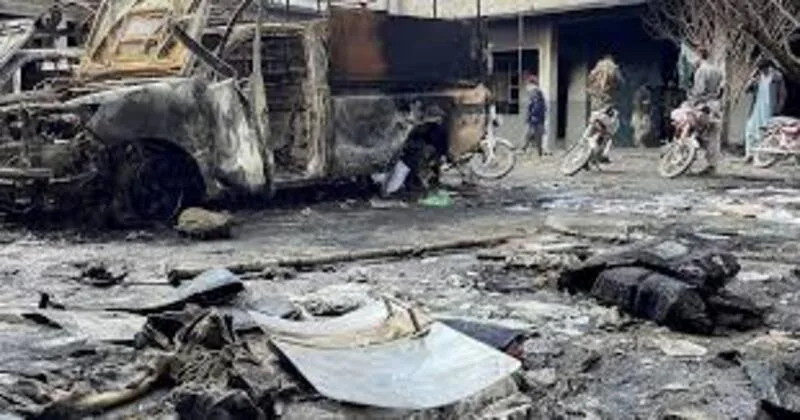
As a result, the movement of the Pakistani security forces was completely blocked. They were locked in the hands of BLA amidst the difficult terrains of Balochistan with limited communication access. The rough geographical landscape was thus used by the BLA as a fertile strategic ground to propel an attack on Pakistan. BLA infact, launched simoultaneous attcaks from Quetta, Gwadar, Mastung, Noshki, Dalbandin, Kharan, Panjgur, Tump and Pasni, hence posing a major challenge to the Pakistan state and the Army. BLA also claims that it has killed more than 100 Pakistani military personnel.
Pakistan kills more than 145 BLA fighters
In a massive and merciless crackdown, the Pakistan Army has killed more than 145 fighters of the Baloch Liberation Army(BLA). Meanwhile, more than 30 civilians have also been killed including 5 women. This severe suppression illustrates the autocratic or draconian nature of Islamabad. Instead of heeding to the developmental demands of the people of Balochistan, Pakistan is escalating violence leading to the death of innocent civilians including women and children. Further, enforced disappearances are a common scenario in Balochistan where the Baloch people are targeted by the Pakistani officials, making life miserable.
Despite repeated and continuous protests the problems of the Baloch people are not addressed by Islamabad. The region is completely neglected and used only to fulfill the political or terror motives by the Pakistan government. The growing resentment from the people of Balochistan and other activists of the region hence reflects the spiking political instability, domestic disintegration in Pakistan and the crisis situation is indeed slipping out of the control of Islamabad which is hitherto entangled in political and economic gridlocks under the authoritarian rule of the Pakistani Army since decades.