National Festivals are spaces where representation becomes visible. The Republic Day Parade, as Bharat’s most formal state ritual, offers a structured view of how different regions, communities and institutions are positioned within national imagination. Every Republic Day, Bharat as a nation becomes a moving gallery of cultures, colours, rhythms, uniforms, traditions, and symbols converging at the ceremonial boulevard of Kartavya Path, New Delhi. Processional contingents, visual tableaux, and ceremonial formations move through this ceremonial space not to make claims, but to celebrate national spirit coated with a deep sense of respect towards the Republic. Representation of the North East in this space is not articulated through statements or slogans, but through a strong and steadfast presence facilitated by organic oneness. The parade unfolded with a deep, quiet pride which was detailed, layered, and richly textured in ways that felt deeply affirming. The Mixed Scouts marching contingent led by Lieutenant Amit Choudhary of the 2 Arunachal Scouts set the tone with discipline and dignity, followed by the Assam Regiment commanded by Captain Aryan Deolkar, a regiment that has already earned the Best Marching Regiment award four times. The Delhi Police woman band, led by Sub-Inspector Ruyangunuo Kense from Nagaland, carried its music with reverberating authority thus solidifying North East as a capable commandant and leader for the future of Bharat.
Assam Tableau Enchants Visitors
As the visual continued, the Assam tableau on Asharikandi, showcased a terracotta craft village in Dhubri district, one of the major hubs of terracotta craftsmanship in the State. It reminded viewers of a living tradition that has breathed continuously in the nation’s cultural ecosystem. Alongside it, the tableau of the Ministry of Skill Development and Entrepreneurship, guided by its motto “Powered by skills, building a self-reliant, future-ready India,” threw spotlight on weaving traditions from the North Eastern State of Nagaland, placing regional skill systems at the centre of Bharat’s contemporary developmental story. Nagaland’s tableau, representing the Hornbill Festival, carried a deeper cultural continuity: a festival that begins every year on December 1, the same date on which Nagaland attained statehood in 1963 through the process of three Naga people conventions, linking celebration, history, culture-led tourism and community-based self-reliance into a single symbolic frame. Manipur’s tableau, themed “Towards Prosperity: From Agricultural Fields to International Markets,” foregrounded chilli, rice, and oranges, tracing a journey from local cultivation to global exchange- putting on display the inherent economic disposition of the State. This continuum found a wider national echo in the Ministry of Culture’s tableau celebrating 150 years of Bharat’s national song which put Mizoram at the heart of it. This was followed by the presentation of Vande Mataram: The Eternal Resonance of Bharat, curated by the Sangeet Natak Akademi, shaped through the collective presence of 2,500 artists from every State and Union Territory. This was performed under the creative direction of Dr Sandhya Parecha where North Eastern traditions, including Bodo and Manipuri dance forms, took their place within a single national composition. Together, these moments simply reflected a Republic in motion where Arunachal, Assam, Manipur, Nagaland, and the wider North East appeared with confidence, continuity, and belonging, not as additions, but as enduring beats of the same national rhythm.
Gallantry and service awards reflected the region’s deep institutional presence within Bharat’s security and defence architecture. Major Arshdeep Singh of 1 Assam Rifles was awarded Kirti Chakra; Major Leishangthem Deepak Singh and Subedar PH Moses of 1 Assam Rifles, along with Rifleman Manglem Sang Vaiphei of 3 Assam Rifles, were conferred Shaurya Chakra. The sons of the land and the defenders of the nation proudly accepted the honour and immortalised their presence in the echoes of national history.
President Hosts Reception
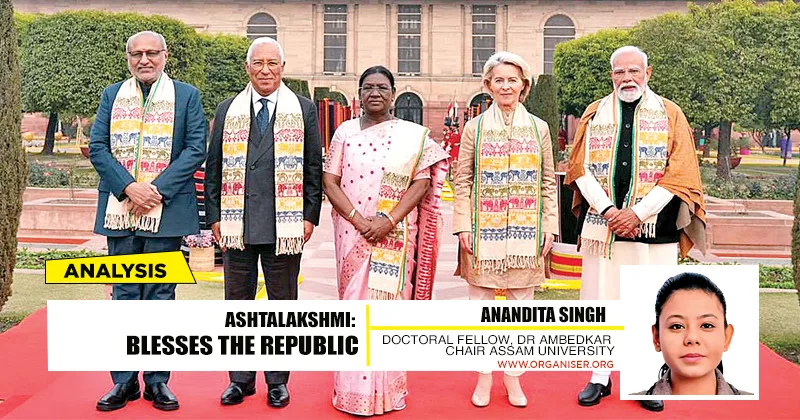
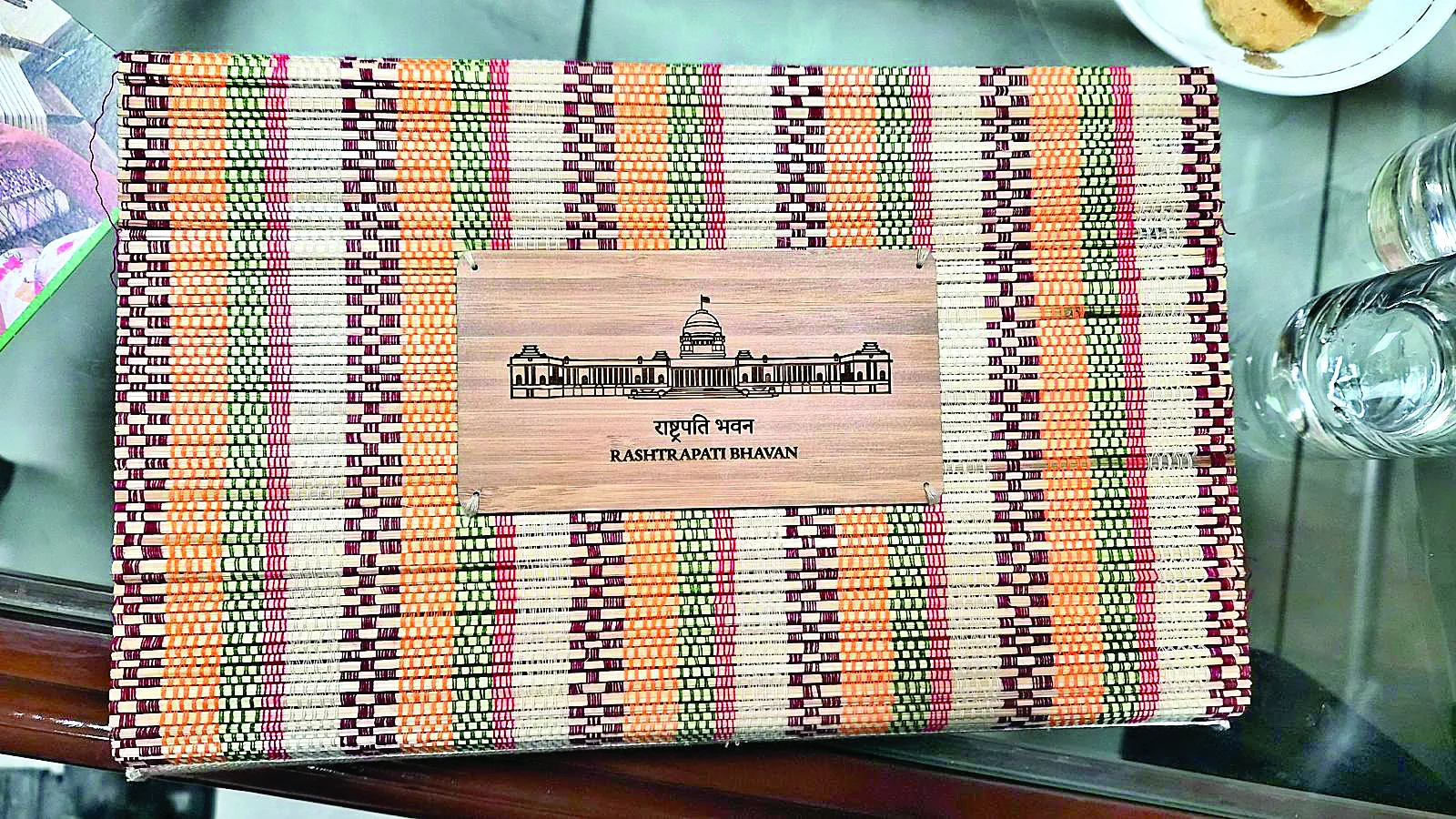
This presence flowed beyond the parade route and the responsibilities of security spilled gently into the ceremonial spaces that surround Republic Day. At the “At Home” reception hosted by President Droupadi Murmu at Rashtrapati Bhavan for the 77th Republic Day, the traditional Assamese Gamosa was placed in the hands of guests and this was where protocol met poetry. The highest rituals of the Republic were thus, adorned with threads of regional culture. In that simple offering of cloth, the nation seemed to whisper a quiet truth: that there is room for every tradition, every memory, and every community within the Indian civilisational space.
Cultural presence found another language at the Republic Day High Tea, where flavours from the North East entered the ceremonial table. The menu consisting of Matabari Peda, Pati Sapta Pitha, Black Rice (Chak-Hao) Kheer, Narikol Laru, Til Pitha, Til Laru, and Khapse carried more than taste; it carried stories of soil and season, of harvest and hearth, of craft and community. In these culinary choices, the North East arrived as familial, its flavours folding seamlessly into the everyday rhythms of national life, merging cultural continuity into cultural intimacy, and symbolism into belonging.
Together, the layers of gallantry award recipients, the parade formations, the tableaux, the honours, the ceremonial textiles, and the curated cuisine formed a coherent symbolic landscape. North East did not appear as a subject of representation; it appeared as a participant in the Republic’s everyday rituals, as a presence already embedded into Bharat’s very existence like breath in the body, not noticed, but indispensable.