
“Every work has got to pass through hundreds of difficulties before succeeding. Those that persevere will see the light, sooner or later.” –Swami Vivekananda, in LVIII Alasinga – Letters of Swami Vivekananda, U. S. A., February 17, 1896, Complete Works, Vol 5
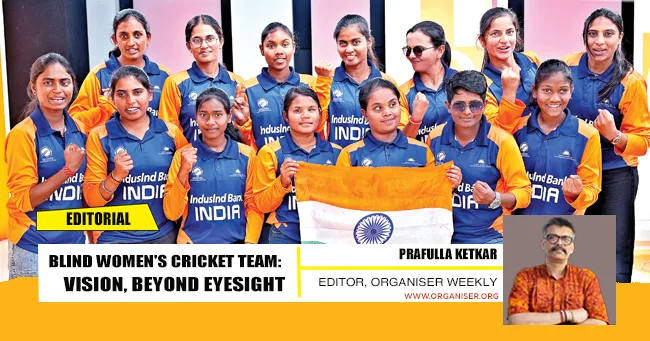
When the T20 World-Cup-winning blind women’s cricket team visited the Organiser studio on the Republic Day eve, it was a celebratory occasion for us, as the voice of the nation. Not that celebrity visits to media houses are a new phenomenon, but these guests were very special. Each team member has a story to tell. Their mentors, themselves from the Divyang community, displayed extraordinary character by founding an institution to create opportunities for the blind. The stories and the vision of this team are an eye-opener for all of us.
The office bearers of the Cricket Association for the Blind in India (CABI) are not just blind players, but they have also built an ecosystem to nurture future players. They passionately talk about the game and the need to provide opportunities to every Divyang person, without showing ill will towards anyone. Their conversation was full of compassion and commitment to the cause, a rare commodity when an initiative succeeds professionally. From a scratch, they built an association for blind cricket and established their brand by organising the first-ever T20 World Cup for blind women. If you face some difficulty in life, it is an opportunity to strengthen yourself to help others, which is the first lesson of this cricket team.
The players’ entry into the Organiser’s office was interesting, as they disembarked from the vehicle in teams. Each supporting the other with special skills and senses. As the team composition ranged from complete blindness to players with 2 metres of vision to 6 metres of vision, team spirit was natural to them as a survival instinct. In our lives, supporting each other’s strengths and weaknesses is the mantra for success, and these blind players displayed that beautifully.
Each one of them had a story to tell. Initially, girls who mostly came from rural or tribal regions, with a very difficult childhood, were not very comfortable talking about themselves. Once they opened up about their struggle they explained how their lives changed after success. Once humiliated or neglected for being visually impaired, none of these girl had success in their head. They had gratitude towards their parents, society and the association. Handling success is not easy, and these ordinary girls with extraordinary success in the World Cup demonstrated it in the simplest way – by remembering everyone who contributed to achieving the milestone.
People with eyesight need not have vision for life, as these blind cricketers do. In fact, they have a disability at the mindset level, because of which they cannot show empathy for others. Discrimination against fellow human beings on any ground is the sign of that ‘mindset disability’. Everyone requires in life is empathy and opportunity to excel, not sympathy or punitive equity. Such behaviour is possible only if we overcome the mental blocks and develop a sense of fraternity towards our fellow beings.
Any sportsperson performing at the international level is a matter of pride for us. However, the success of para-athletes brings special joy and positivity. They don’t just bring medals and trophies; they give us life lessons. They give us vision beyond eyesight, that of compassion and perseverance.