An act of religious superiority is a sign of radical Islamism. Offering namaz at unauthorised public locations is a provocative and tricky attempt to evade the law, while playing out a convenient narrative as a pre-planned strategy.
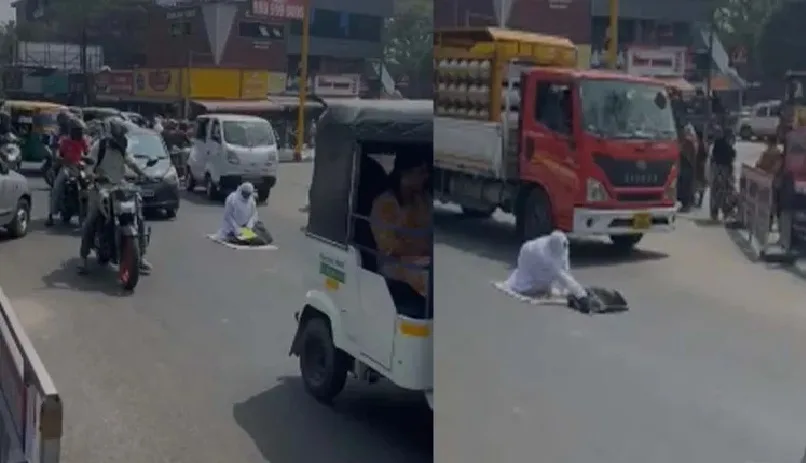
The latest incident came to light on January 28 at the busy IMA Junction in Palakkad, where a purdah-clad woman was found offering namaz in the middle of the road. The act led to severe traffic congestion, bringing vehicular movement to a halt for a prolonged period and causing inconvenience to commuters.
Police intervened after the traffic disruption worsened and took the woman into custody. During interrogation, she reportedly stated that she offered namaz in the middle of the road to attract public attention to the family property disputes she has been suffering, a justification that has further intensified public debate on the appropriateness of religious acts in public spaces.
Her namaz has created the worst sort of traffic obstruction on the road. Therefore, the victims of the traffic jam and the others demand a case to be registered against the woman for obstructing the traffic.
Pushing one’s religious interests into public, even at the cost of others’ right to travel, is an offence; hence, it warrants action.
Some people wonder what would be the reaction of the authorities if Ganpati Homam is organised in the middle of the roads. Some people reminisce about what happens in London, where the Muslims argue for their right to pray in the London streets. A large section of the people see a step forward for a theocratic state in the Palakkad woman’s action.
Critics argue that if she wanted to gain attention, she could have offered namaz at a mosque itself, rather than disturbing law and order on the roads and endangering public transportation.