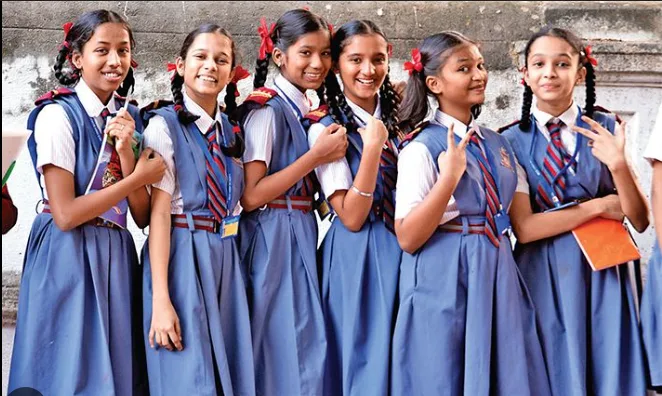
Reaffirming its focus on inclusive growth through education, the Gujarat government on Tuesday announced that it will provide financial assistance worth Rs 1,250 crore to more than 12 lakh girls under the Namo Laxmi Scheme during the 2025-26 academic year. The scheme targets girls studying in Classes 9 to 12 and is aimed at ensuring that economic hardship does not force students to discontinue their education after completing primary schooling.
According to the State Education Department, the Namo Laxmi Scheme has been designed as a comprehensive intervention to address one of the most persistent challenges in girls’ education, dropouts during the secondary and higher secondary stages due to financial pressures, early marriage, domestic responsibilities, or lack of sustained family support. By offering structured and milestone-linked financial assistance, the scheme seeks to incentivise both continued schooling and successful completion of board examinations.
The initiative has been launched under the guidance of Chief Minister Bhupendra Patel, with Education Minister Dr Praduman Vaja and State Education Minister Rivaba Jadeja overseeing its execution. Officials said the scheme reflects the government’s long-term vision of transforming girls’ education from mere access to sustained participation and empowerment.
Under the Namo Laxmi Scheme, eligible students from Classes 9 to 12 will receive a total financial assistance of ₹50,000 spread over four academic years. The assistance is structured in a way that provides regular monthly support while also rewarding academic progression through lump-sum payments upon clearing key board examinations.
For students in Classes 9 and 10, the total assistance amounts to Rs 20,000. Of this, Rs 10,000 is disbursed as a monthly stipend of Rs 500 for ten months each year, helping families meet recurring educational expenses such as transportation, stationery, uniforms, and supplementary learning needs. The remaining Rs 10,000 is released after the student successfully passes the Class 10 board examinations, creating a strong incentive to complete secondary education.
In the higher secondary stage, covering Classes 11 and 12, students are eligible for Rs 30,000 in financial assistance. This includes an annual stipend of Rs 7,500 per year, paid as Rs 750 per month for ten months in each academic year. The final Rs 15,000 is released upon successful completion of the Class 12 board examinations, a milestone that significantly enhances a student’s prospects for higher education, skill training, or employment.
Officials emphasised that this staggered and outcome-linked structure has been carefully designed to reduce dropout rates at critical transition points, particularly after Class 10, when many girls are forced to abandon studies due to financial constraints or social pressures.
The Education Department clarified that the scheme is open to girls studying in schools recognised by the Gujarat Secondary and Higher Secondary Education Board (GSHSEB) as well as the Central Board of Secondary Education (CBSE). This ensures that students enrolled in both state and central board institutions can benefit, provided they meet the eligibility criteria.
Importantly, girls who are already beneficiaries of other government scholarship schemes are not excluded. The Namo Laxmi Scheme offers additional financial support, making it a supplementary benefit rather than a replacement. This approach, officials said, acknowledges that existing scholarships often fall short of meeting the full cost of continued education at the secondary level.
Eligibility criteria for the scheme have been framed to ensure that assistance reaches families that genuinely require support. To qualify, students must have completed Classes 1 to 8 in government or aided primary schools, under the Right to Education (RTE) Act, or completed Class 8 in a private primary school. In addition, the annual family income must not exceed ₹6 lakh. Students who meet these conditions and are enrolled in Class 9 are eligible to apply for the scheme.
Beyond educational continuity, the state government has positioned the Namo Laxmi Scheme as an intervention linked to adolescent health and nutrition. Officials noted that regular financial assistance enables families to provide better nourishment to growing girls, particularly during adolescence, a stage that is crucial for physical and cognitive development. By reducing the economic strain on households, the scheme indirectly contributes to improved health outcomes and overall well-being.
The Education Department highlighted that investing in girls’ education has a multiplier effect on society, leading to delayed marriages, improved maternal and child health indicators, greater workforce participation, and enhanced decision-making power within households. The scheme, therefore, is not merely a welfare measure but a strategic investment in the state’s social and economic future.
Gujarat’s emphasis on girls’ education builds on a legacy of education-focused initiatives launched during the tenure of Prime Minister Narendra Modi as the state’s Chief Minister. Programmes such as Shala Praveshotsav (School Enrollment Festivals), Kanya Kelavani campaigns, and sustained community outreach initiatives were instrumental in improving enrollment ratios and reducing gender gaps in primary education. Officials said these initiatives have since inspired similar programmes in other states.
However, while primary enrollment rates have shown steady improvement, secondary and higher secondary education have remained areas of concern nationwide, particularly for girls from economically weaker backgrounds. The Namo Laxmi Scheme seeks to address this gap by ensuring that girls not only enter secondary school but also remain enrolled and complete their education.
State Education Minister Rivaba Jadeja, while reviewing the implementation framework, stressed that the scheme aligns with the broader vision of women-led development. “Educating a girl means empowering an entire generation,” she has stated on multiple occasions, underscoring the government’s belief that sustained education is the foundation of long-term empowerment.
Education Minister Dr Praduman Vaja also emphasised that strict monitoring mechanisms will be put in place to ensure timely disbursal of funds and prevent leakages. Digital platforms and direct benefit transfer mechanisms are expected to play a key role in ensuring transparency and accountability.
With over 12 lakh beneficiaries expected in the 2025-26 academic year alone, the Namo Laxmi Scheme represents one of the largest targeted financial support initiatives for girls’ secondary education in the state. Officials believe that the scale of the programme will significantly contribute to reducing dropout rates, improving board examination completion rates, and expanding opportunities for higher education and skill development among young women.
As Gujarat prepares to roll out the next phase of the scheme, the government has reiterated that education remains central to its development agenda. By combining financial support with long-term vision, the Namo Laxmi Scheme marks a decisive step toward ensuring that no girl is forced to abandon her education due to economic hardship, reaffirming the state’s commitment to equity, empowerment, and inclusive growth.