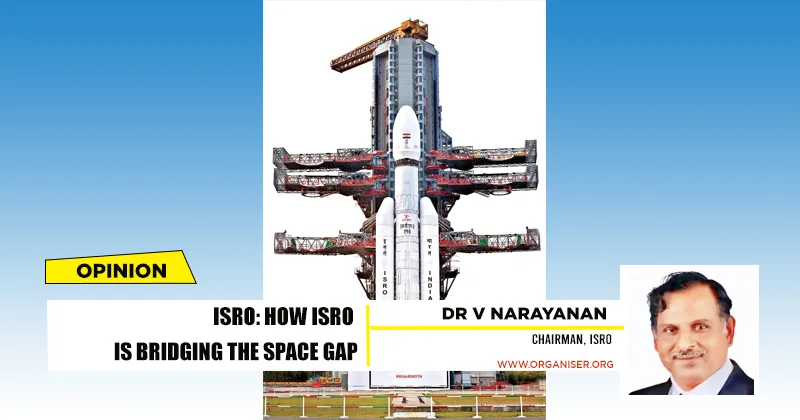
Under the leadership of Prime Minister Narendra Modi, the Indian Space Research Organisation (ISRO) has rapidly indigenised and modernised Bharat’s space programme. Coinciding with this momentum, I have completed one year as Chairman of ISRO, a period marked by several historic milestones and forward-looking initiatives that underscore
Bharat’s growing stature as a global space power.
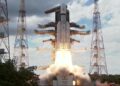
This year has been one of the most fulfilling phases of my professional life. During this period, ISRO achieved its 100th launch from Sriharikota and successfully demonstrated space docking and undocking, making Bharat the fourth nation in the world to achieve this capability. We carried out a landmark synergetic mission integrating NASA’s L-band SAR payload with a 12-metre antenna alongside ISRO’s S-band SAR payload on a Bharatiya satellite. The LVM3 ‘Bahubali’ launcher recorded two consecutive successful missions, including the launch of the heaviest GTO satellite and the heaviest satellite ever placed into orbit from Bharatiya soil. In 2025, ISRO also partnered in the Axiom mission, through which Group Captain Shubhanshu Shukla became the first Bharatiya to travel to the International Space Station and return safely.

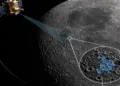
When I assess Bharat’s progress in space exploration, I see a consistent record of world-class missions achieved through innovation and optimal use of resources. Chandrayaan-1 was the first mission to confirm the presence of water molecules on the Moon. The Mars Orbiter Mission earned global recognition for its cost-effectiveness and made Bharat the first nation to enter Mars orbit on its maiden attempt. Chandrayaan-2 successfully deployed an orbiter carrying the highest-resolution lunar camera. Although the soft landing was missed in the final phase, the mission remained largely successful. The detailed analysis of this mission led to a series of corrective measures, all of which were implemented in Chandrayaan-3. Its success made Bharat the first country to soft-land near the Moon’s South Pole and included a novel hop experiment that strengthened confidence for future interplanetary, reusable and sample-return missions. This mission also generated unprecedented interest in science and engineering across the country.
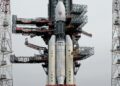
When ISRO began its journey in 1962, advanced nations were already far ahead in space technology. Over the decades, Bharat steadily bridged this gap and, in several areas, emerged as a global leader. From the first SLV-3 launch in 1980, ISRO has progressed through six generations of launch vehicles and completed 104 launch missions. We have launched 134 indigenous satellites and 434 satellites for 34 foreign countries, including a world record of placing 104 satellites into orbit in a single launch. The successful development of an indigenous cryogenic engine, achieved despite international technology denial regimes, remains one of our most significant technological milestones. At present, the Gaganyaan human spaceflight programme is in advanced stages, with the first unmanned mission planned shortly.
Questions are often raised about space expenditure, and I reiterate that ISRO functions in accordance with the vision of Dr Vikram Sarabhai, who believed that advanced technologies must be applied to solve the problems of the common man. Today, space-based services support communication, navigation, disaster management, agriculture, fisheries, transportation and governance. NavIC enables a wide range of civilian applications, while satellite-enabled disaster warning systems and real-time tracking of thousands of trains have saved lives and improved efficiency. Studies show that every rupee invested in the space programme yields three to four times its value in socio-economic returns.
Many advanced nations choose ISRO for launching their satellites because cost efficiency is deeply embedded in our organisational culture. Every expenditure of public funds is subjected to rigorous scrutiny, and each mission undergoes multiple levels of review. We extensively use modelling, simulation and analysis, which has significantly reduced development timelines, as demonstrated by the rapid qualification of high-thrust cryogenic engines. This disciplined and synergetic work culture has continued across generations of scientists.
Looking ahead, ISRO’s roadmap focuses on achieving complete self-reliance in space-based services. Approved missions include Chandrayaan-4 for lunar sample return, a Venus Orbiter Mission and the Next Generation Launch Vehicle with a recoverable first stage. The Bharatiya Antariksh Station is planned by 2035, with initial modules targeted around 2027. Through a fully indigenous mission, Bharat aims to land an astronaut on the Moon and return safely by 2040.
My own journey reflects the transformative power of education and opportunity in Bharat. I was born in a remote village in Kanyakumari district and studied in a Tamil-medium government school with very limited facilities. What sustained me through my journey from diploma studies to engineering, postgraduate education and doctoral research was self-belief, discipline, perseverance and faith.
I believe that science and spirituality are complementary. Being part of Bharat’s sanskriti provides deep intellectual and spiritual enrichment, and our civilisational heritage bears testimony to the scientific and philosophical wisdom of our ancestors. At ISRO, we place strong emphasis on inspiring the younger generation through nationwide outreach programmes, the observance of National Space Day on August 23, and a vibrant work culture that encourages innovation.
science and spirituality are complementary. Being part of Bharat’s sanskriti provides deep intellectual and spiritual enrichment, and our civilisational heritage bears testimony to the scientific and philosophical wisdom of our ancestors
Private industry and startups are essential for expanding satellite manufacturing, launch services and space-based applications. With reforms and institutions such as IN-SPACe and NSIL, ISRO is evolving into an enabling organisation while focusing on advanced missions such as human spaceflight, space stations and heavy-lift launch vehicles. Our space assets also play a critical role in national security. During Operation Sindoor, ISRO systems operated round the clock, supporting precise targeting, effective defence interception and minimal collateral damage.
As Chairman of ISRO, my overarching goal is to contribute to the Prime Minister’s vision of a developed Bharat by 2047. Expanding launch capacity, deploying advanced satellites and supporting national and international requirements remain central to our mission, as Bharat moves towards its own space station, space tourism, lunar missions and, eventually, the possibility of human habitation beyond Earth.
(Article is based on the interview given by Dr V Narayanan, Chairman, ISRO, to Suneesh K, who is the chief editor of Hindu Vishwa)