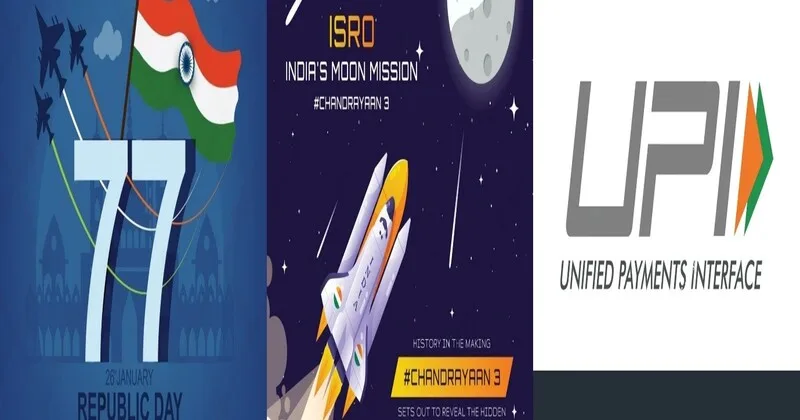
This Republic Day, India is not only marking 77 years as a Republic but also showcasing a decisive year of capability-building. From record-breaking UPI scale and expanding global acceptance to ISRO’s docking milestone and India’s push for AI foundation models, 2025–26 signalled India’s shift from aspiration to execution
Republic Day is not only a commemoration of what India adopted in 1950. It is a yearly reminder of what India must continuously produce stability, capacity, and self-respect. The Constitution created the Republic, but the Republic survives on something more difficult than the execution of ideals. In an age where nations compete through technology, logistics, finance, standards and strategic depth, just intent is not enough. Nations rise when they build systems that work repeatedly, under pressure and with population support.
This year was important for India because it marked a transition from celebrating growth to demonstrating capability. It was not a year of one grand headline; it was a year when several indicators converged: space competence, digital infrastructure, AI readiness, startup depth, and industrial development. All of these signals that India is no longer catching up with developments but beginning to shape outcomes.
The Republic’s new test: Can India build frontier capability?
For decades, India was often described as a large market, a promising democracy or a sleeping giant who has forgotten its power. These labels sound flattering, but they also hide a hard truth markets can be exploited, democracies can be influenced and giants can be distracted. A serious nation is not judged by adjectives. It is judged by its ability to deliver under constraints.
One of the most symbolic achievements of the year came from space; it could not have happened because it was technically difficult. ISRO’s Space Docking Experiment (SPADEX) moved India into a category occupied by only a handful of countries. The mission is not about launching another object into orbit. It is about aligning two independent spacecraft in space and reliably connecting them; it demands precision engineering and high-level control logic.
ISRO confirmed that the two SPADEX satellites were successfully docked on 16 January 2025, and later achieved undocking on March 13, 2025 at 09:20 hours in the very first attempt, in a 460 km circular orbit with 45-degree inclination, with both satellites subsequently orbiting independently and remaining healthy.
This is exactly what makes the achievement politically and strategically relevant. Docking is not a ceremonial technology, it is a foundational one. Once a nation proves docking, it is no longer limited to isolated space missions. It gains the ability to plan for modular space infrastructure, future human spaceflight logistics, satellite servicing and more complex orbital operations. In practical terms, it means India’s space ambitions stop being linear and start becoming architectural. This year mattered because India did not merely advance in space, it advanced in space capability depth.
The digital leap became measurable power: UPI ended the year at a record scale
If space represents the frontier, payments represent the bloodstream of a modern economy. India’s story here is no longer a tech success story. It is a governance and infrastructure success story and this year gave it a record-setting scale.
According to the National Payments Corporation of India (NPCI) product statistics, UPI in December 2025 reached 21,634.67 million transactions (that is 21.63 billion) and a total value of ₹27,96,712.73 crore (nearly ₹28 lakh crore) with 685 banks live on UPI.
This single number matters because it proves something that skeptics used to doubt that India can build a national-level digital system that is both massive and routine. 21 billion monthly transactions is not niche adoption. It is civilisational scale digitisation.
A separate report summarising NPCI numbers noted that December 2025 saw 2,163 crore transactions, with value close to Rs 28 lakh crore and year-on-year growth of 29 per cent in volume and 20 per cent in value compared to December 2024.
The significance is not merely that Indians are paying by QR code. It is all about that India has proven that a country can run financial rails as public digital infrastructure with high frequency, low friction, and increasingly exportable. Government-linked reporting in late December stated that UPI is already accepted in eight countries Bhutan, Singapore, Qatar, Mauritius, Nepal, UAE, Sri Lanka and France. India is working to expand further.
That is why this year mattered where India’s digital capability is no longer only a domestic convenience. It is becoming a component of India’s external economic presence. In the 21st century, influence is increasingly built not only through speeches and summits but through standards and infrastructure that other countries integrate into daily life.
India’s startup ecosystem crossed a hard milestone: 2 lakh recognised startups
If payments are the bloodstream, startups are the oxygen supply for entrepreneurship, risk-taking and innovation distributed across geography and sectors. India’s startup ecosystem has been discussed for years, but this year it crossed a milestone that carries both symbolic and practical weight.
PIB release in 2026 January stated that India had over 2 lakh DPIIT-recognised startups as of December 2025, placing India firmly among the world’s largest startup ecosystems. Another report quoting Commerce and Industry Minister Piyush Goyal noted that India recognised more than 44,000 startups in 2025 alone, calling it the highest annual addition since the Startup India initiative began. It also highlighted that nearly 48 per cent of recognised startups have at least one woman director or partner.
These numbers matter because they indicate breadth. An innovation ecosystem becomes national only when it becomes socially distributed and institutionally supported. A startup system with gender participation approaching half is not a small elite bubble, it is becoming part of the Republic’s economic structure.
It is not just growth, it is consolidation and discipline too. Another report on the ecosystem stated that about 730 startups shut down in 2025, sharply lower than 3,903 closures in 2024 even while funding challenges persisted.
This year, therefore, marks a shift from startup hype to startup survivability. Survivability is what makes ecosystems real. A Republic does not benefit from startups that appear and disappear. It benefits from startups that scale, become employers and add productive capacity to the economy.
AI became national strategy: India moved from using AI to building AI
Every decade produces one technology that rewrites power equations. For this decade, that technology is artificial intelligence, especially large foundation models, compute infrastructure and language systems. The year was important for India because AI stopped being treated only as an app trend and began to be approached as a sovereign capability.
A PIB release from October 2025 stated that 12 companies were developing foundation models using 38,000 GPUs available at ₹65 per hour, with a national large language model planned for launch by end-2025.
This is not a small claim. Computer access is one of the biggest barriers to AI development. When a country starts building shared compute capacity and selecting domestic entities to build models, it is trying to prevent a future in which it becomes entirely dependent on foreign systems for intelligence, translation, search, education tooling, and automation.
Earlier in 2025, another PIB report stated that India’s national compute capacity had crossed 34,000 GPUs and that additional startups had been selected to build India’s own foundation model.
The strategic point is clear: India is attempting to secure a position in AI where it is not merely consuming tools but defining systems that will operate in Indian languages, Indian governance contexts, and Indian social realities.
Why this year felt like a turning point
India’s rise is often framed in terms of GDP growth, demographics and global attention. But this year’s importance lies in something else compositional strength. Multiple layers of national capability matured simultaneously.
Space docking showed frontier competence. UPI showed system scale. Startup recognition showed economic depth. AI compute and foundation model development showed strategic intent. None of these alone makes a superpower. But together, they indicate an economy and state moving beyond ambition into repeatable delivery.
This is what Republic Day actually commemorates in modern terms. The Constitution is not just a book of rights. It is an operational design for civilisational continuity through institutions, procedures and discipline. In the same way, modern national power is no longer a product of rhetoric. It is produced by platforms, protocols, engineering competence, and industrial stamina.
This year is so important for India because India showed that it can build systems that do not collapse under their own weight even when the scale is 1.4 billion citizens, thousands of languages and dialects and constant external pressures. That is not a small achievement. That is the definition of national maturity.
On this Republic Day, the most accurate way to describe India is not developing or emerging. It is structuring its capabilities so that growth is not accidental and sovereignty is not negotiable. This year will be remembered as a year when India did not merely celebrate the Republic.