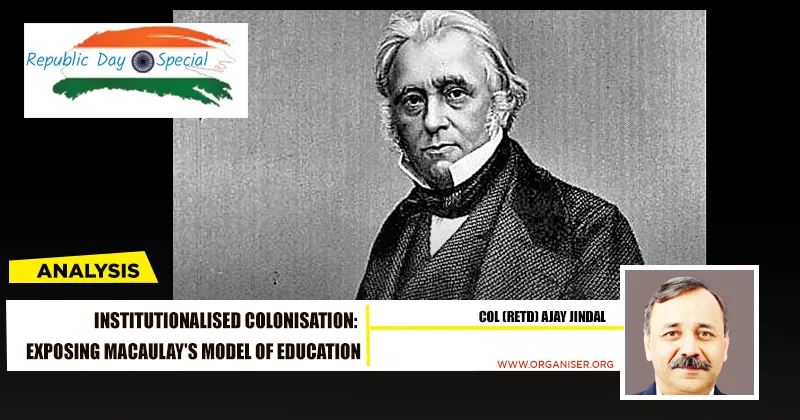
The attempt to recast Thomas Babington Macaulay as a moderniser who rescued Bharat from intellectual decay is not just historically thin—it is strategically misleading. It relies on a deliberate separation of Macaulay’s 1835 Minute from the political economy of the British Empire. But once that economic context is restored, Macaulay looks exactly like what he was: an administrator executing an imperial brief designed to reduce the cost of governance, discipline society and ensure a continuous drain of Bharatiya wealth to Britain.
From the early 19th century to the First World War, British policy in Bharat turned on one central axis—the “Drain of Wealth” identified by Dadabhai Naoroji and empirically documented by RC Dutt. Contemporary economic research shows how direct that connection was: every one per cent rise in the colonial drain boosted Britain’s profit rate by nearly nine percentage points. This was not incidental; it was the business model of empire. Once that motive is placed at the centre, everything else aligns. Education, the census, military recruitment—none of these were designed as social reform. They were instruments to stabilise an extractive state at minimal cost. Read in this light, Macaulay’s Minute on Bharatiya eduction becomes unmistakable. Sitting on the Supreme Council during a phase of fiscal tightening, he advocated English education because it could produce a class of low-cost intermediaries—economically dependent on colonial employment, culturally conditioned by British intellectual norms, and politically harmless. His goal was explicit: to create a class “Indian in blood and colour, but English in tastes, in opinions, in morals, and in intellect.” That is not the language of a reformer. It is the language of an administrator describing a workforce. And despite desperate attempts today to remove race from his project, Macaulay’s own words make the hierarchy clear. His claim that a single shelf of European literature outweighed all Indian and Arabic literature was not literary judgement. It was civilisational propaganda. He was operating in an environment already shaped by Charles Grant’s evangelical contempt and James Mill’s dismissal of Hindu civilisation. Macaulay merely converted their prejudices into policy. If English education was meant to shape minds, the Army after 1857 was redesigned to control bodies. The rebellion shattered British confidence. The response was the “Martial Races” theory—an administrative device dressed up as anthropology. Communities that rebelled were deemed “non-martial”; while those that remained loyal were elevated.
The classification had nothing to do with military ability. As historian Jeffrey Greenhut wrote, the doctrine simply declared “educated and intelligent Indians as cowards” and “uneducated and backward Indians as brave.” The logic was political loyalty, full stop. The result was an Army engineered not for professional excellence but for dependable obedience. Bharatiya soldiers filled imperial ranks, policing rebellions at home and fighting wars abroad, while remaining structurally insulated from the English-educated elite the empire had just created. Alongside military control came social control. Defences of colonial “reform” collapse on the moral front as well. Racial slurs such as “Nigger” and “suar” were commonly used by British officers. This was institutional culture, not deviant behaviour. The most devastating evidence, however, remains the Bengal Famine of 1943. There was no monsoon failure. There was food elsewhere in Bharat. It was simply not moved. Wartime priorities and administrative inertia cost between 800,000 and 3.8 million lives. An empire that presides over mass preventable death cannot be credited with civilising intent. The earlier The Indian Express defence of Macaulay invoked the Mahabharat’s Ashwatthama episode to justify strategic deception. But the epic is unambiguous: Krishna’s instruction to Yudhishthira occurs under Aapad Dharma, the dharma of emergency, and carries immediate moral consequence—Yudhishthira’s chariot descends to earth after he speaks the half-truth.
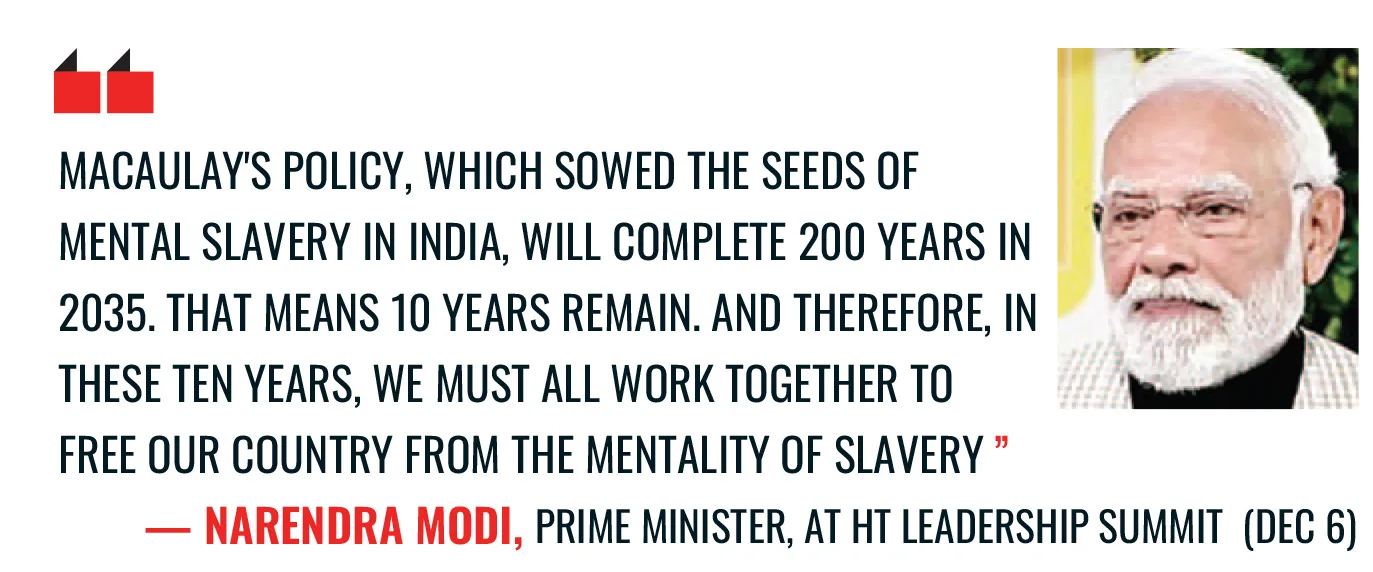
The Mahabharat treats moral compromise as a weight. Colonial governance treated deception as routine policy. The analogy is fundamentally misplaced. Reimagining Macaulay as a civilising “Mahatma” is not an innocent mistake. It reflects the durability of the cognitive system he helped design. English education, Army restructuring and caste enumeration were not disconnected reforms. They were parts of a single architecture built to secure an extractive empire by creating obedient intermediaries, loyal soldiers and administratively legible subjects. These structures outlasted colonial rule because they were efficient at what they were designed to do. They shaped institutions, social categories and aspirations long after the British left—and they continue to shape how we understand modernity and merit.
Recovering historical clarity is not about settling scores with the past. It is about understanding how deeply the architecture of colonial power shaped the foundations of modern Bharat. Macaulay was not a civiliser offering Bharat modernity. He was a strategist serving an empire built on profit and hierarchy. Decolonising our understanding does not require rejecting modern education or administrative systems, it requires recognising the purpose for which they were originally designed—and refusing to let that purpose define our present.