
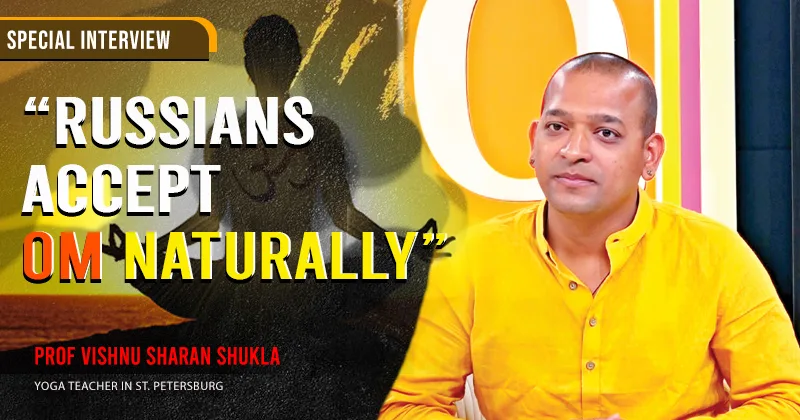
Yoga Grand Master Vishnu Sharan Shukla, who is a household name in Russia as through sheer hard work and patience he has become face of the Yoga movement there, says Yoga is practised more openly in the nation that has historic ties with Bharat. He believes there’s a bond between Russian and Sanskrit languages. Interestingly, he points out that Russians are comfortable chanting ‘Om’ and embracing yoga. He is the founder of Russia’s first Yoga Museum and the Authentic Yoga Centre Sanskar, dedicated to preserving and promoting the classical traditions of yoga in Russia. In a freewheeling interview with Lakshmi Ranjith, Assistant News Editor of Organiser (Digital), Yoga Grand Master Vishnu Sharan Shukla, who works as Yoga teacher in St. Petersburg and was previously associated with the Consulate General of India there, explains his journey as a Yoga Guru in Russia. Excerpts
Russia shows a stronger inclination toward yoga. How has Yoga emerged as a powerful cultural bridge between Bharat and Russia?
Bharat has worked very hard to build closer ties with Russia by sharing its culture. Indian Embassy and cultural groups have introduced Bharatiya values in Russia, making them a meaningful part of Russian society. In the last decade, Russians have shown more respect for Bharatiya culture and traditions.
Watch the full interview here: https://www.youtube.com/watch?v=0o8VT30AMKk&t=10s
Many Russians see Yoga as more than just sitting still or meditating. For them, it is a complete way of life rooted in Bharatiya culture. We can see that they focus less on difficult poses and more on breathing, mental discipline, and clear thinking. Russians have understood that Yoga ensures good physical health, mental well-being, and inner balance in a lasting way.
“Yoga has found strong acceptance in smaller towns and remote regions, even far from big cities in Russia. Harsh weather, for example, prolonged winters, leaves many people in these areas feeling a sense of disconnection and limited interaction with nature”
Indian Embassy has worked closely with Russian cultural and health organisations to promote Yoga and used the shared interest in health and well-being to present Yoga not just as an exercise, but also as a way of thinking and living rooted in Bharatiya culture.
What are the main reasons why Russians turn to yoga and what challenges do they face?
Yoga has found strong acceptance in smaller towns and remote regions, even far from big cities in Russia. Harsh weather, for example, prolonged winters, leaves many people in these areas feeling a sense of disconnection and limited interaction with nature. For them, winters are physically and emotionally isolating. Therefore, Yoga helps bridge this gap by fostering inner balance and forges a renewed connection with nature.
Though the Russian Ministries are secretive, they are interested in Bharatiya culture and Yoga. They have been extending a helping hand and advising us to conduct Yoga events in major cities and in remote villages. Ministries are tasked to conduct cultural events, particularly from India. Indian Consulates in various regions of Russia are also actively participating in cultural events in coordination with their Russian counterparts.
You have practised Yoga across many countries. Which country has been the most welcoming?
Among European countries, Russia doesn’t impose any restrictions on Yoga practices. In Russia, I find that Yoga is practised more openly, without many cultural barriers. People are comfortable chanting “Om” and fully embracing the practice. In some other European countries, I have noticed a certain hesitation or restraint when it comes to including ‘Om’ and other Hindu elements. Russians accept it naturally, much like Indians do.
It seems that International Yoga Day has gained prominence in Russia. What is your take on this?
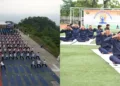
Since 2017, when the International Yoga Day event started, we have been focusing on organising large, dedicated events in open spaces and public parks. Our aim is to include more people every year. Over the last two years, more than 10,000 people have participated in International Yoga Day events in St. Petersburg. In Moscow, the event has attracted between 10,000 and 20,000 participants.
Which dimension of Yoga do Russians relate to most, and how is that different from the way Yoga is practised in the West?
Most Russians turn to Yoga mainly to heal injuries. Many also seek relief from anxiety and stress, and practise Yoga for relaxation and therapeutic benefits. Yoga therapy, in particular, draws strong interest because it combines modern scientific understanding with human anatomy and traditional Yogic knowledge. People are curious to know how Yogic practices have developed since ancient times and how these methods work on the body as therapy.
During the winter, the absence of sunlight also makes Russians anxious. The advice which we give is ‘breath in and breath out’
How important was maintaining accurate Sanskrit in preserving the meaning while translating Boris Grebenshchikov’s Bhagavad Gita?
Russian poet and singer Boris Grebenshchikov developed an interest in Buddhism and Hinduism. Later, he became interested in the Bhagavad Gita and began writing it. I was the book’s reviewer. He translated the book in his own way, understanding each shloka of the Bhagavad Gita. My job was to retain the meaning and essence of each shloka of the Bhagavad Gita as it was translated into Russian.
“European countries are conducting research on Yoga. In Russia, studies have examined how simple Yoga practices can benefit astronauts”
With your background in Astrophysics and Yoga research, how open are Russian academicians to studying Yoga scientifically?
European countries are conducting research on Yoga. In Russia, studies have examined how simple Yoga practices can benefit astronauts. These practices help astronauts retain bone density after returning to Earth from space, reducing the risk of bone fractures.They have their own laboratories and institutes where they conduct research by collecting samples from people doing quality breathing exercises. They have also introduced pilot projects on Yoga to treat diseases such as Asthma.
When leaders practise Yoga, it can influence and shape a nation’s mindset. Bharat’s Prime Minister, Narendra Modi, is known to practise Yoga, and he believes this is reflected in India’s economic and cultural growth. Yoga has the potential to promote peace worldwide. Former Russian President Dmitry Medvedev also practised Yoga.