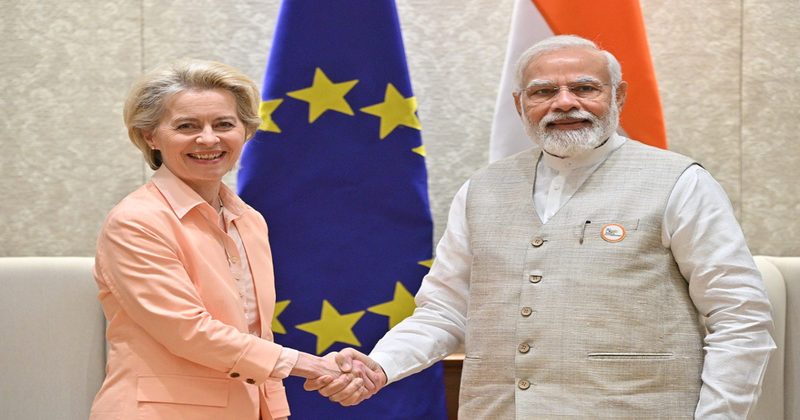
The Trade Agreement between India and the European Union set to be sealed is an opportunity for building a robust economic framework for India and the 27 members of the EU. The upcoming India-EU summit is likely to be a major breakthrough for the Free Trade Agreement (FTA). Besides, there will be a major boost in defence and security partnership between India and the EU. The visit of Mr. Antonio Costa, the President of the European Council and the President of European Commission Ursula Von der Leyen, as the Chief Guests on the occasion of the celebration of 77th Indian Republic Day and prior to this on January 25, to Co-Chair the 16th India-EU Summit will set the background for building up a highly comprehensive economic strategic policy for future.
The beginning has already started with brighter note in the backdrop of recent Challenges posed by the new shift in economic policies of the powerful actor in world politics and quagmire created by the ongoing unending unsustainable conflicts between Israel-Palestine and Russia-Ukraine. The recent economic negotiations for the development of solid partnership between India and 27 countries of European Union have created platform for building relations in trade, economic partnership, issues related to investment protection and brought about contiguity among the member countries. Besides, there are subtle efforts for taking on myriad concerns and challenges faced in establishing joint collaborations in Asia, Pacific and African region.
This certainly exhibits high level insight and understanding of both sides. Prime Minister Narendra Modi had shown tremendous foresightedness and remarkable vision in recent years and made relentless efforts for creating myriad channels of negotiations , trade, global security and a fresh pathway towards inclusive democratization of world politics. Their Approach has set out a very clear way forward by getting fully involved in new techniques and developing challenging strategies to meet the need of all the partners. The issue that remains vital is to bring so many countries to a negotiating table of working out a strategy of relaxing vaccines related trade aspects of intellectual property rights to help saving maximum lives at the time of global health emergency.
The increasing support and agreement with regard to limiting climate change issues and opening up gateways for renewable energy and development in technological know how along with channelizing the sources of power generation and creating a mechanism to withstand any sudden threat posed by BRI (Belt and Road Initiatives) augur well for peace and prosperity of all the member countries. The 2019 Japan EU deal was an effort in this direction. There has always been a series of extremely good relationship between India and the EU with the trade share having crossed a decent landmark during last half a decade which was way more than expected.
During the last few years or so there has been a closer ties particularly with Germany, Italy, Netherlands having been the biggest importers from India and Germany, France and Belgium the largest exporters of goods. The recent efforts would further boost and cement their ties with each other and create a genuine environment for stabilizing economic growth(along with ensuring free flow of goods and services) strategic security, prosperity, stability and combating sudden challenges arising due to climate change. Further, EU’s Civil Protection System landing smooth help during dire strait due to spikes of second wave of over expanding tentacles of Coronavirus has further opened venues for a closer integration and numerous areas of cooperation and negotiations for mutual well-being of both sides.
Foreign relations are operated through an efficient diplomacy and diplomacy is all about right gestures and cooperation and coordination at the time of crisis. The ever friendly and forthcoming gestures of Prime Ministers of Belgium, Spain and French President Emmanuel Macron appreciating the efforts of India in the fight against World Pandemic of worst kind speaks volume about the intimate ties between India and the EU. In Broad Based Trade and Investment in past brought both sides on a common platform despite having not arrived at conclusion on some vital issues of market access and Foreign Direct Investment(FDI) for free trade. There has been a contiguity with regard to nuclear energy and sustainable development concerning environmental issues.
Further negotiation may lead to creation of a strategic mechanism to provide a shield against terrorism, international crime, drug dealing, smuggling and cyber threat unleashed by non -state actors. This may also accelerate maritime friendly ties and bolster up security around Indian Ocean and Indo-Pacific areas which have lately become areas of concern. Hence, a collaborative partnership among the nations through equity and access to those who are in need at the time of unprecedented crisis may show the level of insight in empowering and motivating people across the board towards extending helping hand and saving lives.
Besides, the pursuit towards promotion of their well beings would lead to tremendous effort towards enhancement of overall development scenario in Europe and India. The sum and substance of the idea is to ensure that the New structural thinking and orientation changes through a fresh perspective and a framework for key demands while maintaining a synergy among various stakeholders to negotiate even on the issues of different perspectives. There has been an area of concern between the EU nations and India and it is about the increasing misuse of the Unmanned Aircraft Systems(UAS) technology. Although this technology is mainly used for commercial purpose due to its easy availability and affordability.
This has posed major question as how to identify the possibility of its misuse by the extremists. Repeated misuse of drones by terrorists across the globe has posed severe threats to the security of all the countries world over. There has been a dialogue dealing with the misuse of drone technology between India and the EU of late. Though the background for shaping a common partnership between the two had already started during July 2020 under the auspices of “EU-India Strategic Partnership: A Roadmap to 2025” and another conference of cooperation in developing the EU-India Strategic Partnership during 2021. In the backdrop of ongoing West Asian Crisis, Russian-Ukraine Conflict and simmering unrest in Pakistan and Afghanistan there is every likelihood of its misuse by non-state actors. Hence, efforts towards creating a common understanding and platform for encountering terrorism via European Union Project on enhancing security cooperation in and with Asia remains very vital.
The upcoming challenge will be to develop a perfect regulatory processes and modern way of intelligence gathering and sharing of paramount information helpful in anticipating the forebodings of sporadic attacks by non-state actors. The India-EU partnership on encountering international terrorism would certainly depend on how a foolproof risk management system is developed to address the security challenges emanating from the possibilities of new biological, nuclear and chemical attacks either by individual terrorist or a group of distraught people.