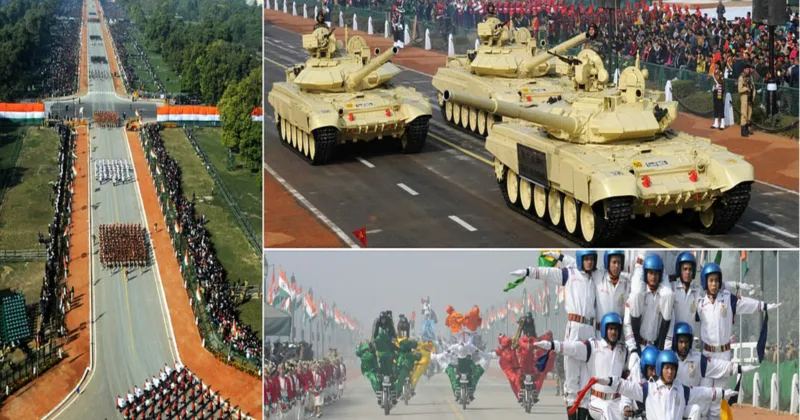
NEW DELHI: In the early hours of January 23, even before the winter fog loosens its grip on the capital, the heart of New Delhi begins to move to a different rhythm. Barricades rise quietly, boots echo on empty roads, and ceremonial commands cut through the cold air along Kartavya Path. For a few hours, Delhi is no longer merely a city, it becomes the living stage of the Republic.
The Full Dress Rehearsal of the Republic Day Parade, conducted every year on this date, is not just a routine drill. It is the most crucial ceremonial checkpoint before the nation gathers on January 26 to mark the adoption of the Constitution. Every movement today unfolds exactly as it will on Republic Day morning.
Delhi Traffic Police has, as they do every year, issued a traffic advisory with all the relevant details of the R-Day Parade Full Dress Rehearsal plan for 23rd January (it’s Friday and a working day) so that those on essential commutes to offices, schools, airports, hospitals, etc. will not be caught unawares.
Traffic Advisory
In view of Full Dress #RepublicDay Parade Rehearsal on 23rd January, 2026, special traffic arrangements will be effective on various routes. Please follow the advisory.#DPTrafficAdvisory pic.twitter.com/QMMlKvw25W
— Delhi Traffic Police (@dtptraffic) January 21, 2026
A Morning That Mirrors Republic Day
Unlike the Beating Retreat rehearsals, which are held in the evening, the Full Dress Rehearsal takes place in the early morning hours, mirroring the timing and scale of the main parade. Long before most of the city wakes up, troop movements are already underway, and key arteries around Vijay Chowk, India Gate, Kartavya Path, Tilak Marg, and Raisina Hill are placed under layered security.
For Delhi’s residents, particularly those living or working in Lutyens’ Delhi, January 23 is a day that requires planning and patience. For the administration, it is a day of absolute precision.
When Governance Adjusts to Ceremony
The parade route is flanked by some of the most important institutions of the Indian state. Offices such as Baroda House, North and South Block, Shastri Bhawan, and Udyog Bhawan, along with residential clusters like Princess Park, Pandara Road, and Tilak Marg, function within a carefully regulated security envelope today.
Access to these areas is staggered. Entry points are limited, visitors are restricted, and residents often move through identity checks even for short distances. Several government offices issue advisories for delayed reporting or flexible work arrangements, quiet accommodations made so that the Republic’s most visible ritual proceeds seamlessly. The other benefit of this almost garrison-like state of these offices on this day is that those serving in these places can get to see the complete rehearsal of the parade that would be held on 26th January in advance and from very close quarters, in fact, the comforts of their offices.
Delhi Metro Rail Corporation (DMRC), which is the megapolis’ arterial commute network that prides itself in the last mile connectivity across the National Capital Region, has also upped its security alert procedures.
Team of Metro unit ramps up ground-level security with enhanced foot patrolling in coordination with CISF ahead of Republic Day.
Public vigilance remains key — Dial 112 for suspicious activity. #DPUpdates
#HelloDelhiPolice#HelloPoliceStation @DelhiPolice @CPDelhi pic.twitter.com/obCbzVf5tI— DCP Metro Delhi (@DCP_DelhiMetro) January 19, 2026
Apart from routine security and safety measures, a team of Metro units in each station and zone has focused on ground-level security with enhanced foot patrolling in coordination with CISF ahead of Republic Day.
Service Update
Due to security arrangements on the occasion of Republic Day celebrations, entry and exit at selected metro station gates will remain temporarily closed on 23rd & 26th January 2026, from 3:00 AM till the conclusion of the programme.
Stations include- Central… pic.twitter.com/z2EpLNmqGf
— Delhi Metro Rail Corporation (@OfficialDMRC) January 22, 2026
Several key stations of the DMRC will keep their entry and exit points closed for certain hours on 23rd and 26th January in view of the Dress Rehearsal and the R-Day Parade.
Shastra Pooja: Where Tradition Meets Discipline
Visuals from the rehearsals, shared late on January 22, showed armed forces personnel performing ‘Shastra Pooja’ before the 21-gun salute. The moment captures the uniquely Indian ethos of Republic Day, where military discipline coexists with spiritual reverence.
#WATCH | Delhi | Armed forces personnel seen performing 'Shastra Pooja' at the beginning of rehearsals for the 21-gun salute at the 2026 Republic Day parade.
European Council President Antonio Luis Santos da Costa and European Commission President Ursula von der Leyen are the… pic.twitter.com/K2EpTmT17h
— ANI (@ANI) January 21, 2026
Weapons here are not merely tools of defence; they are consecrated symbols of duty, restraint, and service to the nation. Rooted deeply in India’s Sanatani civilisational ethos, Shastra or Ayudha Puja, which is the ritual worship of weapons for the protection of the motherland, has been referenced in ancient texts as a sacred duty of the state.”
A Republic Day Under Global Watch
This year’s celebrations carry added significance. India’s 77th Republic Day will be attended by European Council President António Luís Santos da Costa and European Commission President Ursula von der Leyen as chief guests. Their presence brings enhanced diplomatic and security protocols, making today’s rehearsal all the more consequential.
#WATCH | Delhi: Rehearsals for the 77th Republic Day parade underway at Kartavya Path.
European Council President Antonio Luis Santos da Costa and European Commission President Ursula von der Leyen are the chief guests for the 77th Republic Day celebrations. pic.twitter.com/z9EPiJZjhD
— ANI (@ANI) January 20, 2026
Every convoy route, ceremonial pause, and security drill tested this morning will be replicated with precision on January 26.
Culture at the Core
Even amid the grandeur of uniforms and artillery, Republic Day remains deeply cultural. In the run-up to the celebrations, Rashtrapati Bhavan unveiled this year’s ‘At Home’ invitation, celebrating the living traditions of India’s North-Eastern region.
Here's a glimpse of the specially designed 'At-Home' invitation that has been sent from the President of India to the guests for the 77th Republic Day.
The invitation kit this year celebrates the living traditions of India’s North Eastern Region. This invitation is a tribute to… pic.twitter.com/pUDkRUj5TI
— President of India (@rashtrapatibhvn) January 18, 2026
Designed as a tribute to the artisans of the Ashtalakshmi states, the invitation reflects the larger spirit of Republic Day, one that honours not just the might of the state, but the civilisational diversity that sustains it.
If you wish to book a seat for yourself and/or seats for your family to watch the grand ceremony on 26th January, the Ministry of Defence has made it available on mobile app.
Tickets for #RepublicDay Celebration (RDC) 2026 — including
🇮🇳 Republic Day Parade (26 Jan)
🎺 Beating Retreat Rehearsal (28 Jan)
🎶 Beating Retreat (29 Jan)can now be booked via the “Aamantran” Mobile App on iOS
👉 Download from the iOS App Store and book your seats easily!… pic.twitter.com/Fo1LA3DKjn
— Ministry of Defence, Government of India (@SpokespersonMoD) January 10, 2026
Why January 23 Matters
If January 26 is the Republic’s proclamation to the world, January 23 is its silent vow to its own people.
It is the day when the Indian state rehearses responsibility, when institutions, the armed forces, the civil administration, and citizens align to a single rhythm.
As dawn breaks over Delhi on January 23, the city does not merely pause. It stands guard.
Not in disruption, but in devotion, to the Republic that will rise, three days later, beneath the tricolour.