CHIKKAMAGALURU: Serious allegations of illegal construction have surfaced in Chikkamagaluru district, where a high-value luxury resort is reportedly being built in the ecologically sensitive Western Ghats region, in blatant violation of forest and wildlife protection laws. The project, reportedly promoted by senior Congress leaders, has drawn sharp criticism from environmentalists, who accuse authorities of remaining silent despite clear legal violations.
According to the allegations, the resort is being constructed at the foothills of the Chandradrona mountain range, part of the Western Ghats chain, without obtaining mandatory ‘No Objection Certificates’ (NOCs) from the Forest Department. The site is located close to the buffer zone of the Bhadra Tiger Reserve and also falls under an eco-sensitive zone, where strict restrictions are imposed on large-scale construction activities.
Congress Leaders Accused of Violating Forest and Wildlife Laws
Chikkamagaluru is a major tourist hub, attracting visitors from across Karnataka, India, and abroad. As tourism continues to grow year after year, the district has seen a surge in resort projects. While several developments have followed legal procedures, the present case has raised alarms due to the alleged scale of violations and the political clout of the individuals involved. Former Karnataka Pradesh Congress Committee treasurer Vinay Karthik Prakash and Chandraprakash have been accused of undertaking the resort project in violation of multiple environmental and forest regulations.
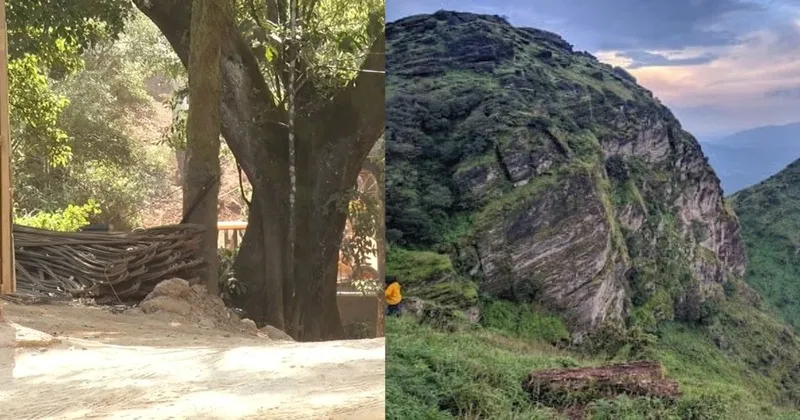
The resort, reportedly valued at over Rs 50 crore, is being built on Survey Number 53 of Kolagave village, where a hillock has allegedly been damaged to make way for construction. Environmental activists claim that the land lies in a sensitive zone rich in shola forests and rare plant species unique to the Western Ghats ecosystem. Any alteration of terrain in such areas is considered environmentally hazardous and strictly regulated under law.
Records indicate that in 2020, the accused leaders purchased around 4.32 acres of coffee plantation land in Kolagave village. Though land-use conversion was reportedly obtained during the tenure of the then Deputy Commissioner, activists argue that such conversion alone does not override forest and wildlife protection norms. Crucially, they allege that no clearance was obtained from either the State Forest Department or the Union Ministry of Environment, Forest and Climate Change, which is mandatory for projects located within or near buffer zones of tiger reserves.
Experts Warn of Irreversible Ecological and Geological Damage
Construction activity is said to have begun in November 2025. However, under existing rules, no large buildings or mining-related activities are permitted within a 10-kilometre radius of a buffer zone without explicit approval from both central and state authorities. Despite this, work has allegedly continued uninterrupted.
Environmental activist Veeresh has alleged that the Forest Department’s inaction is deeply troubling. “This is a clear violation of the Wildlife Protection Act, 1972. Even after repeated complaints, officials have failed to stop the work or initiate legal action. Such silence only strengthens suspicions of political pressure,” he said.
The Chandradrona mountain range, which includes famous tourist spots like Mullayanagiri, is known for its rich biodiversity and serves as the source of several sub-rivers. Experts warn that unregulated construction could cause irreversible damage to fragile ecosystems and water sources that support both wildlife and human settlements downstream.
Geological Survey of India Had Flagged Construction Risks Earlier
Adding to the concern, scientists from the Geological Survey of India have previously warned that large-scale construction in the Chandradrona range could destabilise the terrain, posing long-term risks not only to the mountains themselves but also to nearby regions, including Mullayanagiri. Environmentalists argue that ignoring such warnings for commercial gain reflects a dangerous disregard for ecological balance.
The alleged illegal resort has now become a symbol of larger governance failures in protecting environmentally sensitive regions. Critics question how such a massive project could proceed without clearances and why enforcement agencies have not acted decisively. The episode has renewed calls for an independent inquiry and immediate suspension of construction until all legal and environmental aspects are thoroughly examined.