
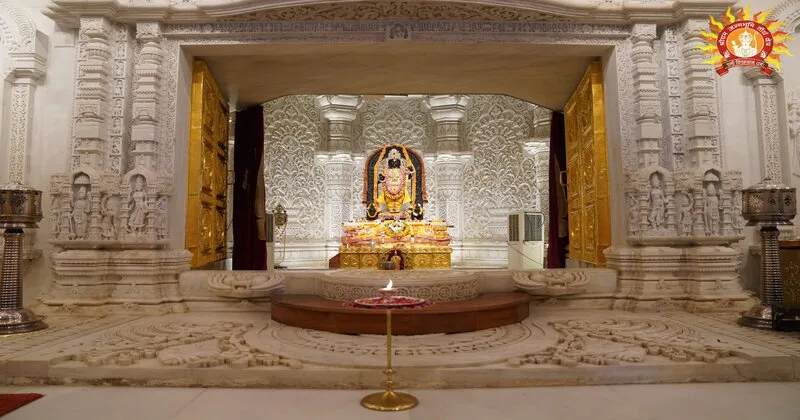
Millions of people worldwide attended Ram Lalla’s Pran Pratishtha (consecration) on January 22, 2024, which marked the beginning of Bharat’s spiritual revival. The birthplace of Shri Ram, Ayodhya, is more than just a city; it is a timeless, spiritual resonance. It represents Shri Ram’s embodiment of dharma, truth, sacrifice, and an ideal way of life. Ayodhya rises tall as a light of Bharatiya culture, Sanatan Dharma, eternal devotion, and a path forward to make Bharat “Vishwaguru” to bring peace to the world, while the recently constructed Ram Mandir glows in spiritual brilliance.
The magnificence of Hindu philosophy and culture is demonstrated by the Shri Ram Mandir. Its elaborate design, which represents the artistic and architectural genius of ancient Bharat, displays traditional Bharatiya skill, knowledge and workmanship. Beyond its magnificent architecture, the temple transcends linguistic and geographic barriers, serving as a unifying force across Hindu and global culture. It serves as a reminder of their common ancestry and a source of cultural pride for the Hindu diaspora worldwide. In a world growing more interconnected by the day, it promotes unity and upholds the timeless principles of Hindu Dharma. The image of Shri Ram is not limited to Ayodhya or Bharat. His aura is actually felt worldwide. He is a symbol of humanity as a whole.
In the context of Hinduism, the construction of the Ram Mandir represents a significant turning point in the religious and cultural legacy of millions of people. In addition to being a physical building, the temple honouring Lord Ram is a symbol of spiritual rebirth, cultural preservation, and the embodiment of principles deeply imprinted in the hearts of Hindus and believers worldwide. The story of the Ram Mandir strikes a deep chord with Hindu Dharma’s ethos, representing a shared desire for the divine to return to a hallowed place. For Hindus, the Ram Mandir serves as a physical reminder of their ancient heritage and a symbol of the culture’s everlasting vitality. As a result, the temple represents both the fundamental principles of our society and the attributes of Rama that all people find admirable. The conclusion of the 28th Dwapara and the beginning of Kaliyug in this 7th or Vaivasvata Manvantara were marked by the symbolic re-establishment of Ramrajya following Krishna’s death in the fifth millennium BCE.
The term “Ram” refers to more than an ancient civilisation that persists to this day, that is Bharat. The name stands for an identity and a value that transcends all historical eras in practice and vitality. Folktales from Bharat’s northern and southern regions, as well as from the country’s west and east, live on in people’s hearts. The name “Ram” is one that children in every corner of Bharat admire from an early age. His legendary life stories have spread beyond Bharat’s borders to Southeast Asian nations, where the Ramayana is still portrayed creatively in theatre, music, dance, painting, and sculpture.
The Valmiki Ramayana in Sanskrit, Tulsidas’ Ramcharitmanas in Hindi, Kamban’s Ramavataram in Tamil, and numerous more regional retellings of Shri Ram’s epic have reverberated throughout Bharat for millennia. His role as Bharat’s unifying factor is highlighted by this common story that transcends languages and customs. Beyond Bharat, the Ramayana has an impact throughout Southeast Asia; the art of Myanmar and Laos, Thailand’s Ramakien, Cambodia’s Reamker, and Indonesia’s Kakawin Ramayana all demonstrate how ingrained Ram’s principles are in world cultural traditions. Ram’s principles are universally appealing, as seen by the magnificent monuments of Angkor Wat and the shadow puppets of Java.
This magnificent temple honouring Shri Ram can be seen as a national and international representation of Bharat’s soft power. The Ram Mandir’s significance extends beyond local borders and into the global sphere. This temple will become a symbol of love, trust, international brotherhood, and all the positive aspects of humanity, resonating with people worldwide as nations redefine their cultural and historical narratives. Bharatiya culture’s fundamental inclusiveness will undoubtedly provide a more supportive atmosphere. Despite the tumult of history, Ayodhya’s spirit persisted, transcending national boundaries and reverberating around the world. Beyond Bharat, Bhagwan Ram is revered in Nepal, Sri Lanka, Thailand, Indonesia, and other countries.
For thousands of years, Bharat’s culture, customs, and social ideals have been shared with the entire South Asian subcontinent. These characteristics, as well as the regional political dynamics, could be redefined by the Ram Mandir. The fundamental qualities of Bharatiya civilisation, inclusivity and acceptance, have historically played a crucial role in bridging the political divide between the various nations, religions, cultures, and traditions from around the world, making Bharat a completely different state where religious pluralism is guaranteed and encouraged.
The Shri Ram temple in Ayodhya celebrates centuries of resiliency and Bharatiya culture rather than commemorating devastation. The purpose of a darshan of Ramlalla is to uphold the fundamental principles and values of our society, emphasise their importance, and act as a lasting reminder of these principles to coming generations. The Ram Lalla idol’s “pran pratishtha” ceremony at Ayodhya Ram Mandir was more than just a Dharmic ritual. There was a lot more. It is witnessing the global awakening of civilisation and the emergence of a nation that has finally broken free from the bonds of colonialism.
“This is a fantastic decolonisation effort. However, everyone who discusses decolonisation is quite angry. In a YouTube video, Canadian journalist Daniel Bordman praised Bharat for the “pran pratishtha” event, saying, “What this is, is a proud revival of the Hindu civilisation.” “The Ram Mandir is a shining reminder that Bharat not only survived the onslaught but is starting to thrive,” corporate expert Lars RKT Noreng wrote on X. The precise definition of Pran Pratistha is “the establishment of life force,” which gives the idol of Ram Lalla life and turns it from a simple shape into a god who can grant blessings and receive prayers.
In a time when disruptive modernity and the echoes of ancient dharma collide, Shri Rama’s unwavering ethos serves as a mirror, a sponge, and a reflection of the many, frequently opposing interpretations and aspirations that shape and propel modern Bharatiya society and the world. Bhagavan Shri Rama is the perfect “Maryada Purushottama,” a harmonic combination of adhyatmik depth and martial valour, standing tall in the vibrant tapestry of Bharatiya ethos and representing the ideal man as imagined in Bharatiya society, literature, music, and song.
A new era of inclusion in Bharat has been made possible by the construction of the Ram Mandir. People from all walks of life are invited to gather and celebrate Bharat’s cultural mosaic at this place, which has become a symbol of shared heritage. The Ram Mandir’s pran pratishtha serves as a moving reminder of the common ideals that bind the people of Bharat together. The majesty of the Mandir signifies a strong commitment to Shri Ram and a shared resolve to put past grudges behind us and embrace a prosperous future.
If Shri Ram is considered as a benchmark, it’s not because he is merely a divine power; rather, it’s because he demonstrated the degree of human potential and tenacity that can produce wonders and miracles. Despite being human at birth, he is revered as a divine figure for his peace and tranquillity from an early age. Despite its strong Hindu roots, the tale of Shri Ram Mandir has a universal lesson. Bhagwan Ram’s life serves as an example of fairness, duty, and harmony—values that cut across all cultures and religions. As a result, the temple is both a hallowed site for Hindus and a symbol of ideals that uplift people worldwide.
It encourages people from diverse backgrounds to consider the tenets of dharma and strive for a life characterised by justice, compassion, and integrity. A “Swa” mentality, which incorporates a “Nation and Bharatiya culture first” attitude, has replaced colonialism as the primary concern of every Bharatiya. This will set our nation and society up for growth in every aspect of life. Shri Ram is more than just a name and a figure. He is a timeless source of inspiration that has nourished and penetrated this hallowed civilisation. Seeing our nation embrace its ancient roots on a scale never before seen in recent decades is encouraging. As Bharat rises, striking a balance between modernity and tradition, let us declare that where roots are deep, victory is certain.