The familiar division of “North India” and “South India,” though convenient in modern discourse, arises largely from colonial cartography and administrative logic. Civilisational sources speak instead of Uttarapatha and Dakṣiṇapatha—not as opposed cultural blocs, but as interconnected cultural corridors through which texts, rituals, teachers, and metaphysical insights travelled. This indigenous imagination of space is captured in the Puranic assertion: ekam eva hi tattvaṃ bahudha pratibhati—the One Reality appears in many forms.
To speak of the North and South of Bharat, therefore, is not to invoke a binary, but to recall a spatial vision in which movement precedes maps and unity is sustained through circulation rather than uniformity. In this sense, such a gathering is not merely academic; it becomes an act of decolonial remembrance—an attempt to recover how this civilisation has historically known itself across time, space, language, and form.
What does it mean for a civilisation to remember itself after centuries of colonial interruption and ideological distortion? When Krama and cultural flows are invoked, when Kashmir and Kerala are spoken of together, the inquiry moves beyond any single text or region. It invites deeper reflection on how Bharat has known herself, how that self-knowledge has been obscured, and how it might be reclaimed today. This inevitably compels a re-examination of the very idea of the Nation, Bharat.
Rethinking Rashtra
Modern thought has proposed dominant frameworks for understanding the nation. The first is NavaRashtravada—the idea that the nation is still “in the making.” Jawaharlal Nehru’s declaration in A Tryst with Destiny exemplifies this view, presenting the nation as a future political project rather than an already existing civilisational reality.
This formulation reflects a European modernist inheritance, where the nation emerges from political will, economic integration, and institutional consolidation. Within this framework, Rashtra becomes provisional rather than civilisationally grounded. Continuity is reinterpreted as cultural plurality without a unifying metaphysical core, while political unity is projected forward as aspiration rather than recognised as inheritance.
Closely allied to this is BahuRashtravada—the belief that multiple nations coexist within one territory. Both frameworks share a reluctance to recognise Rashtra as a trans-historical civilisational reality. Much of modern education and historiography has been shaped—and distorted—by these paradigms.
The Bharatiya Understanding of Nationhood
In contrast, the earliest articulations of collective belonging in the Bharatiya tradition are not based on a political contract, but on an ontological relationship. The Atharva Veda declares: bhadraṃ ichchhantaḥ sva-vidaḥ—those who know themselves wish well for all. Social cohesion here arises from self-knowledge (sva-vidya), not external regulation.
This vision is further affirmed in the verse: mata bhūmiḥ putro’ham pruthivyaḥ—the Earth is my mother; I am her child. This is not a metaphor but an ontology. The land is not territory to be possessed, but a living matrix to which one belongs. Rashtra is thus inherited through participation in geography, memory, ritual, and value.
Dr BR Ambedkar expressed this insight when he defined nationalism as “the feeling of corporate sentiment of oneness which makes everyone charged with the feeling that they are kith and kin.” Nationhood, for him, preceded governance; it was an affective and moral unity. This resonates with Giuseppe Mazzini’s description of the nation as “a spiritual principle, based on memories of a rich heritage and a keen desire to live together.” Across these formulations lies a shared recognition of the nation as a living moral organism.
The Bharatiya conception affirms ChiRashtravada—the understanding that the nation is ancient yet dynamic, continuous yet capable of renewal. It is not “made” anew in every generation; it is remembered, reinterpreted, and re-inhabited.
Recovering this distinction is not nostalgia. It restores a civilisational self-understanding in which political forms serve a deeper cultural and metaphysical unity. Only when Rashtra is understood as a continuum of consciousness, rather than a temporary arrangement of power, can national integration move beyond administrative coherence towards genuine civilisational solidarity.
National Integration: A Civilisational Perspective
Contemporary discussions of national integration in Bharat often remain confined to political structures or constitutional frameworks. While important, these are only the outer scaffolding of unity. Bharat was never held together solely by political power. Long before the modern nation-state, she existed as a deeply integrated cultural and spiritual organism.
Her unity arose not from uniformity, but from a shared metaphysical vision that allowed diversity to flourish without fragmentation. Dr B R Ambedkar stated this with clarity in his 1916 Columbia University paper, later published as Castes in India: “It is the unity of culture that is the basis of homogeneity… not only a geographical unity, but a deeper and more fundamental unity—the indubitable cultural unity that covers the land from end to end.”
Under colonial rule, this organic unity was systematically misrepresented. Bharat was portrayed as a “mosaic” or a “congeries of races.” Philosophies were reduced to abstraction, rituals dismissed as superstition, and regional traditions labelled as “folk survivals.”
A genuinely decolonial approach must reject these binaries: high philosophy versus low ritual, pan-Indian versus local, textual versus performative, North as spiritual and South as sensual. These are not civilisational inheritances, but residues of an external gaze that failed to understand how this civilisation lives, thinks, and remembers.
Consciousness as the Ground of Reality
At the heart of Bharat’s civilisational vision lies a radical insight: reality itself is consciousness. Kashmir Shaivism expresses this succinctly in the dictum ‘Chaitanyam atma’—consciousness is the Self. Consciousness here is not a by-product of matter or a passive witness, but vibrant, creative, and self-luminous.
The Mahanayaprakasha salutes Shiva as one whose very body is consciousness: Shrīmanmahaprakashavapuṣe Shivaya namaḥ. Consciousness manifests the universe not by compulsion but by freedom—svechchhaya svabhittau vishvam unmīlayati—unfolding the cosmos upon its own screen.
This vision reverses the assumptions of modern epistemology. It does not reject science but deepens the meaning of knowing. If consciousness alone is real and all beings are its expressions, no social hierarchy can claim ultimate ontological validity. Kashmir Shaivism thus emerges as a profoundly ethical vision, affirming the essential equality of all beings.
Rabindranath Tagore articulated this ethos in Swadeshi Samaj: “To feel unity in diversity, to establish unity amidst variety—that is the underlying Dharma of Bharat… Without destruction, she seeks accommodation within one great system.”
This principle applies equally to knowledge traditions. Sanskrit shastra and Malayalam mantra, Kashmiri verse and Kerala ritual, are not hierarchically ordered but diverse modalities of a shared intelligence. To label one “high” and another “low” is to reproduce colonial hierarchies within indigenous scholarship.
Krama, Tantra, and the Flow of Knowledge
Tantra refuses confinement. It sanctifies the world, divinises embodiment, and allows knowledge to flow across languages, regions, and social boundaries. As Maheshvarananda declares, sva-shakti-vistara-matraṃ jagat—the universe is the expansion of one’s own power.
Kashmir Shaivism never imprisoned truth within rigid structures. Knowledge flowed, adapted, and incarnated wherever conditions were ripe. Arbitrary social and linguistic barriers were not merely questioned but experientially transcended.
This vision finds refined articulation in the Krama system. Krama affirms the Absolute as pulsating awareness rather than static perfection. Shakti stands at the centre as the very power of manifestation. Every act of perception becomes a movement in consciousness recognising itself.
Krama thus offers an indigenous model for plurality and process, avoiding both homogenising centralisation and fragmentary identity politics. It honours difference without losing sight of unity.
Kashmir, Kerala, and Living Metaphysics
Kashmir occupies a unique place in this narrative as the land where this vision received its most rigorous articulation. Within its Shaiva and Shakta traditions, reasoning, experience, and ritual informed one another. Abhinavagupta embodies this synthesis: the same thinker who systematised Krama and Trika also authored the great commentary on the Natyashastra, affirming that aesthetic rasa and mystical experience arise from the Self tasting itself.
From Kashmir, these ideas travelled south as lived practices—through Karnataka’s Veerashaiva movement, Tamil Shaiva Siddhanta, and finally into Kerala’s ritualised Shakta-Shaiva landscape. In Kerala, Krama becomes embodied metaphysics. Bhagavati worship, the Sapta Matrukas, Theyyam, and Kalamezhuthu are not “folk survivals” but ritual commentaries on non-dual philosophy. When a socially marginal performer becomes the living deity before whom all bow, Krama is enacted ontologically.
To perceive this requires a decolonial gaze—one that recognises ritual as thought, performance as philosophy, and embodiment as a valid mode of knowing.
The school of Pratyabhijña, founded by Somananda and refined by Utpaladeva and Abhinavagupta, teaches a simple yet transformative truth: one is already what one seeks. Liberation is not acquisition but recognition—the removal of forgetfulness of one’s own nature.
If Pratyabhijña provides the logic of liberation, Krama provides its movement. As the path of the Mahartha, centred on Kali as Time and Perception, Krama understands consciousness as rhythmic flow articulated through the five movements of awareness—emission, maintenance, withdrawal, the ineffable, and radiance.
As Krama travelled south, it did so as lived upasana, teaching that plurality is not a snare to escape but a sequence to be experienced and reabsorbed into the unity of the Self.
Shaivism and Cultural Flows to the South
As Kashmiri Shaiva thought moved south, it did not merely pass through Karnataka; it took root and cross-pollinated. The twelfth century marked a profound spiritual transformation through Basavanna and the Veerashaiva movement. Veerashaivism and the Vachana tradition drew significant philosophical grounding from Kashmiri Pratyabhijña. The doctrine of Shakti-Vishishtadvaita echoes Kashmiri non-dualism, and like the Kashmiri masters, the Sharanas rejected the notion of the world as illusion (maya), affirming it instead as Shiva’s leela.
The Veerashaiva principle of anga–linga samarasya—the identity of the soul and the Divine—stands as the lived equivalent of Kashmiri “recognition.” Here, Pratyabhijña was embodied rather than merely argued. Earlier Shaiva ascetic traditions such as the Kalamukhas and Pashupatas served as conduits for Kashmiri texts, while inscriptions like the Belagavi plates attest to the circulation of the Īshvarapratyabhijñakarika within temple networks.
Allama Prabhu’s poetry mirrors Abhinavagupta’s doctrine of vimarsha, self-reflective consciousness. His evocation of the “Light within the Light” resonates directly with prakash, the self-luminous awareness central to Pratyabhijña.
Under the Chola Empire, Tamil Nadu became another site of synthesis. Royal patronage facilitated the circulation of Kashmiri texts, while the Tirumurai hymns anticipated recognition through devotion. Shaiva Siddhanta, systematised by the Meykandar school, reframed Kashmiri monism through a dualistic lens, yet preserved its core intuition: liberation as the removal of anava-mala and a return to self-knowledge, ritually enacted in sacred spaces such as Chidambaram.
As these currents reached Kerala, philosophy became ritual. Between the ninth and thirteenth centuries, Kerala absorbed Pratyabhijña and Krama through royal patronage and monastic centres that preserved Kashmiri manuscripts. Shaiva Siddhanta in Kerala retained recognition as pashu-moksha, realised through deeksha. Kerala’s worship of Bhagavati and the Sapta Matrukas embodies the Krama system, preserving vimarsha as vibrating awareness rather than silent witness.
Practices such as Theyyam and kalamezhuthum pattum do not comment on non-duality—they enact it. When a socially marginal performer becomes the living deity before whom all bow, Krama is realised ontologically. This is not ritual inversion but consciousness recognising itself beyond social fixation.
Perennial Civilisational Memory
Colonial narratives described cultural influence in Bharat as linear—from centre to periphery, from Sanskrit to regional. What they missed was an older reality in which centre and periphery were fluid, languages formed a continuum, and ritual and philosophy co-emerged. Krama teaches sequence without absolutes. Kashmir and Kerala are neither origin nor derivative; both are crystallisations of a shared field of consciousness.
The Brahmayamala affirms this unity: neither inner nor outer exists alone; through knowledge and ritual together, reality shines forth in fullness. To place Kashmir and Kerala in dialogue is not to connect distant regions, but to recover a civilisational pattern obscured by colonial modernity.
Bharat will remain united not by force, but by shared spiritual memory. Scholarship must therefore combine historical rigour with the courage to move beyond inherited frames. If Krama becomes not merely a subject of study but a way of being—honouring sequence and diversity while remaining rooted in unity—this inquiry will have served a deeper purpose: enabling Bharat to recognise herself once again as a consciousness-civilisation.
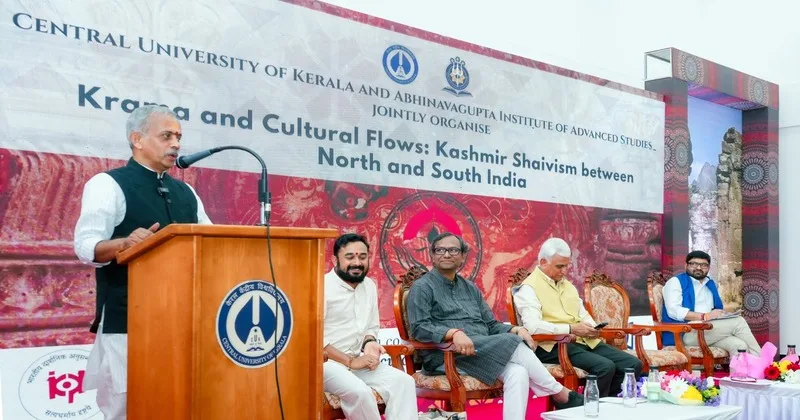
(Excerpts from J Nandakumar Ji’s speech at the international seminar on ‘Krama and Cultural Flows: Kashmir Shaivism between the North and South of Bharat’ at the Central University of Kerala (CUK) on January 14, 2026)