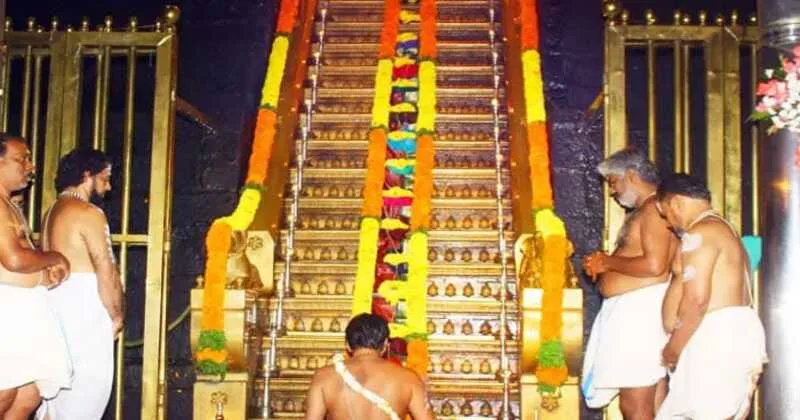
Thiruvananthapuram: A serious corruption scandal has surfaced at the Sabarimala temple, with the Intelligence Wing of the Vigilance and Anti-Corruption Bureau flagging large-scale irregularities in the allocation and sale of special offerings, most notably the highly revered Padi Puja (special ritual at the 18 Holy Steps). According to the vigilance report, Padi Puja slots have been booked in advance, reportedly running up to 2040, by insiders and their proxies and are later resold in the black market at exorbitant prices. A ritual officially priced at Rs 1.37 lakh is being sold in the black market at up to ten times that amount, exposing what many are calling a parallel economy operating within one of India’s most sacred shrines.
The report points to improper intervention by employees of the Travancore Devaswom Board (TDB) in the management and allocation of offerings. It states that slots for special pujas are being cornered by board employees and their benamis (proxies), only to be resold later to desperate devotees at exorbitant prices. The main focus of the irregularities is Padi Puja, a ritual not conducted during the peak Mandala–Makara Vilakku season but performed for four days after Makara Vilakku, during the Masa Puja period (Monthly puja), and on special occasions such as Vishu, Onam, and Pratishtha Dinam.
The vigilance report identifies 18 types of pujas and 39 types of offerings at Sabarimala and warns that widespread irregularities are being committed with the active connivance of Devaswom Board employees and their agents. It stresses that sustained and precise action is urgently needed to dismantle these corrupt networks and restore integrity to mandir administration.
The black-market manipulation is not limited to Padi Puja alone. Similar irregularities have been reported in other high-value offerings such as Thanga Anki Chart, Ashtabhishekam, Sahasrakalasham, Udayasthamaya Puja, Pushpabhishekam, and Kalashabhishekam. Notably, there are officially no available slots for Thanga Anki Chart and Ashtabhishekam until 2035, and for Sahasrakalasham until 2034, yet devotees continue to secure these offerings through unofficial channels at inflated rates. Sahasrakalasham, one of the most important rituals, has bookings completed until May 2034. Priced officially at Rs 91,250, it is performed on the last day of all monthly pujas and involves worship with 1,000 kalashams followed by abhishekam. The vigilance report has called for a probe into whether corruption has infiltrated this offering as well, given the suspicious booking patterns and long waiting periods.
Reacting sharply to the revelations, Hindu Aikyavedi leader Sasikala Teacher launched a scathing critique of the entire Devaswom system. “What was the Devaswom Board meant for? What was its real role? Was it only to draw salary, allowances, cars and coffee?” she asked. Questioning the purpose of having a Devaswom Minister, she added, “Was it only to show off to devotees while opening the temple and to issue appointment orders to party members?”
She further raised concerns about the failure of Devaswom Vigilance, judicial supervision, and internal controls. “There was no shortage of anything, no lack of manpower, no lack of authority. Then why all this corruption?” she asked. Sasikala Teacher argued that the situation might have been far better if a committee of genuine devotees had been entrusted with supervising temple affairs. “At least the burden of feeding these white elephants would have been avoided,” she remarked.
The revelations have shaken public confidence in Sabarimala’s administration and triggered a wider debate on how a sacred institution has become vulnerable to black-market manipulation. With the vigilance report now in the public domain, the spotlight is firmly on the Travancore Devaswom Board and the state government to act decisively and ensure that faith, not profiteering, governs one of India’s holiest pilgrimage centres.