Over the past several years, Jamia Millia Islamia has repeatedly found itself at the centre of serious allegations ranging from coercive religious practices to discrimination against non-Muslims, Dalits and tribals. Many have increasingly described the centrally funded minority institution as one where complaints of ideological coercion, caste-based bias and administrative retaliation are not aberrations but part of a recurring pattern. From allegations of forced conversion to claims that internal grievance mechanisms either fail to act or are allegedly weaponised against complainants, Jamia’s name has surfaced again and again in controversies that raise uncomfortable questions about accountability within the campus.
It is against this backdrop of unresolved allegations and a trail of past complaints that a fresh and disturbing case has now emerged, this time involving physical violence, caste abuse and alleged retaliation against a Scheduled Tribe employee inside the university premises.
Fresh case against a tribal man
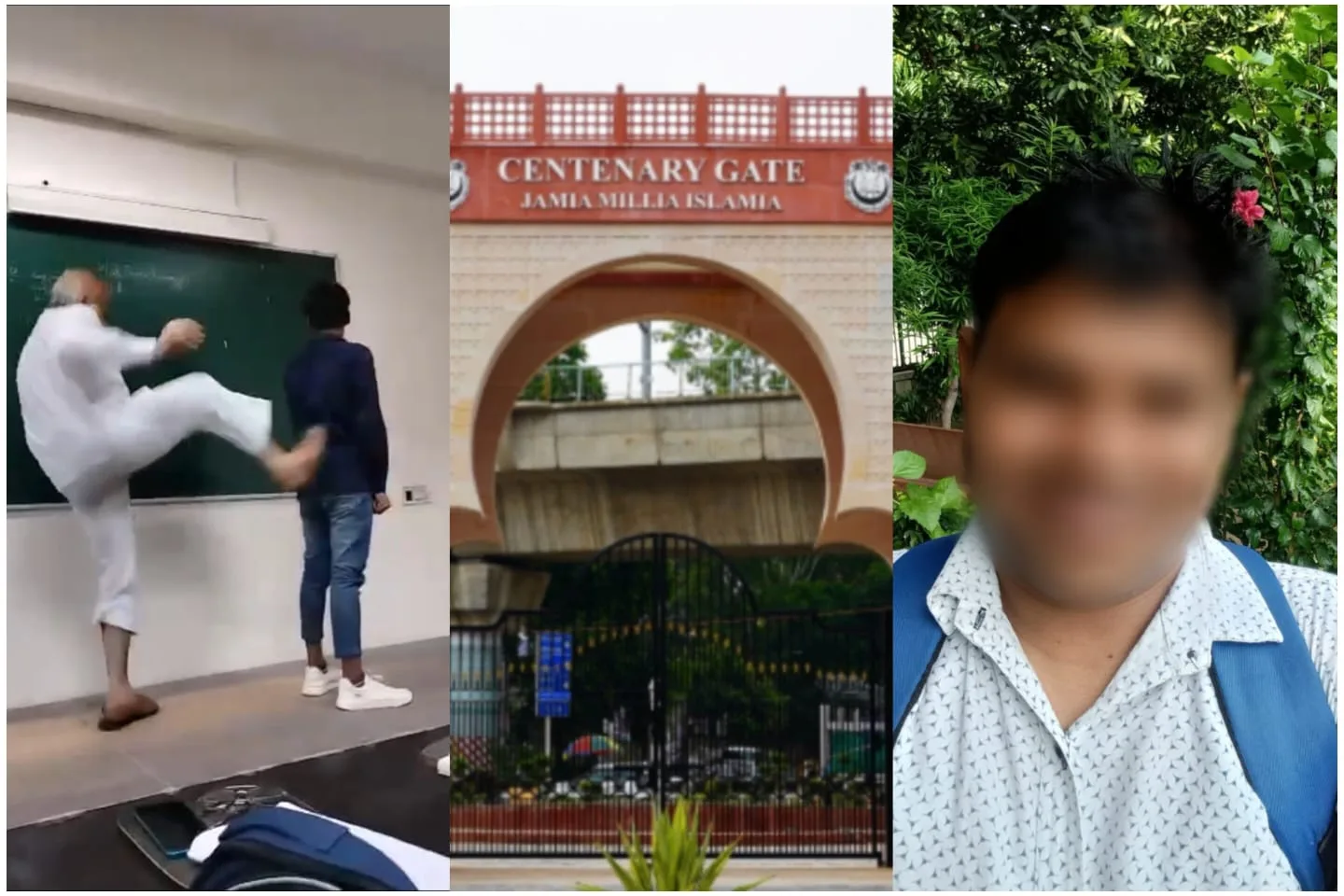
According to a detailed written complaint dated January 17, 2026, submitted to the Assistant Commissioner of Police (ACP), Sarita Vihar-Sukhdev Vihar, the complainant, Ram Phool Meena, son of Narayan Lal Meena, belongs to the Scheduled Tribe community. Meena is employed as an Upper Division Clerk (UDC) at Jamia Millia Islamia’s University Polytechnic, which functions as a unit of the central university. The accused named in the complaint is Dr Riyazuddin, an Associate Professor in the Civil Engineering Department at the University Polytechnic.
Meena has made it clear in his complaint that the alleged assault did not occur in isolation, nor was he the complainant against the faculty member. According to him, the hostility began following a complaint submitted to the Registrar’s office against Dr Riyazuddin over allegations of abuse of students within the university, a complaint with which Meena states he had no direct involvement. However, after a video related to the issue went viral, Meena alleges that he was singled out and made a target. Soon thereafter, he claims, he was subjected to verbal abuse, caste-based humiliation, physical assault and, eventually, a transfer order.
The first incident, as per the complaint, took place on January 13, 2026, at around 3:00 pm. Meena stated that he was working at his desk in the University Polytechnic office when Dr Riyazuddin entered without provocation and approached him. The faculty member allegedly addressed him using a caste-linked slur, saying, “Arey O Meena kamina Hindu Muslim karte hain,” he said, “You Meena scoundrel”.

When Meena objected to the language and asked him to maintain dignity and decorum, the complaint states that Dr Riyazuddin became aggressive and began hurling obscene abuses involving Meena’s mother and sister.
Shaken by the incident, Meena stated that he immediately submitted a written complaint to the Registrar of Jamia Millia Islamia on the same day. Copies of this complaint, he said, have been annexed with his police filing. However, according to Meena, no action was taken for the next two days. More alarmingly, he alleged that the contents of his complaint were leaked from within the Registrar’s office to the accused faculty member, a development that, according to him, directly led to further escalation.
The situation allegedly turned violent on January 16, 2026, at around 5:00 pm, when Dr Riyazuddin returned to Meena’s office. According to the complaint, the faculty member again abused him, this time explicitly targeting his tribal identity and the fact that he had dared to complain within what was described as a “Muslim institution.”
Meena quoted the accused as saying, “Arey harami Meena, tumhari aukaat kaise hui ki tumne mere khilaaf complaint ki? Tum saale Adivasi jangli ho, Musalmanon ke idare mein rehkar mere khilaaf shikayat karne ki jurrat kaise ki?”

Protest and the assault
When Meena protested against this abuse, the complaint alleges that Dr Riyazuddin came close and punched him in the face, followed by four to five additional punches. As a result of the assault, Meena stated that his lips began bleeding and he suffered visible swelling below his left eye.
Following the incident, Meena said he had to visit Jamia’s Ansari Health Centre, where he received primary medical treatment. Medical documents related to the treatment have been attached with his police complaint. He further wrote that the assault caused him severe mental trauma, depression and a deep sense of social humiliation, particularly because the abuse was rooted in his caste and tribal identity at his workplace.
Later that same evening, at around 6:30 pm, Meena approached the Registrar’s office once again, this time accompanied by his Principal, Prof Mumtaz Ahmad Khan. He submitted another written complaint seeking immediate action. According to Meena, the Registrar assured him that the matter would be taken seriously and told him that there was “no need to go anywhere else.”
However, in a move Meena has described as shocking and unjust, a transfer order was issued against him on the very same day. The order is dated January 16, 2026, and bears Order No. F. No. Gen. 32/Esstt.-NT/RO/JMI/2025. Meena has alleged that instead of acting against the accused faculty member, the administration chose to transfer the victim, calling the decision retaliatory, punitive and aimed at silencing him.
In his complaint to the Delhi Police, Meena has sought the registration of an FIR under the Scheduled Castes and Scheduled Tribes (Prevention of Atrocities) Act, 1989, along with relevant provisions of the Bharatiya Nyaya Sanhita.
Speaking to Organiser, Ram Phool Meena said that the abuse he has faced is not limited to the incidents mentioned in his police complaint. He alleged that over a period of time, he has been subjected to relentless pressure to convert, both directly and indirectly, within the university ecosystem. Meena further stated that he has been repeatedly referred to as a “kaffir” by several individuals on campus, a term he described as deeply humiliating and dehumanising. According to him, this sustained harassment and targeting stem solely from his religious identity, asserting that he has been singled out because he is a Hindu.
Spate of incidents against Hindus
The Meena case is not the first time Jamia Millia Islamia has faced such allegations. On July 17, 2024, Organiser reported that Jamia Registrar Nazim Hussain allegedly told a Dalit employee, “Bring Iman, and we will secure your and your children’s careers.” The report triggered nationwide outrage and led to the formation of a fact-finding committee to probe allegations of forced religious conversion within the university.
A few months later, on October 26, 2024, another Organiser report revealed that a Divyang woman was allegedly pressured to convert and told, “Wearing a hijab will bring noor to your face.” These allegations intensified scrutiny of Jamia’s internal culture and administrative functioning.
Under mounting public pressure, the committee released a 64-page report on November 14, 2024, at a press conference addressed by former Delhi High Court judge Justice (Retd) S. N. Dhingra and former Delhi Police Commissioner S. N. Srivastava. The report recorded testimonies from 27 individuals, including seven teaching faculty members, six non-teaching staff members, as well as PhD scholars, students and alumni.
The #JamiaMilliaIslamia Conversion Nexus:
I have been reporting cases from Jamia Millia Islamia where individuals have acknowledged being forced to convert to Islam by both teaching and non-teaching staff of the institution. In the three cases I reported, the allurements ranged… pic.twitter.com/wFHNLRJT5F
— Subhi Vishwakarma (@subhi_karma) November 15, 2024
According to the report, witnesses alleged coercion into religious conversion, discrimination against non-Muslims and career stagnation for those who refused to convert. One Assistant Professor testified that her Hindu beliefs were mocked and that her promotion was denied despite her eligibility, while juniors allegedly lacking qualifications were promoted ahead of her.
Adding to the controversies, Jamia had also faced criticism over an examination question that asked students to “discuss atrocities against Muslims in India with examples.” The question triggered allegations of selective academic framing and ideological bias, further intensifying scrutiny of the institution.
Question in a paper by social work department of Jamia Millia Islamia college – “DISCUSS ATROCITIES AGAINST MUSLIMS IN INDIA GIVING SUITABLE EXAMPLES”
Jamia is a state-run university. On our tax money, they are teaching how to only remember Akhlaq and totally ignore Ram Gopal… pic.twitter.com/GaD65TjczS
— Swati Goel Sharma (@swati_gs) December 22, 2025
Following the earlier controversies, an Officer on Special Duty (OSD) of Jamia Millia Islamia had publicly stated that the university would follow a “zero tolerance policy against forced conversion and discrimination.” However, with fresh allegations now surfacing, this time involving physical assault, caste slurs and an allegedly retaliatory transfer, many argue that such assurances remain limited to statements, with little evidence of implementation on the ground.
With repeated allegations of coercion, discrimination, violence and administrative retaliation emerging from Jamia Millia Islamia, the Meena case has once again brought the institution under a harsh spotlight. The larger and unavoidable question now confronting policymakers and the public is whether it is justified for the Central government to continue funding an institution that is repeatedly accused of forcing religious conformity and punishing those who dare to resist.