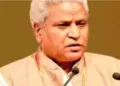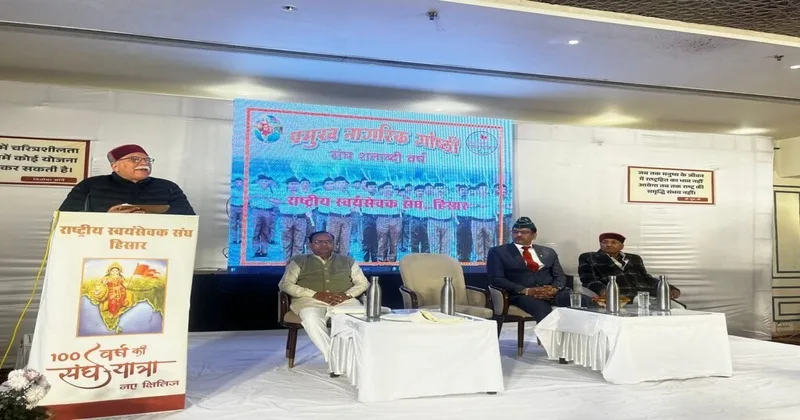
HISAR: Sangh’s centenary year is not a time for celebration but for introspection. The objective this year is to reach those sections of society that have not yet been reached and to unite the entire society into a single thread. The journey of the RSS is a journey from individual character-building to nation-building, said Arun Kumar, Akhil Bharatiya Sah Sarkaryavah of Rashtriya Swayamsevak Sangh (RSS), while addressing a programme at Punjabi Bhavan, Hisar, Haryana, on January 18, 2026.
The programme began with the lighting of the ceremonial lamp and the collective singing of Vande Mataram.
Reflecting on why India had to endure a thousand years of struggle despite its culture once being at the pinnacle of the world, he said that Dr Keshav Baliram Hedgewar identified four fundamental weaknesses in society: First, although individual character was strong, the concept of the nation had weakened. For thousands of years, the identity of people was that of the “children of Bharat Mata,” but during invasions, due to the absence of an organised national consciousness, society fought in fragmented princely states.
Second, there was a lack of pure nationalism. Defeats in struggles were often due to internal betrayal. Dr Hedgewar gave the idea of “Nation First” and emphasised that patriotism is not merely a slogan but a lifelong value.
Third, there was a lack of discipline and organisation. The Vedic concept of nationhood, one thought, one voice, and one goal, was abandoned, leading to a decline in self-respect and the rise of a colonial mindset. Even after Independence, the tendency to consider foreign languages and cultures as superior continued.
Fourth, there was a lack of individual development and awareness of “who we are.”
Based on these four pillars, Dr Hedgewar founded the RSS and laid the foundation of individual development through the shakha system.
Arun Kumar said that the RSS’s path has never been easy. Through struggle and opposition, the Sangh has emerged stronger. The RSS does not consider anyone an opponent; therefore, today, even its critics stand with it. Quoting Jayaprakash Narayan, he said, “If any organisation can fulfil my resolve, it is only the RSS.”
He also referred to the Sangh’s satyagraha for one nation, one constitution, and one head in Kashmir, as well as the service rendered by swayamsevaks during every disaster and time of need. The RSS has never taken credit for its work; this is its defining characteristic. The Sangh believes that every citizen should have food, clothing, shelter, employment, healthcare, and values. Wherever there is a shortcoming in society, the RSS works with a spirit of national service. He said, “Every individual’s pain is my pain”—this has been the soul of Bharat, and that is why India was once great and prosperous.
Speaking on the concept of Panch Parivartan, he said that real change is possible not through discussions alone, but through small, practical changes in daily life. Following national laws and rules, developing awareness of Swadeshi values, and embracing one’s roots with pride is the path to a dignified and meaningful life.
During the question-and-answer session, Arun Kumar said that the term’ caste’ was originally linked to national consciousness and that the distortion of discrimination stemmed from foreign influences. Many social evils were eliminated by great leaders, and the remaining challenges must be resolved with collective societal effort.