
“We, the Hindus, are divided in numerous small communities, many barriers-provincialism-who will respond overcoming all these obstacles? We suffered from many dangers, but we could never be united. When Mohammed Ghouri brought the first blow from outside, the Hindus could not be united, even in those days of imminent danger. When the Muslims started to demolish the temples one after another, and to break the idols of Gods and Goddesses, the Hindus fought and died in small units, but they could not be united. It has been provided that we were killed in different ages due to our discord. Weakness harbours sin. So, if the Muslims beat us and we, the Hindus, tolerate this without resistance-then, we will know that it is made possible only by our weakness. For the sake of ourselves and our neighbour Muslims also, we have to discard our weakness.” – Gurudev Rabindranath Thakur, (From ‘Swamy Shraddananda’, written by Tagore in Magh, 1333 Bangabda; published in the edited book ‘Kalantar’, Viswa Bharati Granthalaya, Calcutta, 1937)
The State of West Bengal is going through different layers of fear psychosis. The ruling party and its leadership exhibit some fears as a political strategy, while others are instilled in people’s minds.
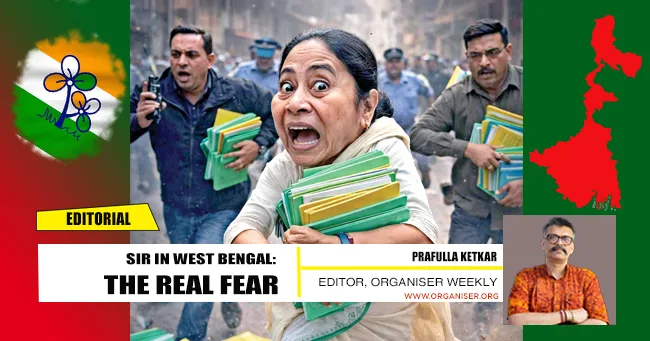
When another drama unfolded in West Bengal, with Mamata Banerjee, along with the State police force, blocking the Enforcement Directorate (ED) raid on the I-PAC office in Kolkata, it was a depiction of her political fear. Bengali versus Bahari (outsiders), and the Union Government’s injustice to Bengalis, are old narratives of the Trinamool Congress (TMC). Although Mamata Banerjee justified her action by saying she acted as a TMC leader, not as the Chief Minister, the manner in which the State machinery accompanied her does not support this claim. The continuous targeting of the Election Commission of India and the process of cleansing electoral rolls through Special Intensive Revision (SIR) reveal a strategy against the Union Government, rather than fear. The Supreme Court hearing on FIRs against the ED has categorically called out the ‘interference and obstruction’ as a ‘very serious issue’. How real Mamata Banerjee’s fear is, only judicial scrutiny will tell.
However, as Organiser Weekly has been following the ground situation in West Bengal since the 2021 Assembly Elections, the fear in the minds of ordinary people is real. TMC, through its political machinery, has instilled such deep fear in voters that they are unable to express their open support for SIR. The way families, especially women, of the people who did not support the ruling dispensation, were targeted is still fresh in the public memory. The anger against the law-and-order situation is palpable, and corruption across the entire State machinery is murmured throughout the State. Off camera, they will speak about ‘Chhapa’ – the real vote-chori that has been happening in West Bengal, the illegal immigrants and the way State machinery is facilitating them and why SIR is necessary to save democracy in West Bengal. Insecurity among Hindus has increased with the worry of Bengal following the dangerous trend in Bangladesh. Yes, the panic and distress are so prevalent that no one is ready to speak openly about them. Will free and fair elections allow the public to vent their silence through votes? It is the genuine concern for the rest of Bharat.
In a democracy, a fearless atmosphere, insulated from external forces, is the precondition for holding free and fair elections. As Gurudev Rabindranath Thakur said, ‘If weakness is cherished and be allowed to exist, torture comes automatically – nobody can stop it.’ Such weakness stems from fear and a lack of unity. Hindu unity and resistance are the only solutions to save democracy in West Bengal, and this is beyond political consideration. Giving people confidence through united resistance against injustice is the only way this civilisational war can be fought and won.