
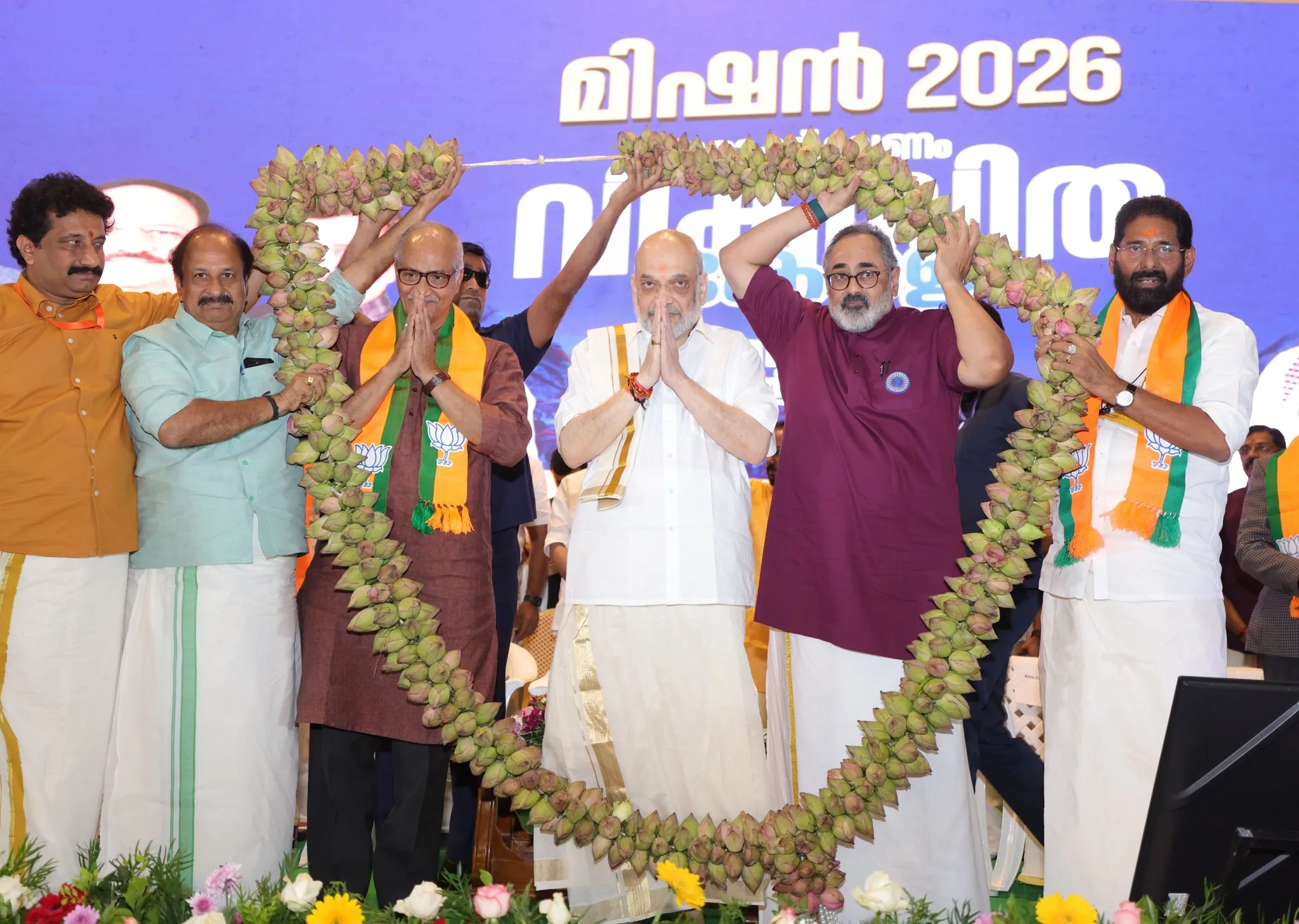
Election management can be charted at a microscopic level, from the booth level to the possible leader of the Assembly, but all this depends on how the voter selects the best from the available choices and whom the voter trusts. This process includes several layers of filtering by a vigilant voter and his perception. In this context, the current tour of Amit Shah and the observers following ground-level and desk-level assessments appear to be in sync with one another.
Earlier, Kerala voters had only two options: either go with the LDF or the UDF, whereas the BJP existed both on paper and on the ground but without electoral success. However, it appears that the arithmetic is changing since 2 years in the state.
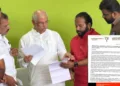
Against this backdrop, Home Minister Amit Shah, on January 11, addressed BJP leaders and workers in the capital city of Tiruvananthapuram. The senior BJP leader’s thrust was on converting the BJP into the ruling party of the state. This was highly significant, as a political churn is taking place across the country in view of the elections due in four states and one Union Territory, that is, five regions. These are Kerala, West Bengal, Tamil Nadu, Assam, and Puducherry, a Union Territory.
Although much has been discussed about all these states, the focus has now zeroed in on Kerala. This is evident in the wake of the much-publicised visit of the Home Minister to Tiruvananthapuram. The tour was clearly confidence-generating and significantly boosted the morale and confidence of workers, cadres, and leaders. Deviating from his usual style, Amit Shah openly spoke about the BJP chief ministerial prospect for the state.
At first glance, this claim appears unbelievable, because Kerala has traditionally been dominated by two powerful alliances: the Congress-led United Democratic Front (UDF) and the CPI(M)-led Left Democratic Front (LDF). Currently, the LDF is in power, with Pinarayi Vijayan serving his second consecutive term as Chief Minister, an exception in a state known for alternating governments. At the same time, there is a serious anti-incumbency factor against the current government.
However, the Congress appears to be in poor shape, with infighting being a regular phenomenon not only in Kerala but also across the country. Therefore, despite strong anti-incumbency sentiment, the Congress does not seem capable of effectively utilising it.
In any political system dominated by two alliances, it is not easy for a third force to emerge. For that to happen, a psychological shift is necessary. Voters must develop a conviction that the “third force” can actually come to power. Otherwise, under normal circumstances, voters would not exercise their franchise in favour of such a party.
Beyond leadership, organisation, and voter base, this psychological shift among voters is crucial. The electorate must believe that the third party can realistically form the government. If voters feel that a party cannot win, they hesitate to support it, fearing that their vote may be wasted or may indirectly help the party they want to defeat.
This is the challenge before the BJP. The party is trying to establish a space for itself. In the 2016 Assembly elections, the BJP won one seat out of 140, making veteran BJP leader and former Union Minister O. Rajagopal its first MLA from the state. However, after five years, the BJP could not repeat the victory from the Nemom constituency when prominent leader and former Mizoram Governor Kummanam Rajasekharan contested in 2021. In the 2024 Lok Sabha elections, the BJP made its parliamentary debut in Kerala by winning a single seat out of 20.
Significantly, the BJP made a major breakthrough in the recently concluded Local Self Government Bodies elections. The party gained power in the Tiruvananthapuram Municipal Corporation, marking its debut in the arena of municipal corporations in the state. The LDF had ruled the corporation for more than four and a half decades.
In this context, the available statistics regarding the BJP’s performance in the Local Self Government Bodies elections assume importance, especially from a comparative perspective.
During his address in Tiruvananthapuram, Amit Shah explained his electoral strategy. He said he has been analysing election data since the age of 15. According to him, the BJP’s vote share in Kerala has grown steadily, from 11 per cent in 2011 to 16 per cent in 2016, and to approximately 20 per cent in the 2024 Lok Sabha elections. He argued that once a party reaches the 20 per cent mark, growing from 20 per cent to 40 per cent does not take five years and can happen much faster. His message was clear: the BJP could potentially touch a 40 per cent vote share in the 2026 Assembly elections.
Prima facie, this argument does not sound believable, and many observers may dismiss it. However, Shah’s confidence is based on factual precedents from various parts of the country. For instance, when the BJP first secured a majority in Uttar Pradesh in 1991, its vote share was 33 per cent. Today, the party has crossed the 50 per cent mark.
Similarly, in Tripura, the BJP did not have a single seat when it went to the polls in 2018. Yet, the NDA went on to win with a two-thirds majority. Tripura is a small state with only two Lok Sabha seats.
Assam, on the other hand, is a large state with 14 Lok Sabha seats. The Congress, led by Tarun Gogoi, won three consecutive Assembly elections there between 2001 and 2016. As per the 2011 Census, Assam’s Muslim population stood at 34.38 per cent, a figure often claimed to be close to 40 per cent today. Despite this demographic reality, the BJP won the Assembly elections in both 2016 and 2021. There is little doubt about its prospects in 2026 as well.
In the 2011 Assam Assembly elections, the BJP secured 16.1 per cent of the votes and won 27 seats, while the Congress had 39.4 per cent of the votes and 78 seats. The AIUDF, a Muslim-centric party, polled more votes than the BJP. By 2016, however, the BJP surged to a 41.9 per cent vote share and won 86 seats, a remarkable leap from 16 per cent to 41 per cent within five years.
These examples demonstrate that when voters’ mindsets change, traditional poll arithmetic becomes irrelevant.
Amit Shah’s analysis of Kerala is based on these precedents. Apparently, Kerala’s Muslim population is around 26.56 per cent. The decisive vote bank in the state is the Christian community, which often determines which alliance comes to power.
The BJP is pinning its hopes largely on Christian votes and expects a shift in this community towards the party. There are multiple reasons for this expectation.
First, the BJP has governed Goa for consecutive terms, clearly with Christian support. In several eastern states as well, BJP-led governments function with Christian ministers, enjoying substantial Christian backing.
Secondly, and more significantly, the Christian community in Kerala faces serious anxiety due to two major issues. The first is “love jihad”, a term that originated in Kerala itself. A former CPI(M) Chief Minister, V. S. Achuthanandan, acknowledged this issue on the floor of the Assembly. Christian organisations raised concerns about indoctrination and religious conversion of young Christian women. Hindus and Christians share this anxiety, and the concern paved the way for coordination between the RSS and Sangh-inspired organisations, thereby expanding the issue beyond the state.
As a result, many Christians believe that alignment with the BJP is beneficial, as the party is seen as uncompromising on such critical issues. Christians are apprehensive about their social, cultural, and demographic survival. A significant number of them believe that aligning with forces opposed to threatening trends such as “love jihad” would be in their interest. However, the big question remains whether this anxiety will translate into votes. Some observers in Kerala believe that many Christians did not vote for the BJP in the recently concluded Local Self Government Bodies elections.
Nevertheless, there is no doubt that the BJP needs Christian support to reach a 40 per cent vote share in the 2026 Assembly elections. In this direction, party leaders have been taking several steps as part of its outreach. During the last two Christmas seasons, PM reached Christian community in Delhi. During the BJP National Executive held in Hyderabad, it was reported that leaders were instructed to cultivate good rapport with the Christian community and explain the party’s governance record in BJP-ruled states where Christians are a crucial voting bloc.
At present, the arithmetic does not favour the formation of a BJP government in Kerala in 2026. However, the deteriorating condition of the Congress and its alliances with forces perceived as hostile to both Hindus and Christians could trigger shifts. There are reports suggesting that if the UDF comes to power, it may appoint a Muslim League leader as Home Minister.
Given the hard realities of Kerala politics, there is every possibility of a Christians supporting BJP in upcoming elections. The LDF’s corruption and UDF’s communal politics have pushed the people into a difficult situation.