A suspected 10,000-year-old human settlement buried beneath the soil in Redhakhol, located in Odisha’s Sambalpur district, has captured the attention of the Archaeological Survey of India (ASI). After the discovery of significant prehistoric stone carvings, the ASI on Thursday launched an extensive survey to determine the origin and significance of these ancient remains.
In Sambalpur’s Rairakhol region, rock carvings and other artefacts have been discovered at 42 sites spread across the Bhima Mandali, Raila, Landimal, and Luhapanka panchayats, including the protected forests of Chhatagada and Brahmani. The carvings, which mainly portray animals and birds, are seen as evidence of early human artistic expression, with experts estimating their age at nearly 10,000 years.
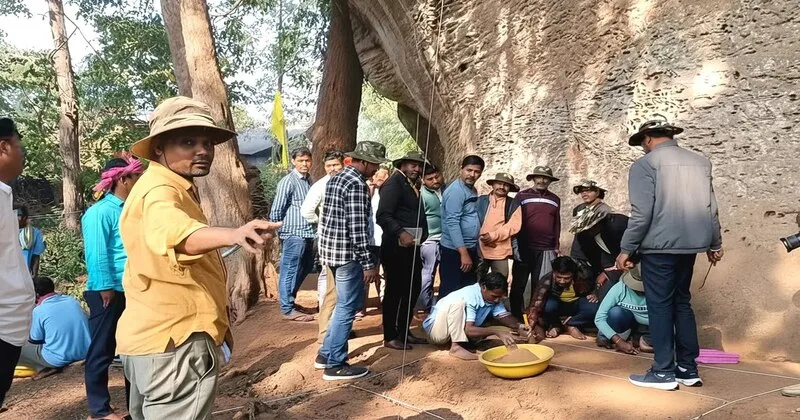
To investigate these discoveries further, the Archaeological Survey of India has launched a comprehensive archaeological survey. The first phase of the exploration is underway at the historic Bhima Mandali cave, where the research team will be stationed for nearly two months to carry out systematic and detailed studies.
The survey is being headed by ASI Superintending Archaeologist DB Gadnayak, accompanied by a 15-member team of specialists. All discoveries made during this extensive investigation will be documented using advanced digital techniques to ensure precise preservation and analysis of the ancient heritage.
“We are making every effort to conduct a thorough survey. The ASI will digitally document the entire process. This survey could help establish the region as a historic site of global significance. The artefacts are scattered across a wide area, including hilly terrains and forested regions,” Gadnayak stated. “It is hard to determine precisely how long the survey will take. However, it could last around two months or possibly even longer,” the archaeologist added.