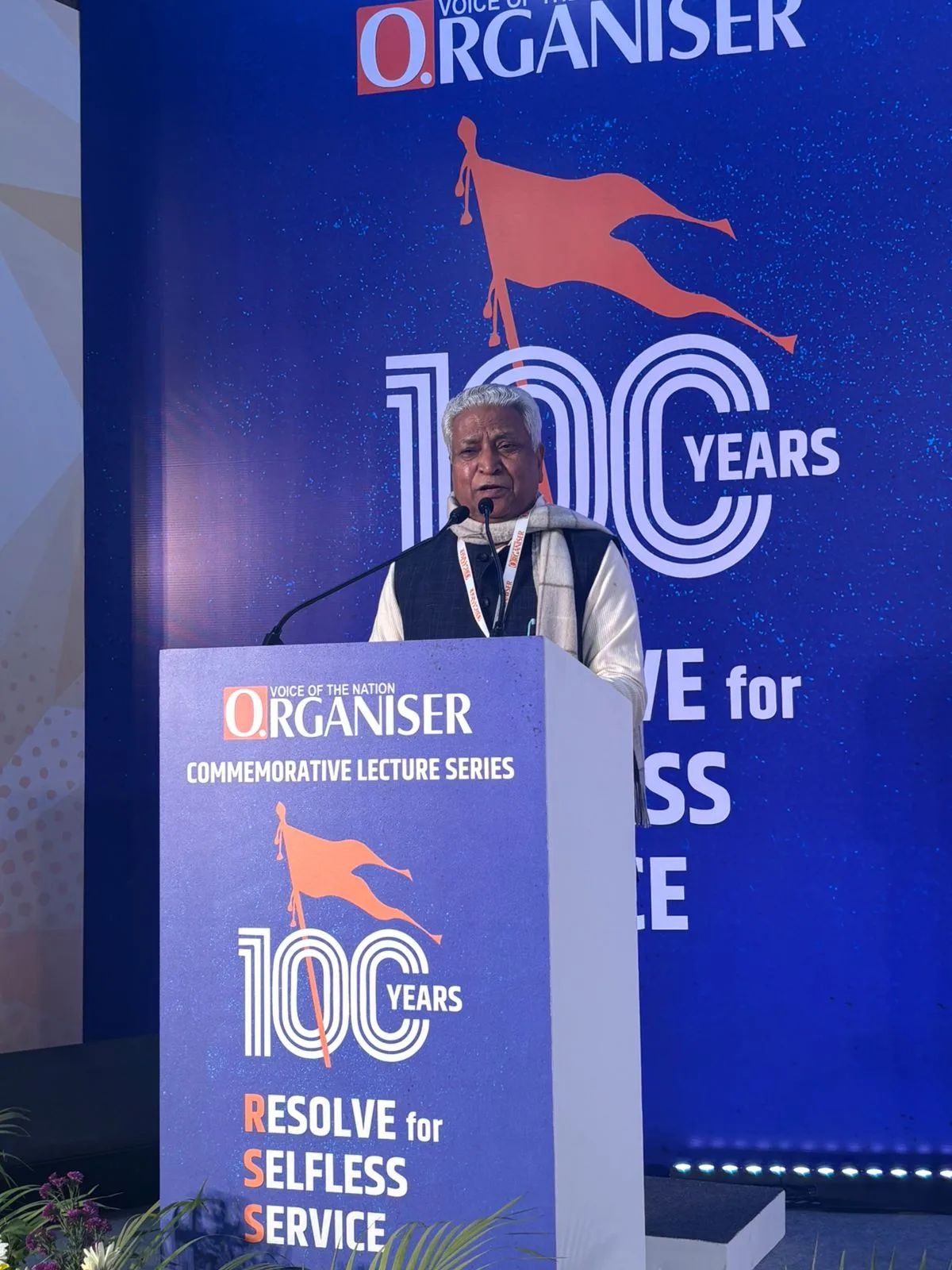
In the first of the four commemorative lecture series by Organiser on ‘100 years of RSS: Resolve for Selfless Service’ held at Sanskriti Bhawan, Lalit Kala Sansthan, Dr Bhimrao Ambedkar University at Agra on January 15, Ramlal Ji, Akhil Bharatiya Sampark Pramukh of Rashtriya Swayamsevak Sangh answered questions related to Sangh by the audience. Excerpts:
Despite having completed 100 years and gaining widespread social acceptance, why does the Sangh still face the same allegations in the English media and intellectual circles, while ordinary people seem to understand it better?
This is not a language issue. Such attitudes exist across all languages. For some, opposing the Sangh became a fashion once seen as progressive; many do so unknowingly, and we approach them with empathy. Others act deliberately, often driven by political agendas, yet we engage with them as well. Over a century, the Sangh has grown strong and socially accepted. Even critics now listen and interact. We engage not only political parties but also Muslim and Christian communities, emphasising that there is no “us versus them”—our ancestors were the same and Bharat has always accommodated diverse forms of worship. Much opposition arises from a colonial mindset that created confusion about Dharma and the nation. Dharma is not religion, and Bharat is a cultural civilisation, not merely a nation-state. As Dattopant Thengadi ji said, to understand Bharat, one must study Bharat first, then the world. The centenary year is therefore also a time for self-reflection on how we can reach society more effectively.
What is the Sangh’s view on science and technology?
Technology and scientific research are essential. The world is undergoing rapid change, and new research and discoveries should continue; there is no reason to oppose them. Science must progress and explore new possibilities. However, it would be incorrect to assume that nothing exists beyond science. Bharat’s sages had made remarkable discoveries even in ancient times, such as calculating distances between the sun, the earth, and the moon. This underscores Bharat’s long scientific tradition. Therefore, there is no opposition to science or technology. Within the Sangh, there is an organisation called Vigyan Bharati, which works to promote scientific awareness and the application of science for social good. Engaging with such efforts benefits both society and individuals. Science and research should advance in Bharat and globally—but not merely for convenience; they should ultimately serve human well-being, peace, and happiness.
Is nation-building essentially the same as character-building of individuals?
For the Sangh, the Swayamsevak itself is the answer. A nation is formed by society and culture, and society is built from individuals, families, and communities. Therefore, work must begin from the smallest unit—the individual. That is why the Sangh starts with character-building. We do not use the term “nation-building” but “national reconstruction,” because the nation is ancient and already established. The idea of a “Hindu nation” does not require proclamation—it exists as a civilisational reality. Historically, even Muslims travelling for Haj were identified as “Hindu Muslims,” reflecting this shared national identity.
When values are developed in individuals, they shape society; society, in turn, shapes the nation and its governments. Hence, the individual is the foundational unit. Dr Hedgewar founded the Sangh with the aim of creating good individuals—this is what a Swayamsevak is: one who, by self-motivation, dedicates himself to society and the nation, with patriotism, cultural pride, discipline, an all-India vision, and a spirit of service. Every good citizen is a Swayamsevak. Some attend the shakha, some do not; some are Swayamsevaks today, others will be tomorrow—but all contribute to society and the nation.
You mentioned the killing of Swayamsevaks in Kerala and Bengal, describing it as sacrifice. Yet such incidents rarely receive wide media coverage or public protest. Is the central leadership thinking or doing anything about this?
The media is an important pillar of democracy, and we do not oppose it or boycott it. We engage with media persons, speak to them, and explain our perspective. However, there is a growing tendency to focus more on negative narratives, and that also affects how issues are reported. When large-scale violence occurred in Kerala, we brought the affected workers to Delhi and held a press conference—some had lost limbs. I would like to thank the government and the President for nominating a Kerala worker, Sadanandan Master, to the Rajya Sabha. Both his legs were cut off in an attack, yet he survived, continues to work, and remains committed to the RSS. His nomination is a matter of great satisfaction.
As far as resistance is concerned, struggles have to be faced locally. If it is Bengal, the people of Bengal must fight; if it is Kerala, the people of Kerala must fight. And they are doing so—persistently and with courage. You may recall that the late Sitaram Hegde ji once said that while much is said about the sacrifice of Sangh Swayamsevaks, others also lose their lives in such conflicts. In any struggle, losses occur on both sides—this itself shows that a struggle is taking place. The Sangh is engaged in such struggles in Bengal as well.
Not everything needs to be done with public statements. Some work must be done quietly. Today, symbolic acts often attract more publicity than actual action, sometimes even gaining international attention, while achieving little. Where necessary, there is struggle—ideological struggle, and at times physical confrontation—and Swayamsevaks respond locally. The central leadership of the RSS provides all possible support. In Kerala, many Swayamsevaks are serving long prison sentences, including life imprisonment. Senior leaders have met them in jail; none showed despair, accepting their suffering for their beliefs. The Sangh takes full responsibility for their families—from children’s education to marriages and livelihoods.
Similarly, in Bengal, after the panchayat elections, many people were displaced. Local Sangh karyakartas supported them by helping rebuild homes and restart livelihoods. Political workers are looked after by their respective parties; the Sangh does the same for its people. In any struggle, sometimes one side has the upper hand, sometimes the other. This is an ongoing ideological struggle, fought through ideas and writing, and occasionally through physical confrontation as well.
In recent months, several students and children were trapped in conversion cases. While work is being done, should there not be structured awareness—through experts or lecturers in schools and colleges—since today conversion is increasingly linked with cybercrime and other criminal networks targeting students?
You are right. Today, because of media and social media, even small incidents become national news. However, conversion is not a new phenomenon. In fact, its percentage has declined, while ghar wapsi has increased, and social awareness has grown. This was evident recently when temples across the country were crowded on January 1, largely by young people and couples. Awareness exists, but a key challenge lies in strengthening family values. Samskaras (values) must begin at home—for both boys and girls—about right conduct, emotional judgement, and caution against false narratives. This must also be addressed in schools and colleges. At the organisational level, the Sangh’s Dharma Jagran department works both to prevent conversions and to facilitate return where conversion has already occurred. These efforts are carried out quietly. As Dr Hedgewar once said, the real problem is not others, but the lack of awareness within Hindu society itself. Strengthening understanding, confidence, and social cohesion within society remains essential.
In a diverse society, how can unity and integrity be ensured, and how can democracy and economic development be strengthened?
You have raised a fundamental question. From the beginning, the RSS has believed not in erasing differences but in drawing a larger unifying line. As the well-known illustration goes, instead of erasing a line, a bigger line is drawn so the earlier one appears smaller. Similarly, to overcome divisions of caste, region, language, or religion, the Sangh emphasises a larger identity—that we are all children of Bharat Mata and part of one larger Hindu society. These divisions exist in society, not within the Sangh, and to address them, a broader unifying vision must be taken to society. As for economic development, it is already strengthening, and Bharat’s democracy is very robust—there is no cause for concern.