
“Sometimes I have young men come and talk to me about atheism; I do not believe a Hindu can become an atheist. He may read European books and persuade himself he is a materialist, but it is only for a time. It is not in your blood. You cannot believe what is not in your constitution; it would be a hopeless task for you. Do not attempt that sort of thing. I once attempted it when I was a boy, but it could not be. Life is short, but the soul is immortal and eternal, and one thing being certain, death, let us therefore take up a great ideal and give up our whole life to it. Let this be our determination, and may He, the Lord, who “comes again and again for the salvation of His own people”, to quote from our scriptures — may the great Krishna bless us and lead us all to the fulfilment of our aims!”
–Swami Vivekananda, The Future of India, Complete-Works / Volume 3 / Lectures from Colombo to Almora.
Gen-Z is the most celebrated term these days. The political agitation on the streets and subsequent regime changes in countries like Bangladesh and Nepal, and now a similar attempt in Iran, are attributed to youth who are digital natives and have built movements through social media. The youth in Bharat are being immediately provoked to employ similar tools to create political instability and to question democratic institutions in order to fulfil their aspirations, by hook or by crook. If there are no issues, they are created; if needed, foreign actors are brought into the picture and violence is normalised in the name of ‘azadi’ or ‘justice’. Despite all these efforts, youth in Bharat are not falling prey to such provocations and are determined to contribute constructively to the national transformation. We need to decode the Gen-Z narrative and the differential response of Bharatiya youth to such a destructive attempt.
Youth and aspirations are coterminous. Their dreams for the future energise them to address the problems of the present. When Bhagat Singh, Rajguru and Sukhdev dreamt of freedom, they were Gen-Z of their times. It is true that Gen-Z, characterised by digital consciousness, has a different orientation and behavioural preferences, but the basic instinctive zeal of youth remains the same; only the means would change. The quote attributed to George Bernard Shaw, “If at age 20 you are not a Communist, then you have no heart. If at age 30 you are still a communist, you have no brains”, applies to all generations. Here, the term ‘communist’ is used more as a metaphor than as an ideology. Each generation likes to ask logical questions to the previous one about values, institutions and their contributions. So, ascribing everything to Gen-Z and selling it as a novelty is erroneous. When the terms’ coloured revolutions’ or ‘Arab Spring’ became popular in 2008-09, there was a similar momentum for regime change in various countries. Did Gen-Z lead it? Did it really make a positive change in those countries? Were Gen-Z the real architects of heinous violence in Bangladesh, or were they used as a tool by fundamentalists and foreign powers to fulfil their respective agenda? How many of the attackers on the Nepalese Parliament were really from Gen-Z? Youth must have concerns about democracy and corruption in those countries. However, it does not mean Gen-Z took up arms or took to the streets to resolve the issues. At the most, they helped to build momentum on social media with the hope of bringing about positive transformation. Unknowingly they became tools in the hands of international actors who control data and algorithms. So, what is most pertinent for the so-called Gen-Z is that it must think rationally before forming any opinion on the issue and reacting to it and not be swayed by the sinister agenda of the vested interest.
Fortunately, the youth of Bharat are behaving differently rather sensibly despite repeated provocation. They are also evoked on various issues, from Agniveer to the Citizenship Amendment Act to environmental concerns to fake campaigns like ‘vote-chori’. Some political actors also seek to exploit the situation by inciting the fundamentalists and widening social fault lines. The blatant seditious and violent sloganeering by the likes of Umar Khalid and Sharjeel Imam, which resulted in the Delhi riots 2020, was part of the same game. Yet, beyond a point, none of those tricks achieved much success for two reasons. Firstly, the anti-corruption movement in Bharat from 2010 onwards also had a similar momentum, based on discrediting democratic institutions and a call to decide everything on the streets. It gave birth to a hypocritical party that broke every corruption-related parameter. Bharat, as a civilisation, has the wisdom to learn quickly and make necessary adjustments. The foundations of our Constitutional democracy are so strong that, barring Delhi for a brief period, it is the nationalist forces, not anarchists, who have benefited from it. Secondly, the cultural and spiritual roots of our social and political structures inspire youth to take up a constructive path towards transformation. Not that they do not face problems and expect the State machinery to be ‘people-centric’. They critically evaluate the issues, provide constructive feedback where necessary, and actively participate in the transformation process in the national interest. From the cleanliness drive to the AI mission, the youth have responded positively to the national call.
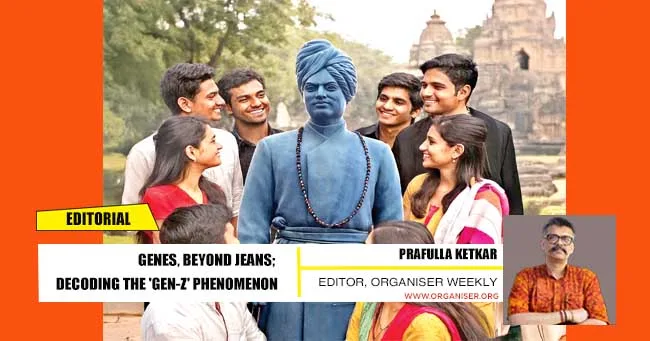
The ‘Gen-Z’ – the youth born after the late 1990s – may be impulsive and excessively driven by the digital space, yet they are in search of their roots. If someone engages them in logical dialogue, they respond positively. They know how to create a convergence between the vibes of a nightclub and the spirituality of Bhajans. They are conscious of global developments but ready to act locally. Considering them ignorant fools is a big mistake, especially in the Bharatiya context. As long as they have icons like Swami Vivekananda, who gave a call to ‘go out, to conquer the world through our spirituality and philosophy’, our youth will always find Bharatiya solutions to global challenges. They are the generation that wears jeans and dhotis with equal comfort; the spiritual urge balances their momentary material aspirations; their foreign adaptations also get a Swadeshi flare, because their genes are Bharatiya, in which change with continuity is a norm.