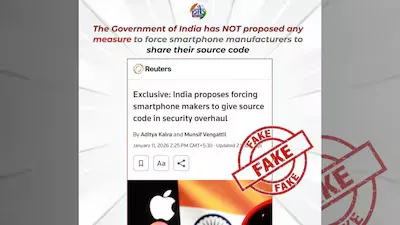
The Union government has categorically denied claims that it plans to compel smartphone manufacturers to share their source code or make mandatory software changes, dismissing a media report that suggested such measures were being considered as part of a broader security overhaul.
The clarification came from the Press Information Bureau (PIB), which termed the claims as “misleading” and urged citizens to rely only on verified and official sources for information related to government policy.
Responding to a report published by international news agency Reuters, the PIB said the Government of India has not proposed any measure that would force smartphone manufacturers to disclose proprietary source code to authorities.
“The Government of India has NOT proposed any measure to force smartphone manufacturers to share their source code,” the PIB said in a post on X, flagging the report under its PIB Fact Check initiative.
Stakeholder Consultations, Not Regulations
The PIB further clarified that the Ministry of Electronics and Information Technology (MeitY) has merely initiated stakeholder consultations to discuss the possibility of a regulatory framework aimed at enhancing mobile security.
According to the government, these discussions are part of routine engagement with industry stakeholders whenever safety or security standards are reviewed or contemplated.
A news report by @Reuters claims that India proposes forcing smartphone manufacturers to share their source code as part of a security overhaul.
❌ This claim is #FAKE
▶️ The Government of India has NOT proposed any measure to force smartphone manufacturers to… pic.twitter.com/0bnw0KQL9Q
— PIB Fact Check (@PIBFactCheck) January 11, 2026
“This is a part of regular and routine consultations with the industry for any safety or security standards. Once a stakeholder consultation is done, then various aspects of security standards are discussed with the industry,” the PIB stated.
Emphasising that the process is still at a very early stage, the PIB added that no final regulations have been framed, and any future framework would be developed only after detailed deliberations with all concerned stakeholders, including manufacturers, technology experts, and industry bodies.
What the Reuters Report Claimed
The Reuters report had claimed that India was considering new smartphone security rules that could require mobile phone makers to share source code with government authorities, inform the government ahead of major software updates, and make several software-level changes to comply with security norms.
According to the report, these alleged proposals had triggered concern among global technology companies such as Apple, Samsung, Xiaomi, and Google, as well as industry associations.
The report further suggested that industry groups had warned that mandatory source code sharing could expose sensitive intellectual property, compromise proprietary technologies, and potentially impact user privacy. Concerns were also reportedly raised over requirements like long-term storage of system logs and allowing government access for security testing.
The government’s sharp rebuttal signals an attempt to counter what it sees as speculative or premature reporting on policy matters that are still under discussion. Officials have stressed that consultations should not be confused with policy decisions, and that India’s approach to digital and mobile security will balance national security concerns with innovation, privacy, and industry competitiveness.
By flagging the report as “fake” and “misleading,” the PIB also reiterated the importance of fact-checking in an era of fast-moving and often speculative technology reporting.
As discussions around mobile security and digital infrastructure continue globally, the government has maintained that any regulatory changes in India will follow due process and transparent engagement with all stakeholders, without imposing unilateral or coercive measures on manufacturers.