Bibha Chowdhuri: Scientist from India who was denied nobel prize
August 13, 2026
  • Read Ecopy
  • Circulation
  • Advertise
  • Careers
  • About Us
  • Contact Us
Android AppiPhone AppArattai
Organiser
  • ‌
  • Bharat
    • Assam
    • Bihar
    • Chhattisgarh
    • Jharkhand
    • Maharashtra
    • View All States
  • World
    • Asia
    • Europe
    • North America
    • South America
    • Africa
    • Australia
  • Editorial
  • International
  • Opinion
  • RSS @ 100
  • More
    • Op Sindoor
    • Analysis
    • Sports
    • Defence
    • Politics
    • Business
    • Economy
    • Culture
    • Special Report
    • Sci & Tech
    • Entertainment
    • G20
    • Azadi Ka Amrit Mahotsav
    • Vocal4Local
    • Web Stories
    • Education
    • Employment
    • Books
    • Interviews
    • Travel
    • Law
    • Health
    • Obituary
  • Subscribe
    • Subscribe Print Edition
    • Subscribe Ecopy
    • Read Ecopy
  • ‌
  • Bharat
    • Assam
    • Bihar
    • Chhattisgarh
    • Jharkhand
    • Maharashtra
    • View All States
  • World
    • Asia
    • Europe
    • North America
    • South America
    • Africa
    • Australia
  • Editorial
  • International
  • Opinion
  • RSS @ 100
  • More
    • Op Sindoor
    • Analysis
    • Sports
    • Defence
    • Politics
    • Business
    • Economy
    • Culture
    • Special Report
    • Sci & Tech
    • Entertainment
    • G20
    • Azadi Ka Amrit Mahotsav
    • Vocal4Local
    • Web Stories
    • Education
    • Employment
    • Books
    • Interviews
    • Travel
    • Law
    • Health
    • Obituary
  • Subscribe
    • Subscribe Print Edition
    • Subscribe Ecopy
    • Read Ecopy
Organiser
  • Home
  • Bharat
  • World
  • Operation Sindoor
  • Editorial
  • Analysis
  • Opinion
  • Culture
  • Defence
  • International Edition
  • RSS @ 100
  • Magazine
  • Read Ecopy
Home Bharat

Bibha Chowdhuri: The Indian physicist whose cosmic ray discoveries preceded a Nobel Prize

Bibha Chowdhuri was a pioneering Indian physicist whose early work on cosmic rays helped identify subatomic particles later credited to Nobel Prize–winning scientists. Her story reveals how brilliance can be overlooked due to gender and global inequality in science

WEBDESKWEBDESK
Jan 10, 2026, 04:00 pm IST
inBharat, Sci & Tech
Follow on Google News
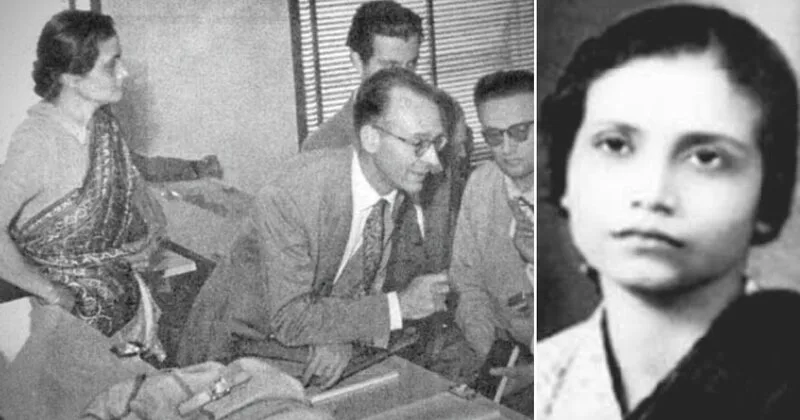
Indian physicist Bibha Chowdhuri (Right)

Indian physicist Bibha Chowdhuri (Right)

Facebook
Twitter
WhatsAppTelegramEmail

Scientific history is often told through the stories of celebrated figures and Nobel laureates. Yet, hidden behind these narratives are pioneers whose contributions were no less significant but whose names faded into obscurity. One such figure is Bibha Chowdhuri (1931–1991), an Indian physicist whose groundbreaking work in cosmic ray research anticipated discoveries that later earned others the Nobel Prize. Her story is not only about scientific excellence, but also about gender, geography, and the unequal recognition of knowledge.

Bibha Chowdhuri was born in Kolkata and grew up at a time when science, especially physics, was considered an unusual career path for women in India. Despite these barriers, she pursued physics with exceptional determination. She joined the Bose Institute in Kolkata, working under the renowned physicist Debendra Mohan Bose, a nephew of Sir Jagadish Chandra Bose.

The Woman Scientist From India Who Was Denied the Nobel Prize

1. Bibha Chowdhuri (1931-1991) was a pioneering Indian physicist from Kolkata. She made significant contributions to cosmic ray research and particle physics in the early 20th century.

2. Working with Debendra Mohan… pic.twitter.com/mO4C08DiAB

— Rakesh Krishnan Simha (@ByRakeshSimha) January 4, 2026

At the Bose Institute, Chowdhuri entered the emerging field of cosmic ray physics, a branch of science that studies high-energy particles originating from outer space. In the early 20th century, cosmic rays were one of the few ways scientists could explore subatomic particles, as particle accelerators were still in their infancy.

Pioneering Work in Cosmic Ray Research

Together with Debendra Mohan Bose, Bibha Chowdhuri used photographic plates to detect and analyze tracks left by cosmic ray particles. This method required extraordinary patience and precision. Scientists had to carefully examine microscopic traces etched by invisible particles traveling at near-light speed.

In the 1940s, Chowdhuri and Bose made a remarkable observation: they identified particles with a mass approximately 200 times that of an electron. This was a crucial finding. Around the same time, Japanese physicist Hideki Yukawa had theoretically predicted the existence of a particle—called a meson—that would mediate the strong nuclear force holding atomic nuclei together. The particle later became known as the pion, while related particles such as the mu-meson (muon) were also being studied.

Also Read: Brutality in Bangladesh: Hindu widow gang-raped, tortured & publicly humiliated by Shahin and Hasan in Jhenaidah

Chowdhuri and Bose’s experimental results closely matched Yukawa’s theoretical predictions. Their work provided early experimental evidence for the existence of these particles, placing them at the forefront of particle physics research.

International Scholarship and Career

Bibha Chowdhuri’s talent soon gained international attention. She went on to earn her PhD from the University of Manchester, where she worked under Patrick Blackett, a Nobel Prize–winning physicist and one of the most influential experimental scientists of the time. Under Blackett’s mentorship, she continued her research on cosmic rays, further strengthening her scientific reputation.

In 1949, Chowdhuri returned to India and became the first woman researcher at the Tata Institute of Fundamental Research (TIFR) in Mumbai. TIFR was then emerging as India’s leading center for advanced scientific research. Throughout her career, she remained deeply committed to cosmic ray studies and experimental physics, contributing to India’s scientific foundations in the post-independence era.

Despite her groundbreaking work, Bibha Chowdhuri received little recognition during her lifetime. She was not awarded major national honors, prestigious fellowships, or public acclaim. Her publications, some appearing in highly respected journals such as Nature, failed to receive the attention they deserved.

The most striking injustice came in 1950, when the Nobel Prize in Physics was awarded to Cecil Powell for the discovery of the pion using photographic techniques. Powell’s work, while undoubtedly important, closely resembled discoveries that Chowdhuri and Bose had reported years earlier. Their contributions were largely overlooked by the global scientific community, a neglect often attributed to a combination of colonial bias, limited scientific networks, and gender discrimination.

For decades, Bibha Chowdhuri’s name remained absent from mainstream histories of physics. However, in recent years, scholars and science historians have begun to reexamine her work and acknowledge her role in early particle physics.

A significant moment of recognition came in 2019, when the International Astronomical Union (IAU) named a star in the constellation Sextans as “Bibha” in her honor. While symbolic, this gesture represents a long-overdue acknowledgment of her contributions to science and her place in its history. Bibha Chowdhuri’s life highlights how scientific recognition is shaped not only by discovery but also by power, privilege, and visibility.

 

Topics: Particle PhysicsForgotten ScientistsHistory of ScienceIndian ScientistsBibha ChowdhuriWomen in ScienceNobel Prize ControversyCosmic Ray Research
Share
Tweet
SendShareSend
✮ Subscribe Organiser YouTube Channel. ✮
✮ Join Organiser's WhatsApp channel for Nationalist views beyond the news. ✮
Previous News

Karnataka: Public funds or party patronage? Congress under fire over National Herald advertisement windfall

Next News

Special Intensive Revision in Uttar Pradesh: Electoral clean-up or political propaganda by opposition?

Related News

Indian immunologist Dr G.P. Talwar

From Soil to Science: How Dr G P Talwar developed a pioneering immunotherapeutic vaccine against leprosy

J Nandakumar presents his book National Selfhood in Science at the Jaipur Literature Festival

Jaipur Lit Fest: J Nandakumar reveals the epic saga of Bharatiya scientists reclaiming national identity

Two black holes in orbit around each other on the right and an explanation of the schematic on the left

Cosmic Dance Captured: Indian Scientists spot two black holes orbiting each other

India’s Silent Battle: The hidden sabotage of its scientific pioneers and the struggle for technological sovereignty

M. Vijayan: Pioneer of macromolecular crystallography in India

Load More

Latest News

Coal India eyes acquisition of Chilean Lithium unit

Coal India eyes acquisition of Chilean Lithium unit to boost critical minerals supply: Report

The Search Committee for the Shri Ram Janmabhoomi Teerth Kshetra has completed its interview process to select the trust's new Chief Executive Officer (CEO)

Who will lead Shri Ram Janmabhoomi Teerth Kshetra Trust? Interviews conclude for first full-time CEO

Hindu Munnani seeks action against evangelical preacher Mohan C Lazarus over FCRA remarks

Tamil Nadu: Hindu Munnani seeks action against evangelical preacher Mohan C Lazarus over FCRA remarks

Adani Group Chairman Gautam Adani

From Hindenburg Storm to US Case Dismissal: Gautam Adani breaks silence, says ‘Trust is greater than any legal right’

NIA raids 13 locations in Tamil Nadu and Mizoram

Drug Peddling Case: NIA conducts raids at 13 locations in Tamil Nadu and Mizoram 

The debate over ‘Vanvasi’ has sparked political controversy, raising questions over tribal identity and constitutional rights (This image is generated by AI)

Why is there so much objection to the term ‘Vanvasi’? Read the Constitution, then raise your questions!

Generation-Z is redefining freedom and nationalism by linking patriotism with innovation, civic responsibility & India’s development (This image is generated by AI)

Generation-Z and the New Meaning of Freedom: How young India is redefining nationalism in the digital age

Threads of Resilience: How Majuli’s Riti Doley of Assam wove her way to a National Handloom Award

Why is the church rattled by FCRA

Why is the Church so troubled by the FCRA Amendment Bill?

Rosary with Budget, Catholic Doctrine on Abortion: TVK’s Slow Push of Tamil Nadu to US Christian Playbook

Rosary with Budget, Catholic Doctrine on Abortion: TVK’s Slow Push of Tamil Nadu to US Christian Playbook

Load More
  • Privacy
  • Terms
  • Cookie Policy
  • Refund and Cancellation
  • Delivery and Shipping

© Bharat Prakashan (Delhi) Limited.
Tech-enabled by Ananthapuri Technologies

  • Home
  • Search Organiser
  • Bharat
    • Assam
    • Bihar
    • Chhattisgarh
    • Jharkhand
    • Maharashtra
    • View All States
  • World
    • Asia
    • Africa
    • North America
    • South America
    • Europe
    • Australia
  • Editorial
  • Operation Sindoor
  • Opinion
  • Analysis
  • Defence
  • Culture
  • Sports
  • Business
  • RSS @ 100
  • Entertainment
  • More ..
    • Sci & Tech
    • Vocal4Local
    • Special Report
    • Education
    • Employment
    • Books
    • Interviews
    • Travel
    • Health
    • Politics
    • Law
    • Economy
    • Obituary
  • Subscribe Magazine
  • Read Ecopy
  • Advertise
  • Circulation
  • Careers
  • About Us
  • Contact Us
  • Policies & Terms
    • Privacy Policy
    • Cookie Policy
    • Refund and Cancellation
    • Terms of Use

© Bharat Prakashan (Delhi) Limited.
Tech-enabled by Ananthapuri Technologies