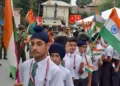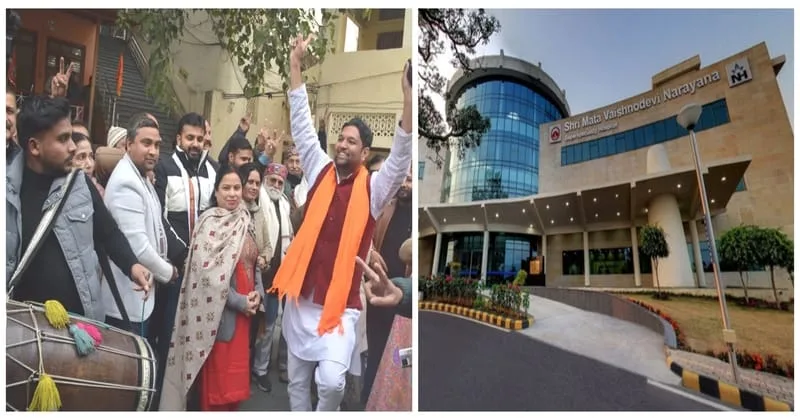
REASI: The nearly 45-day-long agitation led by the Shri Mata Vaishno Devi Sangharsh Samiti concluded on a jubilant note, with scenes of drums, sweets, dancing, and thanksgiving processions marking what the organisers termed a “historic victory.” Members of the Sangharsh Samiti and representatives of nearly 60 affiliated organisations, many of them linked to pro-BJP and RSS-backed groups, poured onto the streets to celebrate the withdrawal of recognition granted to the Shri Mata Vaishno Devi Institute of Medical Excellence in Kakryal, Reasi.
In Jammu & Kashmir, members of the Sri Mata Vaishno Devi Sangharsh Samiti, linked to nearly 60 pro-BJP and RSS groups, were seen distributing sweets and dancing to dhol beats after a medical college lost its recognition.
The groups had openly opposed the admission of Muslim… pic.twitter.com/osKidX0jyD
— Mohd Shadab Khan (@VoxShadabKhan) January 8, 2026
Supporters distributed sweets, danced to dhol beats, and raised slogans celebrating the movement’s success. Protesters expressed satisfaction that Shri Mata Vaishno Devi Medical College had finally been shut, claiming the institution had never met the basic standards required to operate as a medical college.
To mark the occasion, a special prayer service was held at Geeta Bhavan, followed by a formal meeting of the Sangharsh Samiti where leaders reviewed the movement, discussed its strategy, and outlined future directions. Later that day, committee officials and supporters visited the Bhagwan Vishnu Mandir and held a thanksgiving procession.
“The success of this movement is being seen as a victory for the unity and collective struggle of the people of Jammu,” leaders of the Sangharsh Samiti said, adding that the agitation had drawn widespread public support.
The agitation began after the first admission list of the newly established medical college revealed that 42 of the 50 MBBS seats had gone to Muslim students, with one Sikh student also included. Several Hindu organisations and local trade bodies opposed the admissions, arguing that since the college is run by the Shri Mata Vaishno Devi Shrine Board, it should primarily cater to Hindu students.
What began as opposition to the admission list soon escalated into a broader campaign questioning the legitimacy, infrastructure, and functioning of the medical college. The Sangharsh Samiti openly opposed the admission of Muslim students, transforming the issue into a highly charged communal and political controversy.
Amid the ongoing protests, the National Medical Commission (NMC), through its Medical Assessment and Rating Board (MARB), withdrew the Letter of Permission (LoP) granted to the Shri Mata Vaishno Devi Institute of Medical Excellence for running an MBBS course with 50 seats for the academic year 2025–26. The decision, dated January 6, 2026, took immediate effect.
MARB cited Chapter V (Sanction & Penalty), Regulation 29 of the Establishment of Medical Institutions, Assessment & Rating Regulations, 2023, treating the deficiencies found at the college as a penalizable offence. With the approval of the NMC Chairman, the Commission also decided to invoke the Performance Bank Guarantee submitted by the institution.
The regulatory action followed a surprise inspection conducted on January 2, 2026, under Section 28(7) of the National Medical Commission Act, 2019, after NMC received multiple complaints.
The inspection report pointed to extensive and systemic deficiencies in both academic and clinical functioning of the institute. It recorded a 39 per cent shortfall in teaching faculty and a 65 per cent shortage of tutors, demonstrators, and senior residents, severely undermining academic delivery. Clinical exposure was found to be far below mandated norms, with outpatient attendance at just 182 patients against the required 400, overall bed occupancy at 45 per cent compared to the prescribed 80 per cent, and ICU occupancy averaging only 50 per cent. Maternity services were described as “grossly deficient,” with the hospital recording only about 25 deliveries per month.
The report further flagged serious infrastructure and academic gaps, noting the absence of practical and research laboratories in several departments and lecture theatres that did not conform to minimum standards. The central library was found to be poorly stocked, housing 744 books instead of the required 1,500, along with only two journals against a mandated minimum of fifteen. Essential public health and clinical facilities, including an ART centre and MDR-TB treatment services, were missing. Inspectors also observed the absence of separate male and female wards in certain departments, a shortage of functional operating theatres with only two available against the required five, and the non-existence of a minor operation theatre in the OPD area. Equipment for para-clinical subjects was also deemed inadequate. Based on these findings, MARB concluded that the institute had failed to meet the Minimum Standard Requirements (UGMSR-2023) necessary for operating a medical college.
Despite the withdrawal of recognition, the NMC order safeguards students already admitted for the 2025–26 academic year. All students will be shifted to other recognised medical colleges in J&K as supernumerary seats, ensuring that no student loses an MBBS seat. The relocation process will be carried out by the UT government’s designated health and counselling authorities.