The Enforcement Directorate’s coordinated search operations across West Bengal and Delhi on January 8 triggered one of the most intense political confrontations in the state in recent years. According to the agency, simultaneous searches were conducted at ten locations connected to an ongoing money laundering investigation linked to the illegal coal smuggling syndicate allegedly headed by Anup Majee, also known as Lala.
The ED has maintained that the operation was evidence-driven and part of a long-running probe into illegal coal extraction from leasehold areas of Eastern Coalfields Limited (ECL), involving alleged diversion of coal, generation of illicit cash, and hawala transfers. However, the inclusion of premises linked to political consultancy firm Indian Political Action Committee (I-PAC) rapidly transformed the operation into a political flashpoint.
I-PAC and Pratik Jain under the scanner
Among the key locations searched were the Salt Lake office of I-PAC and the residence of its national head, Pratik Jain. I-PAC has played a central role in the Trinamool Congress’s electoral campaigns and is closely associated with the party’s digital, communication, and strategic operations.
The ED has stated that its interest in these premises stems from financial and documentary links under scrutiny in the coal laundering case, not from I-PAC’s political role. The agency has emphasised that the searches were not directed at any political party office but at individuals and entities allegedly connected to the laundering of proceeds of crime.
Chief Minister’s personal intervention raises stakes
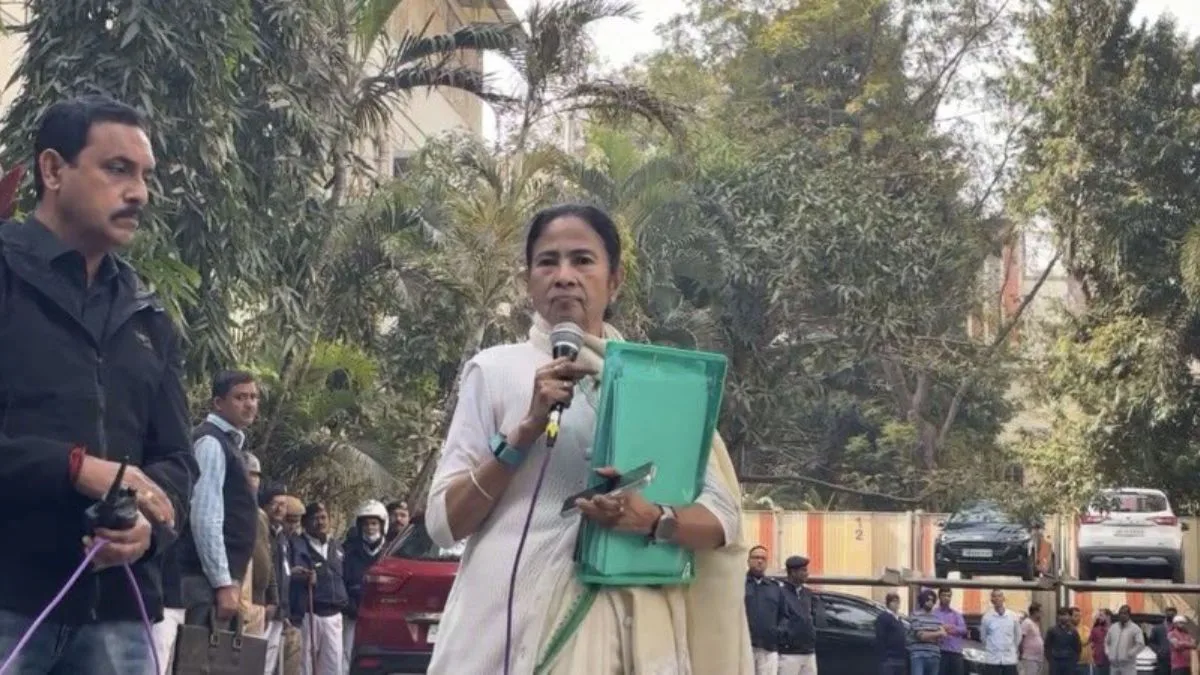
What transformed the searches into a full-blown political crisis was Chief Minister Mamata Banerjee’s decision to personally arrive at the raid locations. Accompanied by senior state police officials, Banerjee first visited Pratik Jain’s residence and later proceeded to I-PAC’s office.
Her arrival led to dramatic scenes, with visual footage showing heated exchanges and heavy police presence. Banerjee accused ED officials of attempting to seize sensitive political documents, hard disks, mobile phones, laptops, and internal party data related to the Trinamool Congress’s election planning.
Addressing reporters, the Chief Minister claimed that the central agency was targeting her party’s “IT office” and trying to steal confidential strategy documents ahead of the upcoming elections. She termed the raids “nasty,” “politically motivated,” and part of a broader effort to destabilise her government.
ED’s Allegation: Evidence ‘Forcibly Removed’
Hours after the confrontation, the Enforcement Directorate issued a strongly worded official statement accusing Mamata Banerjee, her aides, and state police personnel of forcibly removing crucial evidence from the premises under search.
According to the ED, its proceedings were being conducted “peacefully and professionally” until the arrival of the Chief Minister with a large police contingent. The agency alleged that Banerjee entered Pratik Jain’s residence and took away physical documents and electronic devices that were part of the ongoing investigation.
The ED further claimed that the Chief Minister’s convoy then moved to I-PAC’s office, where documents and electronic evidence, including hard disks, were forcibly removed, thereby obstructing proceedings under the Prevention of Money Laundering Act (PMLA).
Agency moves Calcutta High Court
Citing obstruction and hindrance in the discharge of its statutory duties, the Enforcement Directorate moved the Calcutta High Court seeking judicial intervention. The agency asserted that the alleged removal of evidence compromised the integrity of an ongoing money laundering probe.
The High Court agreed to hear the matter, with the case listed before Justice Suvra Ghosh. The development has added a significant legal dimension to what has already become a politically charged confrontation between the state government and a central investigative agency.
Mamata Banerjee’s Counterattack: ‘Political Vendetta’
Mamata Banerjee responded with an aggressive counteroffensive. She accused the ED of acting as a political tool of the Bharatiya Janata Party-led Centre, claiming that the raids were designed to sabotage the Trinamool Congress’s election preparations.
Rejecting the ED’s allegations, Banerjee said she merely “brought back” her party’s documents that were being unlawfully seized. She questioned whether it was the mandate of a financial investigation agency to collect candidate lists, internal strategy papers, and political data of a rival party.
The Chief Minister also announced that complaints had been filed against the ED at the Bidhannagar Police Station, both by the TMC and on behalf of I-PAC, accusing the agency of overreach and illegal seizure.
In a public address, Banerjee directly targeted Union Home Minister Amit Shah, branding him the “naughtiest and nastiest” Home Minister India has seen. She accused him of orchestrating the use of central agencies to intimidate opposition-ruled states.
The Chief Minister also linked the ED action to the ongoing Special Intensive Revision (SIR) of electoral rolls in West Bengal. She alleged a coordinated attempt to delete voter names on one hand while “looting” party data on the other.
Announcing a protest march, Banerjee declared she would personally lead a demonstration across major areas of Kolkata, portraying the raids as an attack not just on her party but on democracy itself.
Opposition Strikes Back: BJP Alleges Abuse of Power
The Bharatiya Janata Party launched a fierce counterattack following the ED’s statement. Leader of the Opposition in the West Bengal Assembly, Suvendu Adhikari, termed Banerjee’s intervention “unconstitutional” and demanded legal action against her for obstructing a federal agency.
Adhikari questioned why sensitive voter lists and political data were allegedly found at a private consultancy firm’s office, asking whether such possession violated electoral and legal norms.
BJP leaders argued that no Chief Minister has the authority to interfere with a lawful search conducted under central legislation and accused Banerjee of attempting to shield individuals linked to serious financial crimes.
BJP IT Cell head Amit Malviya described the ED’s allegations as a “damning indictment” of Mamata Banerjee. He said the agency’s account showed direct obstruction of an investigation under the PMLA.
According to Malviya, the Chief Minister’s actions amounted to misuse of state machinery and police force to protect a private consultancy firm allegedly linked to a coal smuggling network. He called the episode an example of “abuse of power at its worst.”
The BJP’s West Bengal unit also mocked Banerjee’s response, suggesting that the ruling party was in panic mode and struggling to control the fallout.
Allies Rally Around Mamata
Political allies came out in support of Mamata Banerjee. Samajwadi Party chief Akhilesh Yadav posted on social media that the developments indicated the BJP’s weakening position in West Bengal.
The support from opposition leaders reinforced the TMC’s narrative that central agencies are being selectively used against non-BJP governments, especially in states heading into elections.
West Bengal Governor Ananda Bose refrained from commenting directly on the ED raids or the allegations against the Chief Minister. He said the law would take its own course and avoided taking sides.
However, his cryptic remark, “Vinaash Kaal Viprit Buddhi,” added to the political intrigue, with leaders across parties interpreting it as an indirect comment on the unfolding events.
Coal Scam Background
The controversy is rooted in the long-running investigation into alleged coal smuggling from ECL lease areas in West Bengal. The ED has alleged that illegal mining operations generated massive proceeds of crime, which were laundered through shell companies and hawala networks.
Anup Majee, identified as a key accused, has been at the centre of multiple probes. The ED insists that the current searches are a continuation of this investigation and have no connection with electoral politics.
The standoff has raised broader questions about the balance of power between the Centre and states, the autonomy of investigative agencies, and the limits of executive authority.
As the Calcutta High Court prepares to hear the ED’s petition, the episode is set to have far-reaching legal and political consequences. The court’s observations could define the boundaries of permissible executive intervention during central agency operations.
For now, the I-PAC raids have evolved into a larger battle over narrative, power, and control, one that is likely to dominate West Bengal’s political discourse in the run-up to elections.