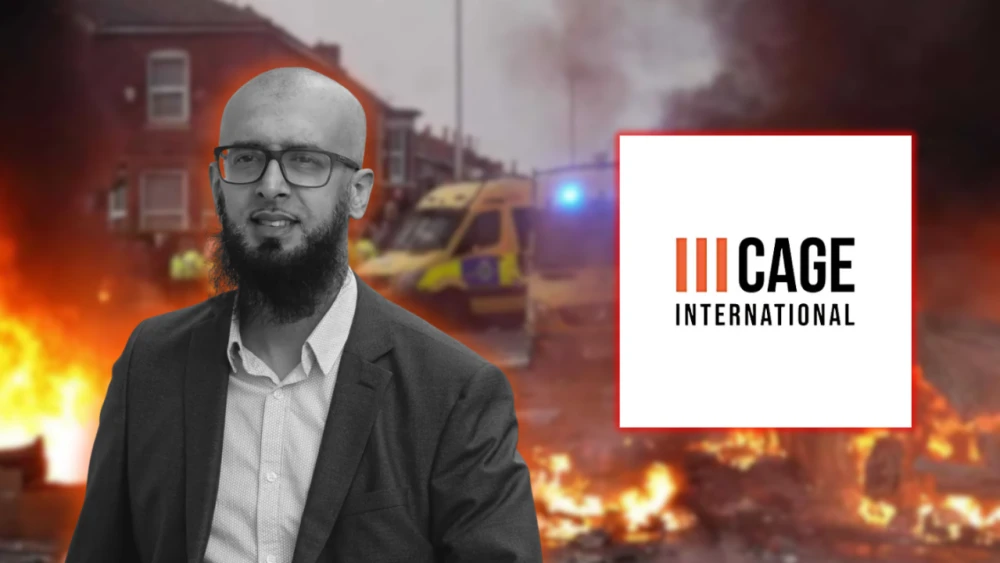
As the Leicester Crown Court prepares to hear the retrial of Majid Freeman on January 9, 2026, an old fault line in Britain has once again been exposed. Freeman, previously convicted for racially aggravated public order offences linked to the 2022 Leicester riots, has become the centre of a renewed propaganda push by CAGE International, an organisation with a long and controversial history of defending Islamist extremists under the banner of civil liberties.
The campaign, titled “Mobilise for Majid Freeman,” calls upon supporters to gather outside the Leicester Crown Court in what CAGE describes as an act of “solidarity.” Many, however, see the mobilisation as a deliberate attempt to intimidate, reframe a judicial process as political persecution, and erase the lived experiences of Hindu victims who bore the brunt of violence during the 2022 unrest.
In flyers and social media posts circulated ahead of the retrial, CAGE International describes Majid Freeman as a “humanitarian,” a “pro-Palestine activist,” and an “anti-genocide campaigner.” The group claims Freeman was unfairly convicted in a “politicised trial” for allegedly defending Leicester’s Muslim community during what it terms “Hindutva-inspired riots.”
One such post on X (formerly Twitter) reads: “MOBILISE FOR MAJID FREEMAN. Humanitarian and Pro-Palestine activist Majid Freeman stood up for the Leicester community during the 2022 Hindutva-inspired riots after multiple failures from Leicestershire Police… Stand in solidarity with him at his retrial.”
The language is striking not just for what it claims, but for what it omits. There is no reference to the judicial findings that Freeman used abusive and inflammatory language with the intent to provoke violence, nor to the false allegations he repeatedly spread against Hindus during a period of extreme communal tension.
Hindu advocacy group INSIGHT UK has sharply criticised CAGE’s intervention, accusing the organisation of “victim-flipping”, a tactic in which perpetrators are portrayed as victims while the actual victims are erased from the narrative.
“Majid Freeman has been convicted for a racially aggravated public order offence linked to the Leicester riots, where the court found that he intended to provoke violence,” INSIGHT UK stated. “Despite this, CAGE is running a campaign presenting him as a persecuted community defender, downplaying actions that fuelled anti-Hindu hatred in a city already on edge.”
The group questioned why an organisation with a documented record of defending extremists is once again mobilising support for an individual whose actions exacerbated fear and insecurity among British Hindus.
Freeman’s current legal troubles stem from his conviction on September 9, 2024, when he was sentenced to 22 weeks in prison by District Judge Amar Mehta at Northampton Magistrates’ Court. The court found him guilty under Section 4 of the Public Order Act.
During sentencing, the judge noted that Freeman’s conduct demonstrated an intention to provoke “immediate unlawful violence” and that he had used “abusive words with the intention that violence would be provoked.” Freeman offered no plea, a move widely interpreted as an acknowledgement that the evidence against him was overwhelming.
This conviction related directly to his actions during the 2022 Leicester unrest, when misinformation spread online played a decisive role in escalating street violence.
Freeman’s record is not limited to public order offences. In July 2023, he was charged with offences related to encouraging terrorism and supporting Hamas, a proscribed terrorist organisation in the UK.
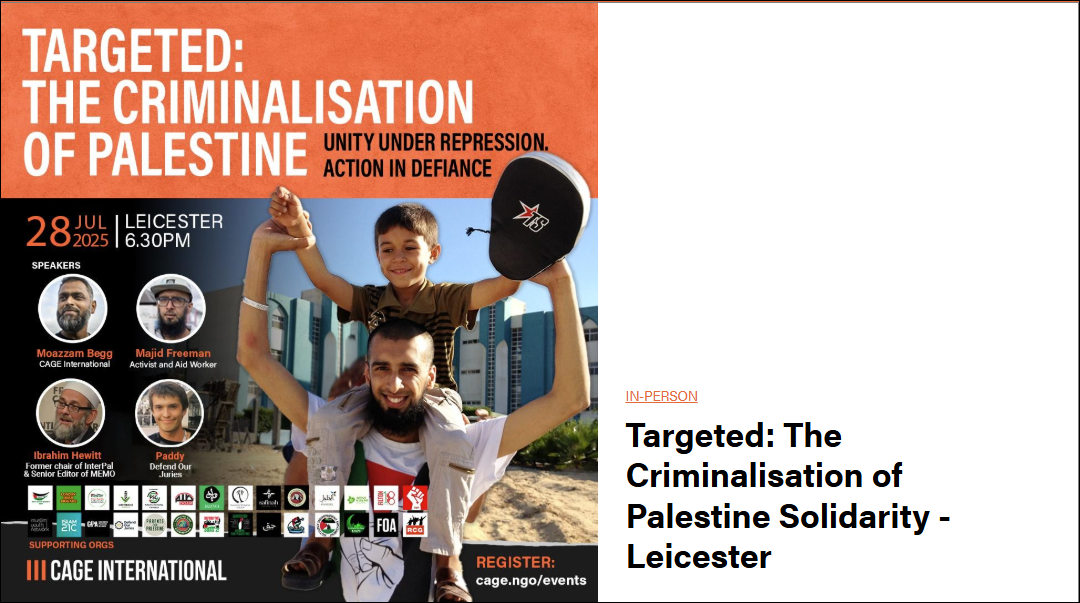
According to the prosecution, Majid Novsarka, also known as Majid Freeman, expressed support for Hamas on multiple occasions between December 2022 and June 2023. Prosecutor Birgitte Hagem informed the court that Freeman had a history of glorifying or encouraging terrorist violence, including social media references praising the perpetrators of the 2015 Charlie Hebdo attack in France.
These charges further complicate CAGE’s attempt to portray Freeman as merely a political dissenter or humanitarian activist.
The Leicester unrest began on August 28, 2022, following a scuffle after India’s victory over Pakistan in a T20 cricket match. During the incident, the Indian national flag was desecrated. Contrary to later narratives, Hindu locals reportedly helped calm the situation and assisted the individual involved.
What followed, however, was a coordinated wave of disinformation. On August 30, Freeman falsely claimed that Hindus were chanting “death to Muslims,” an allegation later categorically denied by Leicestershire Police. The same day, he spread another incendiary claim, that the Quran had been desecrated by Hindus in Leicester. This allegation was also proven false.
Despite being debunked, these claims inflamed tensions. On September 4, as Muslim mobs attacked Hindu neighbourhoods, Freeman continued to post inflammatory content online, accusing Hindu men of assaults and abductions, allegations police later confirmed were entirely fabricated.
Between September 4 and 7, Hindu homes were targeted, religious processions disrupted, and Ganesh Chaturthi celebrations attacked. Eggs were thrown at Hindu symbols, individuals were assaulted, and at least one Hindu man was doxxed after Freeman circulated false claims online.
Supporters of Freeman, including CAGE International and Islamist groups like the US-based Indian American Muslim Council (IAMC), have long circulated a claim that Freeman “saved” a Hindu man during the riots, presenting this as proof of his innocence.
Many argue this narrative is deeply cynical. “How does allegedly saving one individual absolve someone who incited the mob in the first place?” asked one Hindu activist. The argument, they note, mirrors past propaganda tactics seen during communal violence elsewhere, where selective imagery is used to mask broader patterns of organised aggression.
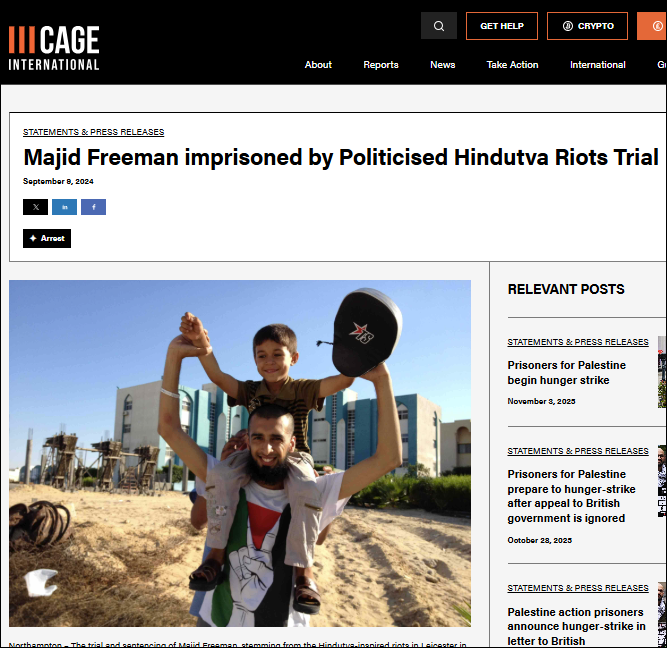
Founded in 2003 as the CagePrisoners Project and rebranded as CAGE International in 2013, the organisation claims to document abuses under counter-terrorism laws. However, its track record has drawn sustained criticism.
In September 2022, CAGE publicly advocated for the release of Muhammad Rahim al-Afghani, a close associate of Osama bin Laden. It has also campaigned for Aafia Siddiqui—often dubbed “Lady Al-Qaeda”—who is serving an 86-year sentence in the US for attempting to kill American officials in Afghanistan.
CAGE is also a vocal supporter of Hamas and has repeatedly framed terrorism-related prosecutions as politically motivated persecution.
Following Freeman’s conviction, CAGE claimed he was jailed as part of a “Hindutva riots trial,” alleging that Leicester police allowed “paramilitary-style marches” by Hindu groups. These claims were contradicted by court findings, which rejected the narrative that Hindus were the primary aggressors during the unrest.
Despite this, CAGE continues to label Hindu victims as “agitators,” reinforcing a narrative that absolves Islamist actors of responsibility while reframing violence as resistance.
With the retrial scheduled for January 9, concerns are mounting that CAGE’s call to mobilise outside the court is less about legal solidarity and more about projecting street power. For many in Leicester’s Hindu community, the sight of organised demonstrations in support of a convicted instigator is a painful reminder of how quickly truth can be drowned out by ideological noise.