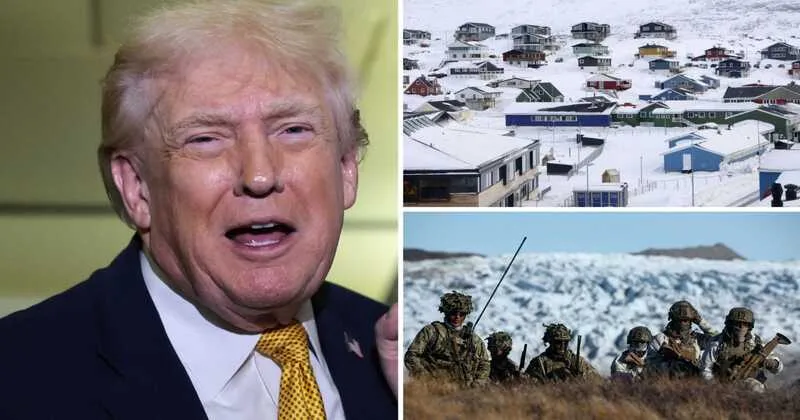
Washington: The United States has escalated global tensions with an extraordinary statement that it will use military force to seize Greenland, a self-governing territory of Denmark and a long-standing ally under the NATO umbrella. This alarming announcement came on the heels of US forces violently capturing Nicolas Maduro, the president of Venezuela, in what most countries around the world denounced as an illegal invasion of a sovereign nation. The Trump administration’s brazen threat to militarily take over Greenland has deeply strained relations with Denmark and provoked fierce pushback from governments across Europe.
Within days of the dramatic operation in Caracas that saw Maduro forcibly removed by US troops, White House officials signalled that the president’s next target is Greenland. This vast Arctic island, home to roughly 60,000 people and rich in strategic military value and natural resources, has repeatedly rejected any notion of becoming part of the United States. Yet the Trump administration publicly declared that using the US military to seize control of Greenland is “always an option,” a statement that amounts to a threat of illegal occupation and a direct challenge to international law and the UN Charter, which prohibits forceful acquisition of territory.
This aggressive posture has ignited fears of a rupture within NATO. If the United States were to attempt forceful annexation of a territory belonging to one of its supposed allies, the foundational principles of collective defence and mutual respect underpinning the alliance would be shattered. European leaders have warned bluntly that any attempt to violate Denmark’s territorial integrity could spell the end of NATO’s cohesion. Denmark’s prime minister has stated that the United States “has no right” to seize Greenland and that any such action would undermine the very basis of Western security cooperation.
The Trump administration, meanwhile, has defended its stance by claiming that Greenland must come under American control to counter perceived threats from China and Russia in the Arctic. Officials argue that the island’s vast mineral reserves, including rare earth elements critical for modern electronics, make it indispensable for US strategic interests. While these claims are framed in the language of national security, critics say they mask a brazen drive for geopolitical domination and resource grab, echoing past eras of imperial expansionism.
Denmark and other European allies have responded with unprecedented unity. Leaders from Britain, France, Germany and several other NATO countries have issued joint statements affirming that “Greenland belongs to its people” and rejecting any foreign attempts to dictate its future. They have underscored that territorial sovereignty cannot be rewritten through threats or force, and that peaceful diplomacy and respect for international law must guide relations among nations.
Adding to the controversy, a White House official’s spouse recently posted a provocative social media image depicting Greenland overlaid with the US flag and captioned “Coming soon,” prompting outrage among Danish and Greenlandic officials. Trump adviser Stephen Miller attempted to dismiss concerns by saying “nobody would go to war with the United States over Greenland,” a remark that only heightened fears of American unilateralism and disdain for allied concerns.
Critics contend that the United States is riding a dangerous wave of coercive foreign policy, emboldened by its illegal action in Venezuela, and now appears ready to undermine decades of diplomatic norms. By openly threatening military action against a NATO ally, the Trump administration has signalled a willingness to subordinate international law and alliance unity to its own expansionist ambitions. If unchecked, these moves could not only destabilise Arctic geopolitics but also weaken the rules-based global order that was established to prevent exactly this kind of territorial aggression.