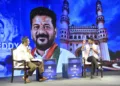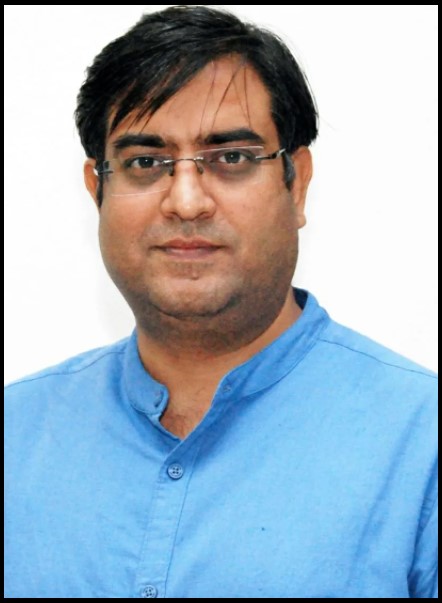

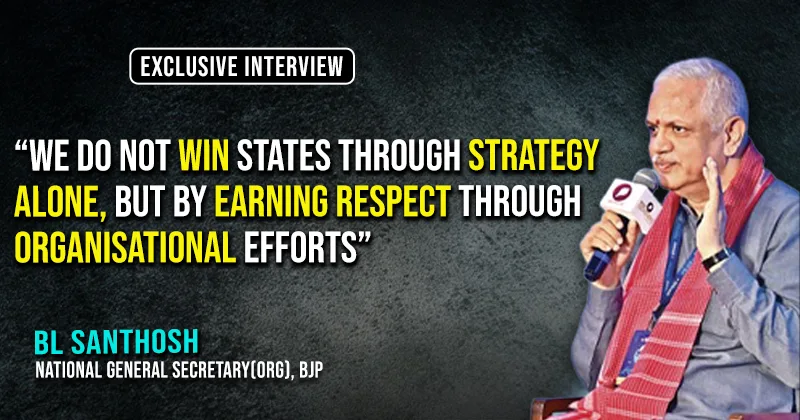
BJP National General Secretary (Organisation) BL Santhosh, in the fourth edition of Sagar Manthan: Good Governance Dialogue, a programme held on the eve of the birth centenary year of former Prime Minister Atal Bihari Vajpayee, spoke at length on various party-related issues, the relationship with the Sangh, and future goals, with Panchjanya Editor Hitesh Shankar, in Sagar Manthan, Goa on December 24, 2025. Excerpts:
The BJP has often surprised opponents by setting ambitious goals. But regarding the party president’s election, is the party now surprising itself?
There is nothing surprising in this. The outside world sees every decision as sudden. For example, when a daughter’s marriage is fixed, the world comes to know only then—it does not mean the search for a groom had not been going on earlier. Similarly, the process continues constantly, but society learns only of the final decision. Our process had been going on for 8–9 months. When the decision was made, it was announced the same day. It may appear surprising, but it is not a conspiracy.
The BJP places great importance on internal discipline. In such a situation, what scope remains for internal democracy and dissent in decisions that flow from top to bottom?
In our party, there is complete freedom for internal dissent. For example, when National President Nadda ji had to take a decision concerning a small town in a small state, I first sought the opinions of 17 people and typed their names and views and sent them to Nadda ji. In the afternoon, he called and said, “You have taken the opinions of 17 people—what is your opinion?” What greater democracy can there be than this? Even for small decisions, such wide-ranging consultation is undertaken. Outsiders feel that decisions “come from the top,” but the process is democratic. Even the President or the Prime Minister, though fully competent, still seek opinions. Democracy in our party is firm.
What is the nature of the relationship between the Sangh and the BJP?
Inspiration has no limit. It is infinite. Inspiration in patriotism, a way of life that puts the nation first, discipline, values, and ethos—all of this inspiration is limitless. Putting it within boundaries would not feel right; it is infinite. But in running the organisation, we have 100 per cent freedom. We hold discussions with well-wishers across the world. Here, they are not just well-wishers; this is our maayka (parental home). Naturally, we speak here as well. How far does the parental home extend? One can say it goes right inside, or one can say it extends outwards—however you understand it. This is our largest source of well-wishers, where we speak freely. We also speak with sants, scholars, and journalists.
Atal ji used to say that we would not seek power merely for the sake of power through maneuvering and compromises. He said, “I would not touch such power even with tongs.” How do you view the ethical dilemma between organisation and power? Is power the final objective, or a means for ideological expansion? If a compromise with core ideas becomes necessary, will the BJP prioritise power, or will ideology remain supreme?
We will do both, because on this path, power is essential to implement ideology. Without power, there are only speeches. It would have been impossible to even touch issues like Articles 370 and 35A. Because our leadership is in power, we were able to remove them; otherwise, we would have continued only with protests.
However, for us, power is not for enjoyment. Not every step is necessary just to win elections. We lost “liberal” support due to decisions such as “decolonisation,” yet we are still doing them because we are ideologically committed. The nation needs this. For us, power is the path to advance our ideas. Wherever we formed government, we implemented our thoughts there. Power is a goal, but for the national interest.
Has there ever been a situation when the party’s political needs and the Sangh’s ideological
advice were different?
Look, if you observe rivers—what in Kannada is called “Pashchima Vahini”—the Kaveri River, due to natural reasons, sometimes splits into two branches for a short while, but later they merge again. The journey of power, organisation, or society is not a straight-line journey; it is navigation. Many times, when obstacles arise, one has to move aside. While navigating, it sometimes appears that these paths are different. When seen from behind, they look separate and seem like a compromise. The direction, however, is firm; there is no “dilution.” But the very character of society is such that one cannot always move in a straight line; one has to navigate. It depends on where you are standing—if you stand behind, it does not look like a compromise; if you stand ahead, it appears so. The BJP is assessed in this manner. For us, this is not deviation or conflict—it is simply navigation. We are navigating the turns. When one moves against this, there is also confrontation.
“In Bengal, there is no political battle; it is a civilisational war. We have to take it forward in that very direction and in that very manner. All of us look at it from the same perspective—the perspective of saving Bharat”
The BJP’s electoral success is often attributed to booth management, but at the grassroots level, which organisational experiment failed from which the party quietly learned a lesson?
There has been no major failure as such. We keep making small improvements. Over time, some techniques become obsolete; this happens everywhere in the world. After the Bihar elections, the analysis brought out 6–7 points that have now become irrelevant. This is not a mistake or a failure. For example, with the rise of WhatsApp and digital media, the political importance of SMS has ended. Over the past 13 years, we have discontinued older methods like SMS. I do not recall any issue that can be described as having “failed.”
The opposition alleges that everything in the BJP is centralised. There must be occasions when internal dissent and criticism arise within the organisation. How do you handle this?
First of all, the BJP is not centralised. That is why, even when a problem arises, we do not face any difficulty in resolving it. Rules are framed by the Parliamentary Board, but they remain flexible. Later, states, local units, and panchayats implement them according to their own circumstances. However, others feel that orders come from the top. As I have said, the party’s internal democracy is strong. When monotony or vested interests enter an organisation, it has to be shaken up—this is how organisations function. This cannot be called centralisation. We have 16,000 mandal presidents in the country (including Goa). We made a rule that there will be no mandal president below the age of 45. This achieved 99.6 per cent success. Their election takes place at the local level; it is not decided in Delhi. Even the mandal president does not know in advance, nor does the Chief Minister before the election. The rule of an age limit below 45 is meant to make the organisation younger and to bring in newness. If this is what is called centralisation, then it is welcome. Otherwise, there is no centralised process. Suggestions come from the local level, and we implement them. If one has to keep a system running, change is necessary. Society functions in the same way; it also needs to be shaken from time to time.
As the National General Secretary(Org), how do you view personality-centric politics versus organisation-centric politics?
Over the last 75 years, the Congress and regional parties have made personality-centric politics a practice. It has become a part of everyday political life. Those who rise within that system also come from the same “school of thought.” Since the school is the same and the syllabus is the same, such people also enter our organisation, but after coming in, they have to give up 90 per cent of those traits. Yes, leaders remain, but everything is not leader-centric. Our process is multi-dimensional. If the party has enrolled 14 crore members, it is not because of any single individual. This achievement has been possible because of 57 lakh workers who enrolled 2 to 10 people each. This is the method that decentralises the organisation, even though the credit goes to the president. Venkaiah Naidu ji used to say, “President presides, party decides.” A person who says this must be discerning, sensible, and possess common sense. We have a more structured process than the professional world. That is why we remain active and continue to grow.
Discipline in the BJP is strict. In such a situation, do workers raise questions, or do they refrain from doing so out of fear, or remain silent out of motivation? How does the party address this?
It is the responsibility of workers holding higher responsibilities to ensure that those at lower levels remain open. In an organisation of this size, we have been largely successful in this regard. However, it is not possible to listen to every point raised by every individual. From a human perspective, this is impossible for the national president. But there is a system in place to ensure that someone or the other listens. There are also mechanisms for redress and satisfaction. I am not saying that our organisation is an ideal one. Over the last 10–15 years, the size of the organisation has grown so much that it has become difficult to fully satisfy everyone. But we make sincere efforts, and for this we have created several forums. Some issues may remain, but they are heard somewhere or the other. I cannot say it happens 100 per cent of the time, but it happens to a large extent.
Often, the opposition attacks the BJP by invoking the Constitution or constitutional institutions, accusing the BJP of destroying the Election Commission or other constitutional bodies. How do you view this?
In our Kannada society, there are two words—iti (lower limit) and miti (upper limit). Parents or teachers used to teach us in childhood: do not fall below iti, and do not rise above miti—so that arrogance does not set in and there is no moral decline. I say this with sadness: the opposition has reached iti. Criticising a capable person like Om Birla is acceptable, but going after his daughter and son-in-law! Dragging in the son and daughter-in-law of the Chief Election Commissioner Gyanesh Kumar! Such shameless people are sitting in the opposition today. These are capable administrators, and by unnecessarily digging into their personal details, they are damaging constitutional institutions. By doing this, they are benefiting neither the country nor society. This is an attempt by the opposition to create instability. We are prepared to face any kind of political opposition fairly. But this act of destabilising the country is something that everyone should condemn in time. We watch this with sadness, but we are confident that the country will move forward.
What is the internal process in the BJP for learning from mistakes? When a mistake occurs, is it discussed openly and is responsibility fixed?
This is a matter like a family matter. We do not speak about it before the media or on the street; a family matter is resolved within the family. For example, today itself (December 24), I resolved three issues from different states—one social and two personal. Our internal system corrects mistakes freely, without discussing them outside. Society, too, shows goodwill towards us. Scholars, sants, and journalists give feedback. If they raise objections, either we correct them or we explain why something had to be done. This is our informal system.
Even when a mother at home points something out, we accept it wholeheartedly.
From the perspective of whether workers are thoughtful, leadership-oriented, or merely disciplined followers of instructions, what will the BJP be like 20 years from now?
Discipline and adherence to instructions are an integral part of any organisation. In the working style, it does not work to say, “I am liberal, free, outspoken.” Discipline and obedience to instructions—these are our strengths. We have them today and they will remain in the future. Our path is not straight; it has to be navigated. This requires individual understanding and wisdom. Organisational work is not like a march-past on a flat ground. Discipline and adherence to instructions are paramount. But deciding how much information to give, or whether to give it at all, requires the use of discretion. I believe both are strong within the organisation.
That is why the organisation remains continuously active and will continue to do so.
Not only will we maintain our current level, we will work twice as hard, because there are still four major states—Kerala, Tamil Nadu, West Bengal, and Punjab—that remain to be brought into our fold in terms of thought and governance. We do not win states through strategy alone; strategy comes at the end. We are engaged in earning the affection and respect of society, which takes a long time. Twenty years from now, our organisation will grow further and expand. At present, we have 1,800 MLAs. We keep asking why we lost the other 1,500 seats, and we continuously analyse this. Before the Lok Sabha elections, we sent workers to one lakh booths that we had lost to understand the reasons. We take pride in the fact that our motivation to work in the organisation comes from our family. We cannot apply the Bihar model in West Bengal, Kerala, Tamil Nadu, or Puducherry. These are only experiences from which we will move forward.
In 20 years, we will carry the Prime Minister’s resolve to free the country from a colonial mindset another 1,000–2,000 kilometers ahead. Today, the challenge before us is to take this vision, in its true ideological form, to the last panchayat and municipal body. Each time, we must bring the same strength that is giving us public support. Now we have to determine how to translate this into our working style and complete it. We are making efforts towards this. Let me make one more thing clear. In Bengal, there is no political battle; it is a civilisational war. We have to take it forward in that very direction and in that very manner. All of us look at it from the same perspective—the perspective of saving Bharat. Winning Bengal will not merely mean becoming the 19th or 20th BJP-ruled state; it will be a step towards saving Bharat from a major demographic challenge. That is why we want to win Bengal, and we will win it.