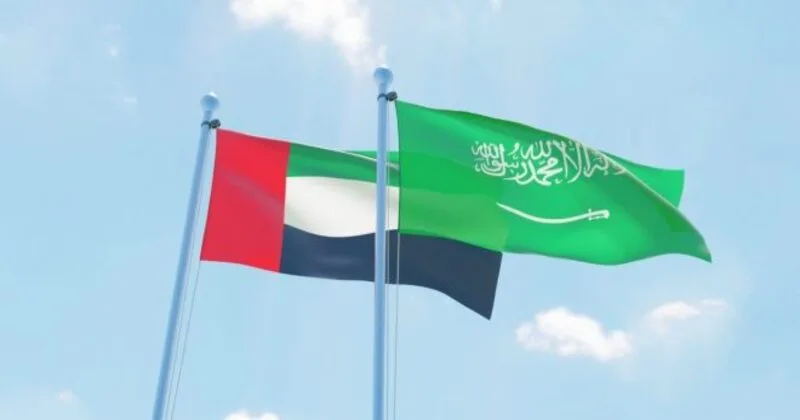
When change occurs quietly in geopolitics, it is often overlooked—largely because it requires a more careful application of mind than any headline-driven analysis permits. That is precisely the case with the evolving relationship between Saudi Arabia and the United Arab Emirates. Two states bound by deep mutual interests, long-standing security cooperation and shared external partnerships are today experiencing a visible cooling of their earlier bonhomie.
To describe this as a rupture would be inaccurate. To dismiss it as inconsequential would be equally flawed. What is unfolding is hard-nosed competition for influence between two rapidly rising powers whose strategic footprints increasingly overlap. This is neither aberration nor crisis; it is a familiar phase in the evolution of successful states.
From hierarchy to parallel ambition
For decades, the Gulf operated on a broadly accepted hierarchy. Saudi Arabia’s geographic scale, demographic weight, religious centrality and energy dominance placed it at the apex of the regional politics. The UAE, though dynamic and outward-looking, functioned as a complementary partner—commercially agile, diplomatically nimble and strategically aligned.
That equilibrium has shifted—not because Saudi Arabia has weakened, but because the UAE has accelerated faster than most anticipated. Through sustained institutional development, administrative clarity and early diversification, Dubai and Abu Dhabi emerged as global hubs for finance, logistics, aviation, technology and soft power. Decision-making remained agile, regulatory systems predictable and economic openness consistent over decades rather than introduced abruptly.
The result was influence extending far beyond the UAE’s physical size. In international politics, success inevitably alters perception. When two states begin shaping the same strategic ecosystem, friction follows—even when objective space exists for both.
Yemen: Cooperation, then strategic divergence
The Yemen conflict initially symbolised the Gulf unity. Over time, however, it revealed differences in strategic emphasis. Saudi Arabia approached Yemen primarily through a security and border-stability lens, viewing outcomes through the prism of territorial integrity and internal security. The UAE, while committed to coalition objectives, focused more sharply on maritime security, port infrastructure, counter-extremism and influence through local partners—areas aligned with its strengths.
When Abu Dhabi adjusted its military posture and reduced its direct footprint, it did so transparently and without confrontation, but decisively. This moment mattered. It demonstrated that the UAE was no longer operating solely within a subordinate framework; it was acting as a self-confident strategic actor capable of parallel decision-making. This was evolutionary, not arbitrary.
Africa, the Red Sea and strategic reach
The divergence becomes sharper when viewed through the UAE’s expanding outreach across Africa—stretching through the Horn, the Red Sea littoral and into North and Central Africa. Engagement in Somaliland, Libya, Chad and beyond is not episodic activism. It reflects a coherent geostrategic design aimed at safeguarding future interests: securing sea lanes, shaping logistics corridors, ensuring port access and building long-term goodwill.
Here, institutional differences matter. The UAE has pursued this agenda largely unencumbered by ideological constraints. The absence of a persistent clergy–royal family tension has allowed policy to remain pragmatic, transactional and interest-driven. Saudi Arabia, despite bold reforms and experimentation, operates under a different historical compact. Clerical influence has receded but not vanished entirely, imposing a degree of calibration in external alignment. This distinction does not signal weakness; it explains divergence in method and tempo.
Economic nationalism and overlapping futures
The most consequential arena of competition today is economic rather than military. Saudi Arabia’s Vision 2030 is ambitious by any measure. It seeks to transform society, diversify the economy, attract global capital and build new centres of gravity such as Neom and the Red Sea projects. These are civilisational undertakings, not incremental reforms.
The challenge lies in the fact that the UAE already represents a working model of many of these aspirations. Consequently, friction has surfaced in areas such as corporate headquarters relocation, regulatory competition, logistics and aviation hubs and energy coordination.
None of this implies zero-sum thinking. The Gulf economy is large enough to accommodate multiple centres of excellence. Yet overlap generates comparison and comparison generates pressure. This is not about one state being “too big for its boots”; it is about two states now wearing similar boots and walking similar terrain.
The US and differentiated alliances
An important new variable is the growing necessity for the United States to manage its two Gulf partners differently. For decades, Washington could approach Riyadh and Abu Dhabi through a broadly uniform strategic lens. That convenience no longer exists.
The UAE is increasingly viewed as an agile, low-friction partner—technocratic, predictable and economically integrated. Saudi Arabia, by contrast, is treated as a transformational heavyweight whose ambitions require careful calibration. Differentiated handling is inevitable, but it also introduces sensitivities neither side can entirely ignore.
I2U2 and the strategic choice
The UAE’s geopolitical maturity was formally acknowledged through its participation in the I2U2 framework with India, Israel and the United States. This reflected confidence in Abu Dhabi’s economic credibility, technological orientation and diplomatic reliability.
Saudi Arabia’s absence from I2U2 is best understood as a matter of choice rather than exclusion. Riyadh has historically preferred strategic autonomy and remains cautious about institutionalized formats that could be interpreted as formal normalisation with Israel. Sequencing matters in Saudi strategy and leverage is preserved by patience. Difference, once again, should not be mistaken for disagreement.
Hybrid frictions and external temptations
While direct conflict remains highly improbable, it would be unrealistic to assume friction will dissipate. Tensions are likely to simmer. Competitive signalling, episodic diplomatic irritation and influence contests in third regions may occur. A low-intensity hybrid stand-off, played out through narratives, economic instruments or proxy influence, cannot be ruled out.
This is where restraint is essential. External actors—countries such as Pakistan, long experienced in Gulf politics—may attempt to position themselves as facilitators. Neither Riyadh nor Abu Dhabi should permit such space to open. Managed competition requires direct engagement, not outsourced mediation.
The ultimate red line
One assumption must never be discounted: the danger of miscalculation. A single missile fired—deliberately or through misattribution—would transform the strategic landscape. False-flag scenarios, while unlikely, are conceivable in a crowded regional environment. This is the contingency both sides must guard against most vigilantly.
The strongest restraint against escalation is not sentiment, history or external pressure; it is self-interest rooted in domestic transformation. Both states are pursuing ambitious national projects that demand stability, investor confidence and regional calm. Hostility would be self-defeating.
Rivalry without rupture
The Gulf is entering a new phase—less hierarchical, more multipolar and more competitive. Saudi Arabia and the UAE are central to shaping that order. Their relationship today reflects ambition management rather than strategic breakdown.
For India and other partners, the imperative is clear: engage both with equal respect, strategic clarity and long-term perspective—without imposing binaries where none exist.
In international politics, the most dangerous misjudgment is mistaking competition among partners for conflict among adversaries. The Saudi-UAE dynamic demands—and deserves—a far more calibrated reading than that.